
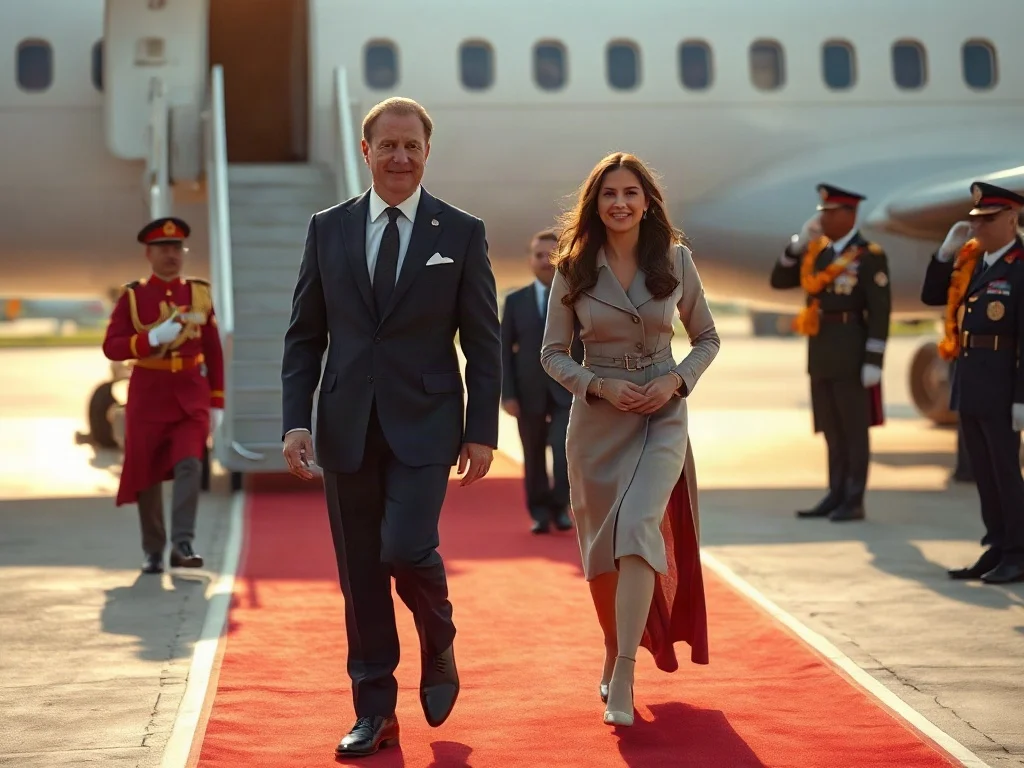
The arrival of the Prince and Princess of Wales in India ahead of a meeting with Prime Minister Narendra Modi marks a visit built less around ceremony than around a single cause. According to the initial report, most of the engagements the royal couple will attend are tied to the Earthshot Prize, the environmental award that Prince William founded. This article breaks the trip down as a process: what is confirmed, how a visit like this is normally constructed, why the Earthshot agenda anchors it, and what to watch as the programme unfolds.
One caution applies throughout. The report available at the time of writing confirms the arrival, the planned meeting with Modi and the Earthshot focus. It does not provide a full itinerary, so anything beyond those points is analysis of how such visits typically work, not a claim about specific events.
What is confirmed about the royal visit to India
Three facts define the story so far:
- The Prince of Wales and Catherine, Princess of Wales have arrived in India.
- A meeting with Narendra Modi is scheduled.
- Most of the engagements relate to the Earthshot Prize.
That third point matters most. Royal tours are usually described as diplomatic exercises. When the main thread is a prize William created, the visit becomes a hybrid: part state-adjacent diplomacy, part campaign platform. The difference shapes how the trip should be judged.
Why the Earthshot Prize anchors the trip
What the Earthshot Prize is
The Earthshot Prize was launched in 2020 as a decade-long effort to find and scale solutions to environmental problems. Its name echoes the moonshot ambition associated with President John F. Kennedy’s space programme. The prize is organised around five categories: protecting and restoring nature, cleaning the air, reviving the oceans, building a waste-free world and fixing the climate. Five winners are named each year, and the project is designed to run until 2030. The official Earthshot Prize website lists the categories, finalists and past winners.
How the prize process works
The prize functions as a pipeline rather than a single event:
- Nomination: Nominators, who are invited by the organisation, put forward projects, companies or individuals working on one of the five goals.
- Assessment: Expert panels evaluate candidates against criteria such as impact potential, feasibility and ability to scale.
- Finalist selection: Finalists are named in each category and gain visibility with investors and partners.
- Awards: Winners are announced at a ceremony, each receiving a financial award and access to support networks.
- Scaling: The organisation aims to connect winners with funders, governments and corporate partners.
The fifth step explains why a trip to India makes strategic sense. A prize that measures success by deployment, not trophies, needs relationships with the governments and markets where solutions can be applied.
The India connection
India is both a major source of environmental pressure and a hub of climate innovation. It is one of the world’s most populous countries, and it faces severe seasonal air pollution, partly linked to stubble burning in agricultural regions. Indian ventures have already featured in the prize’s history: Takachar, a start-up co-founded by Vidyut Mohan that converts crop residue into useful products, won in the Fix Our Climate category in the inaugural 2021 awards. That precedent gives the prize a credible local story to tell.
India also has a clear national climate position. At the COP26 summit in Glasgow, Modi announced a target of net-zero emissions by 2070 and a major expansion of renewable energy. A prize that spotlights scalable solutions overlaps with those goals, which gives both sides a shared vocabulary.
How a royal tour like this is typically built
Understanding the mechanics helps readers separate substance from spectacle. The following sequence describes the general model for overseas royal engagements. It is not a reconstruction of this specific trip.
Step 1: Government alignment
Overseas royal visits are generally undertaken with the agreement of the UK government, which weighs diplomatic priorities and local sensitivities. That is why a royal trip often coincides with broader India–UK relations goals such as trade, technology and climate cooperation.
Step 2: Choosing a theme
Planners select a narrative so the programme feels coherent. Here, the theme is evidently environmental innovation. A clear theme makes it easier to schedule visits, partners and photo opportunities that reinforce one message.
Step 3: Advance work and security
Advance teams survey venues, plan movements and coordinate protection with local authorities. In a country as large and varied as India, logistics often determine which cities and sites are feasible.
Step 4: Sequencing the programme
A typical programme moves from arrival, to an official meeting, to thematic engagements, to community or cultural moments. The Modi meeting is the political anchor, while the Earthshot-related events supply the substance and imagery.
Step 5: Media and messaging
Every engagement is also a communications moment. The couple’s images, speeches and social media posts are designed to reinforce the theme and reach audiences beyond the venues.
Step 6: Follow-through
The most important phase comes after departure: partnerships announced, funding commitments made, or pilot projects launched. Without this phase, a visit is symbolism only.
The Modi meeting: what each side may want
The following is interpretation, not reported fact. For the UK side, a high-profile royal visit is an exercise in soft power: it signals warmth and long-term commitment to a relationship that increasingly centres on trade and technology. For India, hosting the royal couple offers a platform to showcase its clean-energy ambitions and its start-up ecosystem to a global audience. Both governments have reasons to frame the meeting around shared climate goals, which are less politically contentious than many other bilateral topics.
A meeting with the prime minister also lends the Earthshot agenda political legitimacy. Environmental innovation depends on policy: procurement, subsidies, regulation and grid access. A conversation at that level may open doors that a prize ceremony alone cannot.
Opportunities and criticisms
Potential benefits
- Visibility for local solutions: Indian innovators gain international attention and potential investors.
- Policy dialogue: A public meeting can encourage ministries and agencies to engage with Earthshot-style projects.
- Public awareness: A royal presence draws media attention to topics such as air quality and waste.
Common criticisms
- Travel footprint: Critics often question the emissions of high-profile travel by environmental campaigners. Supporters argue that the visibility justifies it, but the debate is legitimate.
- Symbolism over impact: Observers sometimes accuse such events of greenwashing when they are not followed by measurable outcomes.
- Historical sensitivities: Any British royal visit to a former colony takes place against the background of imperial history. How the couple handles this tends to draw scrutiny.
The 2016 precedent
William and Catherine previously toured India in 2016, visiting cities including Mumbai and New Delhi, as well as Kaziranga National Park and Agra. That visit blended heritage, charity work and wildlife conservation. The shift from broad cultural diplomacy then to a tightly focused environmental agenda now reflects how William’s public work has evolved, with climate and nature at its centre.
How to evaluate the coverage
Readers following the visit can apply a simple checklist to separate meaningful developments from ceremonial moments:
- Look for specifics: Named projects, partners and funding amounts are more significant than general statements about cooperation.
- Check who is in the room: Engagements involving ministers, investors or city authorities have more potential for impact than purely symbolic appearances.
- Note the Indian voices: The strongest outcomes will elevate Indian entrepreneurs and scientists, not just foreign visitors.
- Compare claims with sources: Official channels such as the Royal Family website and the Earthshot Prize site provide primary information.
- Track follow-up: Announcements made during the visit should be revisited in six to twelve months.
Frequently asked questions
Why are the Prince and Princess of Wales visiting India?
The initial report says most engagements are connected to the Earthshot Prize, which Prince William founded, and that a meeting with Narendra Modi is planned. Wider diplomatic motives are likely but have not been itemised in the report.
What is the Earthshot Prize?
It is an environmental prize launched in 2020 that rewards solutions in five categories: nature, air, oceans, waste and climate. It is designed to run until 2030.
Has an Indian project won the Earthshot Prize before?
Yes. Takachar, a start-up that turns agricultural waste into valuable products, won the Fix Our Climate category in 2021.
Is this the first time William and Catherine have visited India?
No. They toured the country in 2016, including stops in Mumbai, New Delhi, Kaziranga and Agra.
Does a royal visit change government policy?
Not directly. Royals do not set policy, but visits can raise visibility and encourage dialogue between governments, businesses and innovators.
The real test begins after the motorcade leaves
The most important insight is that this visit’s value will not be measured by the images of its arrival or the handshake with Modi. It will be measured by whether Earthshot-linked ideas become pilots, contracts or policy. Royal attention can accelerate a conversation, but it cannot supply the capital, regulation or infrastructure that scaling demands.
Watch for three signals in the coming weeks: concrete partnerships announced with Indian institutions, any statement from the government connecting the visit to its clean-energy plans, and whether Indian innovators, not only foreign figures, shape the narrative. If those signals appear, the trip will look like a turning point for how the Earthshot project works with the world’s most populous country. If they do not, it risks being remembered as a well-staged moment with an unanswered question: can a prize built on ambition convert goodwill into measurable environmental change before its 2030 deadline?
Frequently Asked Questions
Is this royal visit to India an official diplomatic tour?
The report describes it as built mainly around the Earthshot Prize rather than ceremony. Most engagements relate to the prize William founded, while a meeting with Narendra Modi is planned. That makes it a hybrid of state-adjacent diplomacy and a campaign platform, not a conventional diplomatic tour.
Why does India make strategic sense for the Earthshot Prize?
The prize measures success by how widely solutions are deployed, so it needs relationships with governments and markets that can apply them. India faces serious pollution problems, including seasonal air pollution linked to stubble burning, and is also a hub of climate innovation, making it a natural partner.
Has an Indian project ever won the Earthshot Prize?
Yes. Takachar, a start-up co-founded by Vidyut Mohan, won the Fix Our Climate category in the inaugural 2021 awards. It converts crop residue into useful products, which addresses the burning of agricultural waste. This gives the prize a credible local success story to point to during the visit.
What are the five Earthshot Prize categories and how long will it run?
The prize covers protecting and restoring nature, cleaning the air, reviving the oceans, building a waste-free world and fixing the climate. Five winners are named each year, and the initiative was launched in 2020 as a decade-long effort designed to run until 2030.
Does the article confirm the full itinerary of the trip?
No. The report confirms only the arrival of the Prince and Princess of Wales, the planned meeting with Modi and the Earthshot focus. Anything beyond that is analysis of how royal visits typically work, so readers should not treat it as confirmed events or locations.
How does the Earthshot agenda connect with India's own climate goals?
At COP26 in Glasgow, Modi announced a net-zero emissions target for 2070 and a major expansion of renewable energy. A prize that spotlights scalable environmental solutions overlaps with those aims, giving both sides a shared vocabulary for discussions during the visit.