
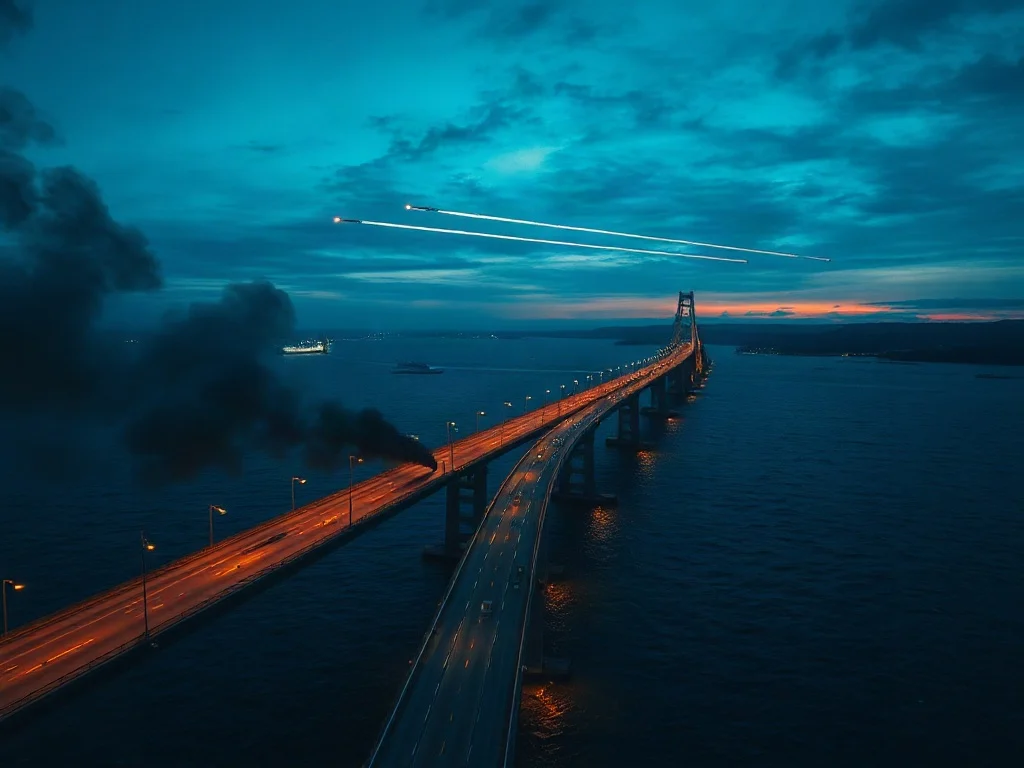
The Crimean Bridge drone attack reported alongside what Russia calls the biggest Ukrainian drone attack of the war is more than a dramatic headline. Russia said Ukraine launched more than 2,000 drones over the course of a single day, while Kyiv came under a record 17 air raid alerts. This article takes a process-analysis approach. It walks through how a mass drone strike is launched, detected, intercepted, counted and assessed, so you can read future claims more critically. Specific figures here come from Russian statements as reported in the news coverage and have not been independently verified.
What was reported, and what remains unclear
The reported facts are simple. The landmark bridge linking Russia to the Crimean peninsula was hit. Russia’s defense ministry described the largest Ukrainian drone barrage of the war, with over 2,000 drones in roughly 24 hours. Kyiv recorded 17 air raid alerts in a day, a record for the city.
Several important details are not established by the headline alone: the extent of the damage to the bridge, whether it remains open to road and rail traffic, how many drones actually reached their targets, and what share of the total were decoys or reconnaissance platforms. Treat each of these as a separate question that needs its own evidence.
Background: why the bridge matters
The Crimean Bridge, also called the Kerch Bridge, spans the Kerch Strait and opened in 2018, four years after Russia annexed Crimea. It is roughly 19 kilometres long and carries both a road and a railway. It has two roles. It is a logistics artery for the peninsula, and it is a political symbol of Russia’s claim to the territory.
It has been hit before. A truck bomb in October 2022 damaged sections of the roadway and caused a rail fuel-train fire, and a July 2023 attack killed two civilians and damaged the road span. Both attacks came during the wider Russian invasion of Ukraine. A new strike therefore fits an established pattern of attacks on the crossing.
How a mass drone attack works, step by step
Step 1: Launch and saturation
An unmanned aerial vehicle campaign succeeds through volume. The logic is a saturation attack: send more threats than defenders can track and engage at once. Cheap one-way systems, similar in concept to loitering munitions and to Iranian-designed models such as the Shahed 136 used by Russia, can be launched in waves from many points.
Launch timing matters as much as launch numbers. Waves staggered over many hours force defenders to stay on alert, drain interceptor stocks and exhaust crews. A single day with over 2,000 drones suggests sustained, multi-wave operations rather than one concentrated strike. That is an inference from the reported total, not a confirmed description of tactics.
Step 2: Detection and alerting
Detection relies on radar, acoustic sensors, visual observers and increasingly mobile networks of spotters. Small, low-flying drones are hard to see on conventional radar, which is why layered detection matters.
Alerts then flow to the public. Ukraine’s system uses regional sirens, official channels and phone apps, and the air raid siren remains the basic signal. The 17 alerts in Kyiv are a measure of how often threats were detected on approach, not of how many drones arrived. Repeated alerts show waves arriving over many hours, and they carry a human cost in lost sleep, disrupted work and time spent in shelters.
Step 3: Interception and electronic defense
Defense against drones is layered. Anti-aircraft systems, mobile gun teams, interceptor drones and fighter aircraft engage physical targets. Electronic warfare attempts to jam or spoof navigation and control links. Each layer has limits. Jamming is less effective against drones using inertial or pre-programmed navigation, and missiles are costly when used on inexpensive drones. This cost imbalance is one of the central debates in modern drone warfare.
Step 4: Counting and claiming
The headline number comes from this stage. A defense ministry typically reports how many drones it says it intercepted or destroyed over a given period, often grouped by region and time window. Several caveats apply:
- Definition of a drone: totals may include decoys, reconnaissance drones and strike drones without distinguishing them.
- Time window: a figure covering a full day may include multiple waves that would look modest if split up.
- Intercepted versus launched: a defense ministry’s count of drones destroyed is not the same as a count of drones launched.
- Source bias: both sides have incentives to emphasize success or enemy aggression.
The figure of more than 2,000 should therefore be read as Russia’s account of the scale, which analysts can compare with Ukrainian statements and open-source evidence over time.
Step 5: Reaching and damaging a hard target
A bridge is difficult to disable. Spans are long, structurally redundant and can often be repaired or partly bypassed. Small drones carry limited warheads, so damage usually comes from repeated hits on one component, such as a roadway section, expansion joint, support or rail line. Sea drones and underwater charges target supports at the waterline, while aerial drones attack the deck.
Assessment is slow. Authorities often declare a bridge safe or closed before independent confirmation. Satellite imagery, geolocated video and traffic data reveal more over days. That is why the claim that the bridge was hit and the question of how badly are two different matters.
Why the Crimean Bridge strike matters militarily
Logistics and the land corridor
Russia has a land corridor to Crimea across occupied southern Ukraine, but the bridge remains important for civilian and military supply, especially for heavy loads on rail. Pressure on the crossing forces Russia to divert resources to defending it and to rely on alternative routes that may themselves be vulnerable.
Naval and regional implications
The peninsula hosts the Black Sea Fleet headquarters at Sevastopol. Supply routes, air defense and naval positioning in the region are linked, so attacks on the bridge cannot be assessed in isolation.
Symbolic and psychological effects
The bridge is a prestige project. Even limited damage carries political weight, both for Ukraine’s messaging and for Russian domestic perceptions of security. Analysts disagree about how much symbolic strikes shift the course of a war, so be wary of strong claims either way.
How to read drone-attack reports critically
A practical checklist helps when the next large-scale report appears:
- Identify the source. Is the number from the defense ministry of one side, the Ukrainian Air Force, or an independent observer?
- Check the time window. Compare like with like: 24 hours, overnight, or a cumulative period.
- Separate launches from interceptions. Ask which is being reported.
- Look for physical evidence. Satellite imagery, geolocated video and official closure notices are stronger than assertions.
- Wait for assessments. Think-tank updates such as those from the Institute for the Study of War and wire services such as Reuters often refine early claims.
Common mistakes
- Treating one side’s total as a verified fact.
- Equating alert counts with attack size.
- Assuming a hit on a bridge means it is out of service.
- Ignoring civilian impact because military claims dominate the coverage.
Frequently asked questions
How do drone swarms overwhelm air defenses?
They force defenders to track and engage far more targets than their sensors, crews and interceptors can handle at once. Cheap drones also impose a cost disadvantage if they are shot down with expensive missiles.
Why did Kyiv have 17 air raid alerts in one day?
Each alert marks a new detected threat window. Seventeen suggests multiple waves of aerial threats over the day. The count says nothing by itself about how many drones reached the city.
Was the Crimean Bridge destroyed?
The reporting says it was hit, but the headline does not confirm the extent of the damage. Earlier attacks in 2022 and 2023 damaged the bridge without destroying it, and repairs followed. Wait for official notices and imagery-based assessments.
Is the figure of 2,000 drones verified?
No. It is Russia’s reported figure. Independent confirmation, if it comes, will likely arrive through comparison with Ukrainian statements, open-source analysis and later official data.
What this record barrage may signal about the war ahead
The most important insight is not the single number but the trend it represents: mass, low-cost drone production is reshaping how wars are fought, and both sides are racing to industrialize it. If more than 2,000 drones in a day is possible, the contest shifts from individual weapons to supply chains, interceptor economics and the speed of adaptation.
Several developments are worth watching. The first is whether the bridge’s operating status changes over the coming weeks, which would show whether the strike was symbolic or operational. The second is whether Russia’s defense claims and independent assessments converge on a consistent picture of how many drones are getting through. The third is whether cheaper interceptors, such as interceptor drones and improved electronic defenses, can reverse the cost imbalance.
A reasonable prediction, and no more than that, is that such barrages will become more frequent and more difficult to verify, which raises the premium on careful reading. The open question is whether either side can build defenses that make saturation attacks too costly to sustain, or whether the economics of the cheap drone will keep favoring the attacker.
Frequently Asked Questions
Can the figure of more than 2,000 drones be trusted as accurate?
Not fully. The figure comes from Russian defense ministry statements as reported in the news, and it has not been independently verified. Counting depends on what each side chooses to include, such as decoys or reconnaissance drones, so the number is best read as a claim, not a confirmed fact.
Do the 17 air raid alerts in Kyiv mean 17 separate drone attacks hit the city?
No. The alerts only show how often threats were detected approaching, not how many drones arrived or hit targets. Repeated alerts suggest waves over many hours. They also reflect a human cost, including lost sleep, disrupted work and time spent in shelters.
Why use so many cheap drones instead of fewer, more advanced weapons?
The goal is saturation: sending more threats than defenders can track and engage at once. Waves spread over many hours also exhaust crews and drain interceptor stocks. Cheap one-way drones also create a cost imbalance, because defenders may need to use expensive missiles against them.
Is it confirmed that the Crimean Bridge is badly damaged or closed?
No. The headline reports a hit, but the extent of the damage and whether road and rail traffic continue are not established. The article advises treating each as a separate question that needs its own evidence, rather than assuming serious or lasting damage.
Why is the Crimean Bridge such a frequent target?
It has two roles. It is a logistics artery carrying road and rail traffic to the peninsula, and it is a political symbol of Russia's claim to Crimea. It was also hit in October 2022 and July 2023, so a new strike fits an established pattern.
Why can't electronic warfare simply stop these drones?
Jamming and spoofing target navigation and control links, but they are less effective against drones using inertial or pre-programmed navigation. Because every defensive layer has limits, defenders combine electronic warfare with anti-aircraft systems, gun teams, interceptor drones and fighter aircraft.