
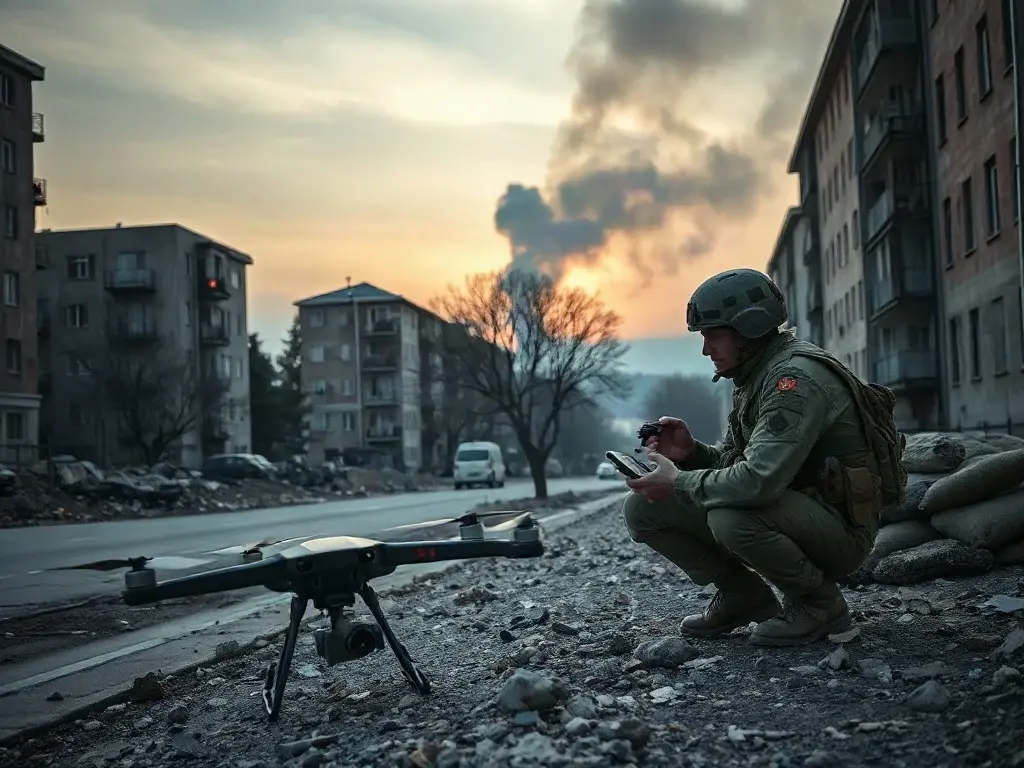
The Slovyansk front line has become one of the clearest tests of what Russia wants from Ukraine and what Ukraine can still defend. A BBC report gained rare access to a specialist drone unit defending the eastern city under heavy Russian fire. It shows a place that is badly damaged but still held, and that Moscow reportedly wants Kyiv to hand over. This analysis separates what is documented from what is interpretation. It examines why a mid-sized city carries such weight, how drone warfare has changed its defence, and what a withdrawal demand would mean in practice. It also asks whether the demand is a negotiating position or a military shortcut.
A caveat on sourcing: the BBC’s headline and summary establish the core facts. The city is devastated, a specialist drone unit is defending it, and Russia wants Ukraine to give it up. This article does not invent operational details beyond that. Where it goes further, it relies on widely documented background and labels analysis as analysis.
Why Slovyansk matters beyond its size
Sloviansk (also transliterated Slovyansk) lies in Donetsk Oblast. Before the full-scale invasion its population was roughly 100,000. Its importance comes from geography and history rather than numbers.
Symbolism and 2014
In 2014 the city was seized by armed separatists led by Igor Girkin, a Russian citizen, during the early phase of the war in the Donbas. Ukrainian forces retook it that July. The recapture is a founding episode in Ukraine’s account of resisting the Russian-backed insurgency, so surrendering the city now would carry a political charge that a simple map change would not.
The urban cluster
Slovyansk forms part of a connected urban belt with Kramatorsk and Druzhkivka, with Kostiantynivka nearby. Military analysts commonly treat these as the last major defensive agglomeration in Ukrainian-held Donetsk. Whoever controls them controls the road and rail links, the industrial infrastructure and the high ground that shape operations across the region. In military terms, Slovyansk is a hinge rather than a trophy.
What the demand to give up Slovyansk actually means
Russia’s stated aim of securing the whole of Donetsk Oblast has long been a feature of its war aims. Moscow has claimed the territory as part of its own, a claim that Ukraine and most of the international community reject. The reported demand that Ukraine withdraw from what it still holds there is a different proposition from a ceasefire along the existing line.
A ceasefire versus a withdrawal
A ceasefire freezes positions. A withdrawal demand transfers territory that Russian forces have not captured by force. This is the central analytical point. Russia has taken ground at high cost in places such as Bakhmut and Avdiivka. Pokrovsk and Siversk have since become further focal points, and the same attritional logic has been visible there. Asking for Slovyansk at the table is, in effect, asking Ukraine to concede what the battlefield has not yet delivered.
The strategic logic of the ask
From Moscow’s perspective, the logic is clear. A negotiated handover would spare Russian forces a long urban warfare campaign against prepared defenders. From Kyiv’s perspective, the same logic is the objection. A surrendered fortress belt would expose the cities behind it and remove the terrain advantage that has made Russian advances so expensive. Reasonable analysts disagree about how much negotiating weight Ukraine retains, but few dispute that the belt is the single most valuable defensive asset left in the oblast.
How drone units shape the defence of Slovyansk
The BBC’s access to a specialist drone unit points to the most important operational change of this war. Unmanned aerial vehicles now do much of the work that artillery, reconnaissance and infantry once did, in what is often described as drone warfare.
Reconnaissance and strike in one loop
Small first-person-view systems, described at first-person view (radio control), and their one-way attack cousins, comparable to loitering munitions, compress the cycle between spotting a target and hitting it. A specialist unit can watch approach routes, identify assembly points and strike vehicles or small infantry groups at low cost. For an outnumbered defender this is an equaliser, because it substitutes cheap precision for scarce shells and soldiers.
The electronic contest
Drones also drive a continuous contest in electronic warfare. Jamming, frequency changes and the adoption of fibre-optic-tethered designs, which are reported widely, are responses to each side’s countermeasures. The practical result is a rapid cycle of adaptation. A unit’s edge can erode within weeks unless it keeps adjusting its equipment and tactics. Any claim that drones have decisively tilted the balance should therefore be treated cautiously, because both sides field them in large numbers.
The limits of the drone defence
Drones do not hold ground. They thin out attackers and make movement dangerous, but they cannot replace infantry to occupy positions, and they cannot stop heavy bombardment. Russia’s use of glide bombs, which can be released from beyond the reach of many air defences, is a central reason front-line towns have been reduced to rubble. A drone unit can raise the cost of an assault. It cannot by itself prevent a city from being slowly destroyed.
A devastated city: civilians, infrastructure and endurance
The BBC describes Slovyansk as devastated, and that description fits a pattern seen across the Russian invasion of Ukraine. The sequence is familiar. Long-range strikes damage utilities, glide bombs and artillery destroy housing, and the population thins out as evacuation orders follow. The destruction of Mariupol in 2022 remains the starkest example of where the pattern can end.
This matters for the negotiating debate for a practical reason. A city that is half-emptied and under constant fire is both harder to defend and less valuable to keep. Critics of a hold-at-all-costs approach argue that a defender can overpay in lives for ground whose economic and civilian worth is draining away. Supporters respond that the cost of conceding terrain, with its exposed hinterland and signal of weakness, is greater still. Both positions are defensible, and the disagreement is genuinely about risk tolerance rather than facts.
Competing readings of Russia’s demand
Three interpretations of the demand deserve separate treatment.
- Maximalist bargaining. Moscow asks for more than it expects to receive, so that a smaller concession later looks like compromise.
- Operational shortcut. Russia genuinely wants the fortress belt without paying for it in casualties, and treats diplomacy as an extension of its campaign.
- Political consolidation. Because Russia has declared Donetsk Oblast its own, the Kremlin has domestic reasons to present full control as the minimum acceptable outcome.
These readings are not mutually exclusive, and the available evidence cannot rank them. The public record shows the demand and the stated claim. It does not reveal intent. Readers should be wary of commentators who present any one of the three as settled.
What to watch and how to read front-line reporting
Front-line reporting, including rare-access pieces like the BBC’s, is valuable but partial. Embedded or escorted access shows one unit’s experience at one time, and it cannot establish the overall trajectory. A few practices improve interpretation:
- Cross-check territorial claims. Compare Ukrainian and Russian statements against independent assessments, such as the daily maps of the Institute for the Study of War.
- Track approach axes, not just the city itself. Pressure on flanking towns often signals a coming attempt to bypass a defended centre.
- Watch logistics. Strikes on supply roads and rail matter as much as direct assault.
- Separate diplomacy from battlefield events. Public negotiating positions often shift without any corresponding change on the ground.
- Note the language. Terms like ‘encirclement’ and ‘liberation’ are used loosely by all sides.
Frequently asked questions
Where is Slovyansk and why is it important?
Slovyansk is a city in Ukraine’s Donetsk Oblast. It is a key part of the urban belt, with Kramatorsk, Druzhkivka and Kostiantynivka, that anchors Ukrainian defences in the region. Its 2014 history adds symbolic weight.
Does Russia currently control Slovyansk?
According to the BBC report, Ukrainian forces are still defending the city under heavy fire. Readers should check current independent assessments, because front-line positions change.
How do drone units defend a front-line city?
They provide reconnaissance and low-cost precision strikes against approaching vehicles and infantry. They also contest the electronic environment. They cannot hold ground or stop heavy bombardment on their own.
Why does Russia want Ukraine to give up the city?
Reported demands for Ukrainian withdrawal from the rest of Donetsk Oblast fit Russia’s long-stated territorial aims. They would also spare Russian forces a costly assault on a fortified urban belt. Motives beyond that are interpretation.
The question the drones cannot answer
The most important insight from Slovyansk is that technology has made defence cheaper while leaving the political question unchanged. A well-run drone unit can make each metre of advance expensive, and the BBC’s access shows how much effort goes into that. But a city can be hollowed out faster than it can be taken, and a diplomatic demand can aim at the first outcome while the army works toward the second.
Watch three things in the coming months. First, whether Russian pressure shifts to the flanks around the urban belt, which would suggest an attempt to avoid a direct assault. Second, whether Ukraine can keep adapting its drone and electronic-warfare tools faster than Russia adapts to them. Third, whether any negotiating framework treats the withdrawal demand as a core condition or as an opening bid. A reasonable prediction, though only a prediction, is that the fate of Slovyansk will be decided less by any single drone unit than by whether either side concludes that the cost of the fortress belt exceeds its worth. That calculation, rather than the rubble, is the open question.