
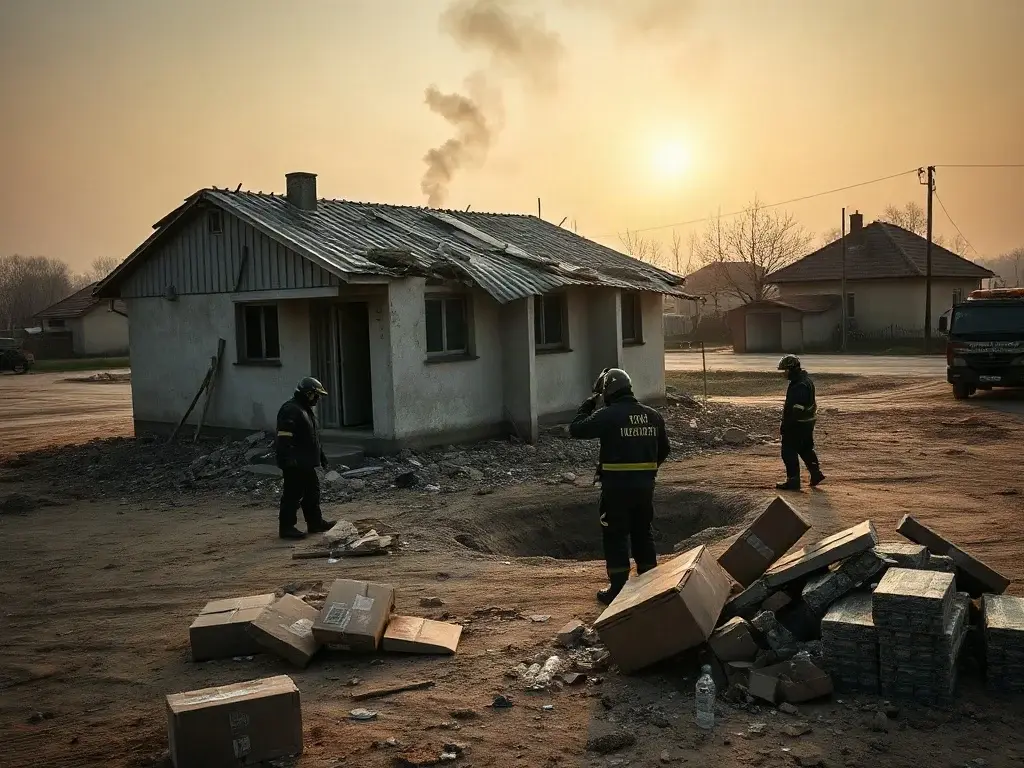
The Russian bombing of a Ukraine aid centre that Kyiv says killed 26 people is a test of how much protection civilians and relief sites still have in the Russo-Ukrainian War. Ukrainian officials say at least nine aerial bombs, each weighing 3,000kg, struck a village in southern Ukraine. President Volodymyr Zelenskyy called the attack “utterly horrific.” This analysis separates what is known from what is not, explains why the weapon matters, and sets out the legal and practical questions that follow.
The source report is brief. It confirms the casualty figure, the weapon weight, the number of bombs, the type of site and the president’s reaction. It does not, in the form provided, give independent verification, a Russian response, or details about who was inside the building. This article does not fill those gaps with speculation.
What Is Known About the Attack
Ukrainian officials say the following:
- At least 26 people were killed at an aid centre in a southern Ukrainian village.
- At least nine aerial bombs of 3,000kg hit the village.
- President Volodymyr Zelenskyy described the attack as “utterly horrific.”
All of this comes from Ukrainian authorities in Kyiv, and early casualty counts in conflict zones often change as rescuers clear rubble. An initial toll of 26 is a floor, not a final number. Anyone assessing the event should wait for confirmation from independent monitors, who usually need days or weeks to verify civilian harm.
Why the Number of Bombs Matters
One heavy aerial bomb can destroy a building. Nine of them, each in the 3,000kg class, point to a sustained strike on a small settlement. A village with a handful of streets cannot absorb that tonnage without near-total destruction of the area hit. The quantity of munitions is therefore analytically relevant to two questions: whether the strike was aimed at a specific target, and whether the force used was proportionate to any lawful military objective.
Why 3,000kg Bombs Change the Calculation
A 3,000kg bomb is among the heaviest conventional air-dropped weapons. Its blast and fragmentation effects reach far beyond a single structure, and the damage radius is measured in tens of metres or more. The effects depend on fuzing, impact angle and construction, and the report does not give these details.
Guided Versus Unguided Delivery
Whether the bombs were guided matters. A guided bomb can in theory be directed at a precise point, which raises the question of whether the aid centre was the intended target. An unguided bomb of this size dropped near populated areas is inaccurate and indiscriminate by nature. Russian forces have been widely reported to use glide bombs that can be released from outside the range of many defences. The source article does not say which type was used here, so no conclusion about intent can be drawn from the weapon alone.
The Air Defence Gap
Weapons released from aircraft at stand-off range are hard to counter. Ukraine’s anti-aircraft systems are optimised mainly against missiles, drones and aircraft, and intercepting a heavy bomb in its terminal phase is far harder than shooting down the aircraft that carries it. Consequently, protection tends to depend on early warning, shelter and dispersal, none of which work well when the target is a gathering point by design.
The Humanitarian Dimension of an Aid Centre Strike
An aid centre concentrates people. Residents arrive for food, medicine, documents or shelter, often at predictable times and in queues. That predictability is the operational weakness of humanitarian aid delivery in a war zone. The more an aid operation serves elderly or immobile residents in front-line areas, the more it relies on fixed locations, and fixed locations are the easiest to observe and strike.
The effects extend beyond the dead and wounded. When a distribution point is destroyed, the surviving population loses access to supplies, and aid organisations must decide whether to continue operating in the area. Some will suspend operations, which raises the indirect toll on those who depended on the site. How large that secondary effect is cannot be stated from the report, but it is the pattern humanitarian agencies have described in other conflicts.
Legal Analysis: Is Striking an Aid Centre a War Crime?
The legal framework is international humanitarian law, anchored in the Geneva Conventions and their protocols. Three principles apply:
- Distinction: attackers must distinguish between combatants and civilians and between military objectives and civilian objects.
- Proportionality: an attack is unlawful if the expected civilian harm is excessive compared with the anticipated concrete military advantage.
- Precaution: attackers must take feasible steps to avoid or minimise civilian harm, including choosing weapons and giving warnings where possible.
The ICRC maintains a public database of customary rules on these points at ihl-databases.icrc.org. Whether a particular strike amounts to a war crime depends on facts that only investigation can establish: what the attacker believed it was targeting, whether any military objective was present, what warnings were given, and what weapons were chosen. Using nine very large bombs on a village raises serious proportionality and precaution questions. It does not by itself settle them.
Who Could Investigate
Accountability routes exist but are slow. The International Criminal Court operates under the Rome Statute and has an open investigation into the situation in Ukraine, and its work is described on the court’s website at icc-cpi.int. The UN human rights office also documents civilian harm through its monitoring mission in Ukraine. National prosecutors in Ukraine and other states are further options. None of these produces fast results, and none can compel Russia to hand over suspects.
Reading the Political Signal
Zelenskyy’s language is deliberate. Describing the strike as “utterly horrific” frames it as a moral outrage aimed at international audiences, especially governments that decide on weapons deliveries and air defence supplies.
The president’s description is a political judgement, not a forensic finding. It tells readers how Kyiv wants the event understood, not what investigators have established.
That distinction applies in both directions. Moscow has repeatedly said throughout the Russian invasion of Ukraine that it targets military sites, a claim contradicted by documented civilian deaths in many incidents. A Russian response to this particular strike was not included in the report provided, so readers should look for one and weigh it against satellite imagery, munition remnants and witness testimony.
Civilian Casualties in Ukraine: Putting 26 Deaths in Context
A single incident with 26 deaths is among the more lethal attacks on civilians in a conflict that has produced thousands of civilian casualties. Official tallies from UN monitors are conservative because they only count deaths verified to their standard, and they acknowledge that real figures are likely higher. For a precise running total, readers should consult the latest UN human rights monitoring updates rather than rely on news summaries.
The pattern matters more than any one number. Attacks that kill many people at once, whether at markets, apartment blocks, transport hubs or aid sites, shape how civilians in front-line regions decide whether to stay or leave. Each such incident also feeds the argument over whether long-range aerial bombing can be deterred by anything short of stronger air defence or negotiated restraint.
What Practitioners and Observers Should Monitor
For Humanitarian Organisations
- Site rotation and dispersal: avoid fixed schedules and large queues where feasible, and use smaller distribution points.
- Deconfliction channels: verify that notification mechanisms are working, and treat them as necessary but not sufficient protection.
- Shelter provision: ensure every site has an accessible, structurally rated shelter, understanding that no shelter withstands a direct hit from a 3,000kg bomb.
For Analysts and Journalists
- Wait for independent confirmation of the death toll and location.
- Look for munition fragments and crater analysis to identify the weapon type.
- Check whether a military objective was nearby, and whether the claim comes from a credible source.
- Distinguish clearly between official claims, verified findings and inference.
Frequently Asked Questions
What happened in the Russian bombing of the Ukraine aid centre?
Ukrainian officials say at least nine 3,000kg aerial bombs hit a southern Ukrainian village and killed 26 people at an aid centre. The figures come from Kyiv and may be revised.
Why are 3,000kg aerial bombs so dangerous?
Their blast and fragmentation effects cover a very large area, so one bomb can level a building and damage others nearby. Nine of them in one village point to extreme destruction.
Are attacks on aid centres war crimes?
Deliberately attacking civilians or civilian objects is prohibited under international humanitarian law, as are disproportionate attacks. Whether this strike qualifies depends on evidence about intent, targeting and proportionality that a formal investigation must establish.
Who investigates strikes like this?
UN monitors, the International Criminal Court, Ukrainian prosecutors and independent open-source investigators can all examine such incidents, with varying powers and timelines.
The Question This Attack Leaves Open
The most important insight is structural. A strike that destroys a place people go for help shows that humanitarian protection in this war depends less on legal rules than on whether attackers are made to bear a cost for breaking them. The rules are clear; enforcement is not.
Three developments are worth watching. First, whether independent monitors confirm the toll and identify the weapon type, which would sharpen the legal assessment considerably. Second, whether Russia offers a specific military justification and whether evidence supports it. Third, whether allied governments respond with air defence deliveries or with statements alone. A reasonable prediction, though not a certainty, is that investigations will move slower than events on the ground, and that attacks with very heavy bombs on populated areas will remain a central issue in any future accountability process. The unanswered question is whether documentation alone can ever deter the next strike.
Frequently Asked Questions
Is the figure of 26 dead final and independently confirmed?
No. The toll comes only from Ukrainian officials, and early counts in conflict zones often rise as rescuers clear rubble. Independent monitors usually need days or weeks to verify civilian harm, so 26 should be treated as a minimum, not a final figure.
Why do nine 3,000kg bombs matter for assessing the attack?
Nine bombs of that size amount to a sustained strike on a small settlement. The quantity is relevant to whether a specific target was intended and whether the force used was proportionate to any lawful military objective, which are central questions under the laws of war.
Does the weapon used show that Russia deliberately targeted the aid centre?
Not on its own. A guided bomb can hit a precise point, while an unguided one of this size is inherently indiscriminate near populated areas. The source report does not say which type was used, so no conclusion about intent can be drawn from the weapon alone.
Why is it so hard for Ukraine to stop heavy aerial bombs?
Ukrainian air defences are optimised mainly against missiles, drones and aircraft. Bombs released at stand-off range are difficult to intercept in their final phase, and hitting the carrying aircraft is much harder. Protection therefore relies on early warning, shelter and dispersal.
Why are aid centres especially vulnerable in a war zone?
Aid centres concentrate people at predictable times, often in queues, and rely on fixed locations serving elderly or immobile residents. Fixed, predictable sites are easier to observe and strike, and their destruction can also cut off supplies and lead aid organisations to suspend operations.
What information is still missing from the report?
The report lacks independent verification, a Russian response, and details about who was inside the building. It also does not specify the bombs' type, fuzing or delivery method, so questions about intent, legality and exact circumstances remain open until further evidence emerges.