
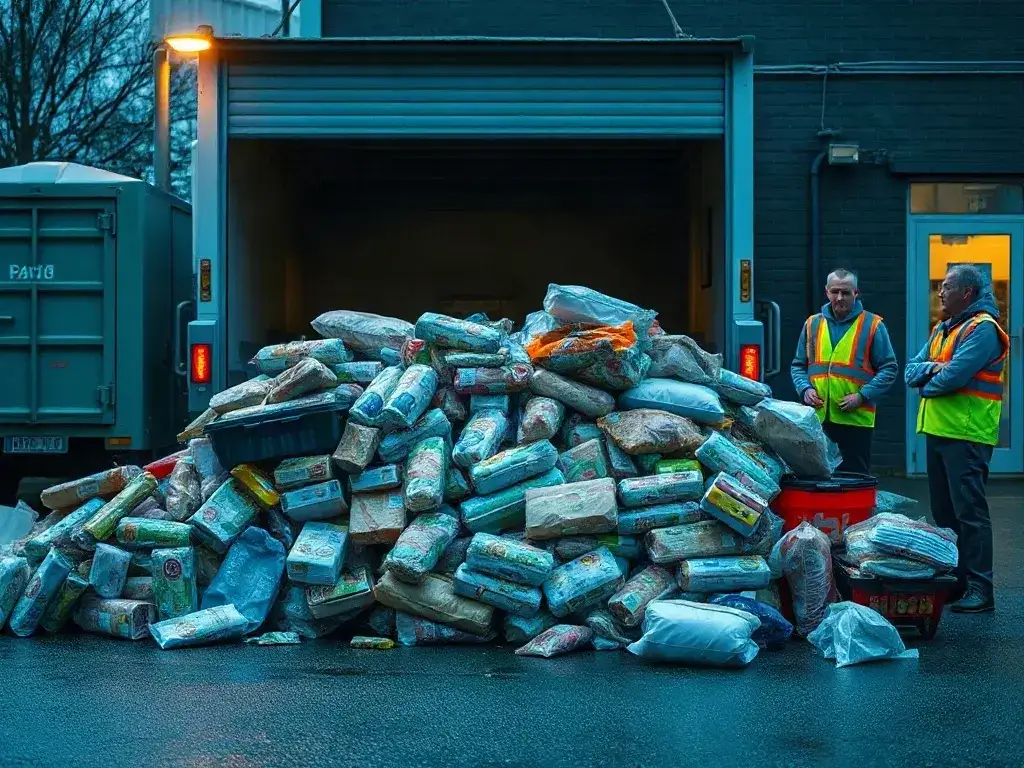
The supermarket freezer cyber-attack reported across seven European countries is a significant escalation in how digital intrusions cause damage. According to the report, dozens of stores dumped huge quantities of food after their refrigerators and freezers were targeted. One quoted line captures the outcome: ‘All this food is now useless.’ The target was not customer data or payment tills. It was the physical process that keeps perishable goods safe. This analysis separates what is established from what is not, and explains why this class of incident is likely to recur.
‘All this food is now useless.’ The sentence matters because the loss was physical and immediate, not a line item in an IT incident report.
The information available to this article is limited to the headline claim: dozens of supermarkets, seven countries, refrigeration and freezer systems targeted. The attack vector, the attacker, the exact date, and the volume of food destroyed are not established here, so none are asserted. What can be done is to explain how such an event is technically plausible and why the response was food disposal rather than a quick restart.
What the supermarket freezer cyber-attack tells us
A cyberattack usually produces financial or reputational harm. Here the harm was thermodynamic. Once a supermarket loses control of its cooling, the product begins a countdown that no software patch can reverse.
Retailers can recover from a failed till system by reverting to cash, manual processes, or temporary closure. Chilled and frozen stock offers no such fallback. Dairy, meat, fish, and ready meals cannot be ‘restored from backup’. This asymmetry makes refrigeration a high-leverage target.
Why disposal, not recovery
Discarding the food is the rational response under food safety rules, not an overreaction. Retailers operate under HACCP-based systems, which in the EU derive from Regulation (EC) No 852/2004. Under these systems, temperature is a critical control point. If a store cannot demonstrate that product stayed within its safe range, it generally cannot sell it.
The loss therefore has two components: food that actually warmed, and food whose temperature history became unverifiable. If monitoring was also disrupted, even stock that stayed cold may have been condemned for lack of evidence. That is a plausible, unconfirmed mechanism, but it explains why losses can exceed what the physical outage alone would suggest.
How hackers can reach refrigeration systems
Modern refrigeration is no longer a standalone compressor. It is a networked system of sensors, controllers, and remote dashboards, part of the broader Internet of Things. Many stores connect these systems to a building management system, which in turn connects to head office or a third-party maintenance provider.
Operational technology versus IT
Cooling equipment sits in the domain of operational technology (OT), which relies on industrial control systems and programmable logic controllers. OT was designed for reliability and longevity, not for hostile networks. Devices often run for a decade or more, receive few security updates, and sometimes use default credentials or unauthenticated protocols.
Three entry routes are most commonly discussed by security practitioners:
- Flat networks: an intrusion into the corporate IT environment spreads into OT because nothing separates them.
- Third-party access: refrigeration contractors often hold remote-access credentials, a classic supply chain attack pathway.
- Exposed management interfaces: controllers or gateways reachable from the internet with weak authentication.
Which route applied in this incident has not been established in the material reviewed here.
Two failure modes with different consequences
An attacker can sabotage cooling directly by changing setpoints, disabling compressors, or suppressing alarms. Alternatively, a broad infection such as ransomware can take down the management layer and leave staff unable to see or control equipment. The second is often collateral damage rather than deliberate targeting. The report says the systems were ‘targeted’, but the difference between intent and spillover has strategic implications that the public record does not yet resolve.
Precedents: when digital failure becomes physical failure
This incident follows a pattern that security professionals have documented for years.
- In 2013, attackers reached payment systems at a US retailer through credentials stolen from an HVAC contractor, as covered in the 2013 Target data breach. It showed that building-services vendors are a viable way into retail networks.
- The Stuxnet worm demonstrated that malware can manipulate physical machinery while displaying normal readings to operators.
- The NotPetya outbreak in 2017 disrupted global manufacturers and logistics firms, including food companies, showing how indiscriminate malware causes operational losses.
- The Colonial Pipeline ransomware attack led the operator to shut physical operations as a precaution, even though the intrusion targeted business systems.
- The Kaseya VSA ransomware attack in 2021 forced hundreds of Swedish Coop stores to close because their tills stopped working.
The lesson is consistent: attackers do not need to understand a victim’s physical process to disrupt it. Shared infrastructure and shared vendors are enough.
The economics of a cold-chain attack
The cold chain concentrates risk. A store can hold tens of thousands of euros of perishable stock at any moment, and a failure that lasts a few hours can make it worthless. Multiplied across dozens of stores in seven countries, the direct loss is substantial, though no verified figure is available here.
Costs beyond the dumpster
- Lost sales: empty chilled aisles drive shoppers to competitors, and some do not return.
- Disposal and logistics: removing and documenting condemned stock carries its own cost.
- Insurance friction: policies may exclude, sublimit, or dispute losses caused by cyber events or by spoilage without physical damage.
- Environmental cost: the incident is also a food waste event, with embedded emissions and a visible reputational dimension for retailers who publicly commit to waste reduction.
The images of piles of discarded food are part of the damage. They make an abstract cyber risk concrete for customers, boards, and regulators.
Regulatory exposure in Europe
The EU’s NIS2 Directive widened the set of sectors required to manage cyber risk and report significant incidents, and food production, processing, and distribution is among them. Whether a particular retailer falls within scope depends on its activities and size, so this should be assessed case by case rather than assumed. The broader direction is clear: supervisors increasingly expect demonstrable risk management, including supplier oversight. The EU cybersecurity agency ENISA publishes guidance in this area.
A multi-country incident also raises coordination questions. Each national authority may have different reporting thresholds and timelines, which complicates response for a retailer operating in seven jurisdictions.
Can hackers shut down supermarket refrigerators? Practical defences
Technically, yes, if the equipment or its management layer is reachable and poorly protected. The countermeasures are well understood, though unevenly applied. Retailers and refrigeration contractors should prioritise the following.
- Separate OT from IT. Proper network segmentation keeps a corporate compromise from reaching store controllers.
- Govern vendor access. Require multi-factor authentication, time-limited sessions, and logging for every maintenance connection.
- Keep local autonomy. Controllers should hold safe setpoints and keep cooling if the network or cloud platform fails. Fail-safe behaviour is the single most valuable design property.
- Run independent temperature logging. Battery-powered loggers that do not depend on the main network preserve evidence and may save stock from condemnation.
- Rehearse manual fallback. Stores need procedures for moving stock to backup cold storage or refrigerated trailers.
- Apply recognised standards. The IEC 62443 series is the established reference for industrial automation security.
Common mistakes
Typical errors include assuming that refrigeration is ‘not IT’, granting contractors permanent remote access, leaving default passwords in place, and testing backups of servers while never testing the loss of cooling control. Measuring security only by data protection misses the hazards that actually spoil product.
Frequently asked questions
Why did supermarkets throw away the food?
Because food safety rules require chilled and frozen products to stay within controlled temperatures. If cooling failed, or if retailers could not prove it had not, selling the stock would be a compliance and health risk.
Was this ransomware?
The information available does not say. The report states only that refrigeration and freezer systems were targeted in a cyber-attack. Treat any claim about the malware type or the attacker as unconfirmed until investigators publish findings.
Are other retailers at risk?
Any retailer with networked refrigeration, remote contractor access, and weak separation between IT and OT carries comparable exposure. The risk is structural rather than specific to one company.
Does insurance cover spoiled food after a cyber-attack?
It depends on the policy wording. Some property policies cover spoilage only after physical damage or a power failure, while cyber policies may exclude or cap non-digital loss. Retailers should check this before an incident.
The lesson in the dumpster
The most important insight is that cyber risk is no longer defined by where data lives but by what a business cannot afford to lose in the next few hours. For grocers, that is temperature. An attacker who understands this does not need to steal anything. Disruption alone converts directly into waste, lost revenue, and public attention.
Watch for three developments. First, whether investigators identify a deliberate attack on refrigeration controllers or collateral damage from a broader intrusion, since that determines whether this is a one-off or a template. Second, whether regulators and insurers start treating refrigeration security as a distinct control area rather than a facilities matter. Third, whether refrigeration vendors begin to ship fail-safe defaults and stronger remote-access controls as standard rather than optional features.
A reasoned prediction, not a confirmed fact: retailers that treat cold-chain control systems as critical infrastructure within the next two years will absorb the cost of segmentation and monitoring quietly. Those that do not will probably learn the lesson in public, with the same image of discarded food. The unanswered question is who bears responsibility when the weakest link is a contractor’s remote-access account: the retailer, the vendor, or the regulator who set the standard.
Frequently Asked Questions
Why did stores throw away food instead of simply restarting the freezers?
Restarting equipment does not prove the food stayed safe. Under HACCP-based rules, temperature is a critical control point, so a store that cannot show product remained within its safe range generally cannot sell it. Disposal is therefore the compliant response, not an overreaction.
Could food that stayed cold still have been thrown away?
Possibly. If monitoring systems were disrupted, stores may have lost the temperature records needed to prove the cold chain was intact. Without that evidence, even properly chilled stock may have been condemned. The article describes this as plausible but unconfirmed, so it should not be treated as fact.
How can hackers reach something as basic as a refrigeration unit?
Modern refrigeration is a networked system of sensors, controllers and remote dashboards, often linked to a building management system. Common routes include flat networks without separation between IT and OT, contractor remote-access credentials, and internet-exposed controllers with weak authentication. Which route was used here is not established.
Why is operational technology harder to secure than normal IT systems?
OT equipment was built for reliability and longevity rather than hostile networks. Devices often run for ten years or more, receive few security updates, and may use default credentials or unauthenticated protocols. That makes patching slow and leaves older refrigeration controllers exposed compared with regularly updated office IT.
Do we know who was behind the attack or how much food was lost?
No. The available information covers only the headline claim: dozens of supermarkets in seven countries had refrigeration and freezer systems targeted. The attacker, attack vector, exact date and quantity of destroyed food are not established, so the article deliberately avoids asserting any of them.
What is the difference between direct sabotage and ransomware in this kind of incident?
Direct sabotage means an attacker changes setpoints, disables compressors or suppresses alarms to spoil goods. Ransomware instead takes down the management layer, leaving staff unable to see or control equipment. Both can cause food loss, but they differ in intent, technique and the way recovery must be handled.