
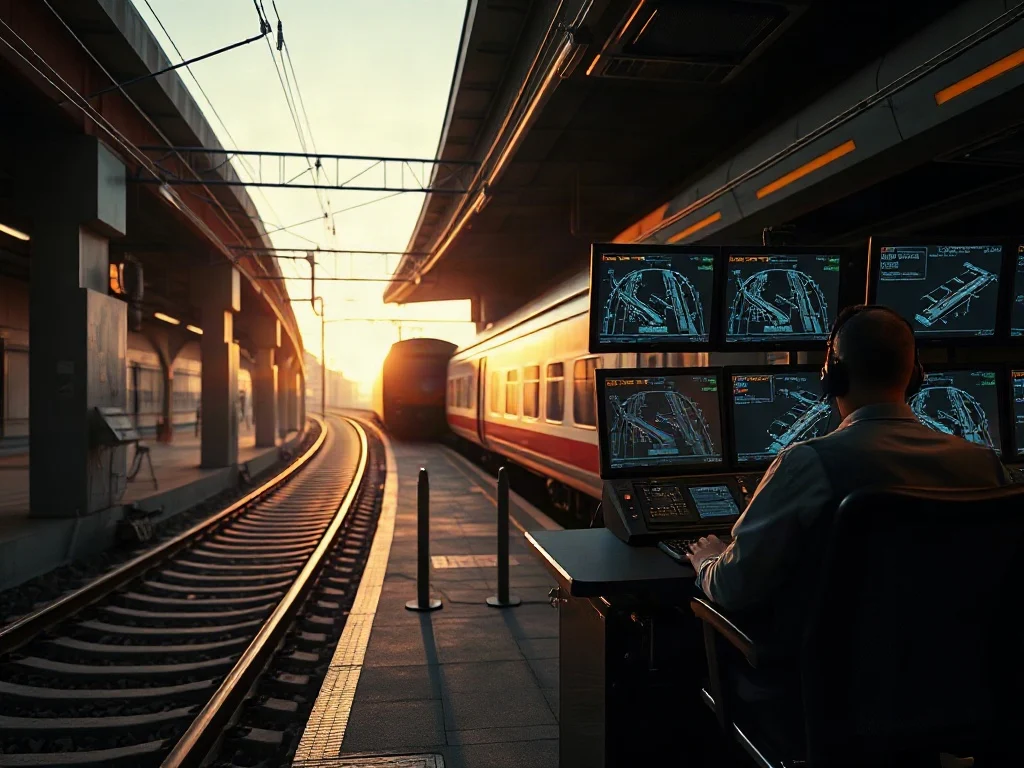
Leaked audio recordings from a Spanish railway control centre have drawn intense public attention after appearing to capture exchanges between controllers and train drivers shortly before a serious rail incident. The most striking fragments suggest that one train received authorisation to proceed even though another train had already stalled on the same stretch of track. For a spain train crash investigation, that single detail matters enormously, because it points away from a purely mechanical failure and toward questions of signalling, communication and procedural compliance. This article examines what the leaked material appears to show, what remains unverified, and why the case has implications well beyond one accident.
Background: How Spanish Rail Traffic Is Controlled
Modern passenger railways rely on layered systems to prevent trains from occupying the same section of track at the same time. In most networks, signalling systems display authorisation to drivers, while a centralised traffic control centre coordinates movements across a wider region. Spain operates a large high-speed and conventional network managed largely by Adif, the state infrastructure manager, with train operations conducted by companies such as Renfe. The division of responsibility between infrastructure managers, operators and control staff is a recurring source of both efficiency and ambiguity.
Key terms are worth clarifying. A block section is a stretch of track in which only one train is permitted at a time under standard operating rules. Track clearance refers to the authorisation given to a driver to enter or continue through a section. When a train stops unexpectedly, controllers are usually expected to halt or reroute following trains. Failure to do so, whether through human error, system malfunction or miscommunication, is among the most dangerous possibilities in rail operations.
Why Control Centre Communication Matters
Voice communication between controllers and drivers remains a critical safety layer even in digitised networks. Radio exchanges provide a record of instructions, acknowledgements and situational updates. Investigations of rail accidents internationally have repeatedly identified breakdowns in this channel, including ambiguous phrasing, incomplete handovers and delayed reporting of incidents. The audio in question is therefore significant not only for its content but for the window it offers into how information flowed during a critical interval.
What the Leaked Recordings Appear to Show
The reported fragments capture brief exchanges in which a controller appears to instruct a driver to continue, apparently without a clear reconciliation of the status of a preceding train. Publicly reported quotations emphasise the phrase that the journey should continue, which has been widely cited in coverage. It is important to distinguish between what the audio plainly contains and the interpretations layered on top of it. At the time of writing, the authenticity, full context and chronological sequence of the recordings have not been established by an official investigative body in any document available for this analysis.
The central question raised by the leak is not whether a message was spoken, but whether the authorisation given was based on accurate information about the track occupancy at that moment.
Distinguishing Fact From Interpretation
- Established so far: Recordings attributed to control and driver communications have been published and reported by major outlets.
- Not yet established: The precise timing of each message relative to the stall, whether controllers had accurate data, and whether any signalling defect contributed.
- Interpretive claims: That the audio proves negligence. Such a conclusion requires the full investigation file, including signalling logs and procedural records.
Competing Explanations for the Sequence of Events
Several explanations are plausible and should be evaluated independently. The first is a human procedural error, in which a controller issued clearance without confirming the status of an earlier train, perhaps because the stalled train had not been reported promptly. The second is a technical information failure, in which track occupancy displayed to controllers did not reflect the real position of the stalled train due to sensor, software or communications problems. The third is an organisational explanation, where staffing pressures, unclear escalation rules or inconsistent training contributed to a decision that appeared correct under normal assumptions.
These explanations are not mutually exclusive. Rail accident analysis typically finds layered causes rather than a single failure. The most useful investigations test each hypothesis against logs, timestamps and operator statements rather than selecting the most dramatic narrative.
Advantages and Limits of Audio Evidence
Audio recordings provide direct evidence of what was communicated, which is far more valuable than secondhand reconstruction. However, they have clear limits. A recording shows words, not the information on the controller’s screen. It does not show whether a driver had visual confirmation of an obstruction, nor whether an automatic protection system was active. Responsible analysis therefore treats the recordings as one input among several.
Regulatory and Safety Implications
Within the European Union, railway safety is shaped by directives and by the work of the European Union Agency for Railways, which promotes harmonised safety standards and interoperability. Spain’s own regulatory bodies oversee operators and infrastructure managers. Any finding that clearance procedures were not followed would prompt scrutiny of rule compliance, supervision, and the design of interfaces between control software and human decision-makers.
Ethical and legal dimensions also arise from the leak itself. Publishing internal recordings can serve public interest by exposing possible failures, but it can also complicate investigations, affect the privacy of staff and influence witnesses. Investigators generally prefer that sensitive material be handled within formal processes, and the circulation of partial audio before official findings can distort public understanding.
Practical Lessons for Railway Operators
- Require explicit read-back of track status and clearance instructions for every movement involving a recently reported stoppage.
- Design control interfaces so that a stalled train automatically flags adjacent sections as occupied until confirmed clear.
- Log all radio and telephone communications with synchronised timestamps accessible to investigators.
- Conduct regular drills simulating simultaneous incidents and communication breakdowns.
- Establish clear escalation pathways so that drivers and controllers can halt movements without hesitation.
Common Mistakes in Public Interpretation
Public discussion of rail accidents often collapses complex causation into a single villain, typically an individual employee. This framing is rarely accurate and can obscure systemic weaknesses. Another frequent error is treating early leaked material as definitive. Readers should be cautious about claims that a recording proves intent or that a specific person alone bears responsibility before investigators have published their conclusions.
Future Developments and What to Watch
Several developments are worth monitoring. Official investigation reports, once published, will determine whether the leaked exchanges were decisive or contextual. Regulatory responses, including any changes to clearance procedures or signalling standards, will show how authorities interpret the lessons. Broader trends also matter: the expansion of digital train control systems such as the European Train Control System is intended to reduce reliance on voice coordination, yet it introduces new software and cybersecurity dependencies that require rigorous oversight.
It is reasonable to predict increased pressure for automated protection that can override or verify human clearance decisions, but this is a projection rather than an established outcome. Implementation involves substantial cost, legacy infrastructure challenges and the need to preserve human judgement where automation fails.
Frequently Asked Questions
Has the authenticity of the leaked Spain train crash audio been confirmed?
As of the reporting available for this analysis, official confirmation of the recordings’ authenticity and full context had not been published. Readers should rely on investigative findings from competent authorities for definitive conclusions.
Does the audio prove that controllers were at fault?
No single recording can establish fault. Determining responsibility requires access to signalling data, procedural records, staffing information and witness accounts, all of which are typically examined in a formal investigation.
Why is voice communication still used in modern rail networks?
Voice communication provides a flexible, direct channel for coordinating complex situations and handling failures. It remains a backup and complement to automated systems, although it is also a point where misunderstanding can occur.
The Question the Recordings Leave Open
The most important insight from the leaked audio is that safety in rail transport depends on whether every participant holds the same accurate picture of the network at the same moment. If the recordings confirm that clearance was granted without that shared picture, the case will test whether current procedures and technologies can reliably close that gap. Readers should watch for the official investigation, for any changes to clearance rules, and for how quickly digital protection systems are deployed. The unresolved question is whether the rail sector will treat this episode as an isolated procedural lapse or as evidence that human-machine coordination requires a fundamental redesign.
Frequently Asked Questions
¿Son auténticas las grabaciones filtradas del centro de control?
Hasta el momento, las grabaciones han sido publicadas y comentadas por medios importantes, pero su autenticidad, el contexto completo y la secuencia cronológica no han sido confirmados por un organismo investigador oficial. Conviene esperar al expediente de investigación antes de dar por probadas las interpretaciones que circulan sobre ellas.
¿Qué significa que un tren tuviera autorización para avanzar con otro detenido en el mismo tramo?
En las normas habituales, cada tramo de vía bloqueado solo debe ocupar un tren a la vez. Si un controlador autoriza el avance cuando otro tren ya está parado en ese mismo tramo, se rompe esa separación de seguridad. Esto apunta a un posible fallo de información, de señalización o de procedimiento, más que a una avería mecánica aislada.
¿Un fallo de señalización podría explicar lo ocurrido en lugar de un error humano?
Sí, es una de las explicaciones plausibles que deben evaluarse. Un defecto en los sistemas de detección de ocupación de vía podría hacer que el controlador creyera que el tramo estaba libre. Distinguir entre error humano y fallo técnico exige revisar los registros de señalización y de tráfico, algo que los audios por sí solos no permiten determinar.
¿Por qué las comunicaciones por radio son tan importantes en un accidente ferroviario?
Aunque las redes estén muy digitalizadas, la voz entre controladores y maquinistas sigue siendo una capa de seguridad clave. Las grabaciones registran instrucciones, confirmaciones y avisos de incidencias. Muchas investigaciones internacionales han identificado fallos en esta vía por frases ambiguas, traspasos incompletos o avisos tardíos, por eso el audio aporta información sobre cómo fluyó la información en un momento crítico.
¿Qué diferencia hay entre Adif y Renfe en la responsabilidad de estos incidentes?
Adif es el gestor de infraestructuras, responsable de la vía, la señalización y, en buena medida, del centro de control de tráfico. Renfe es una operadora que presta el servicio de transporte con sus trenes y maquinistas. Esta división de responsabilidades puede generar ambigüedad sobre quién debe responder por un fallo de coordinación, por lo que la investigación debe determinar qué parte del proceso falló.
¿Podría esta investigación tener implicaciones más allá de este accidente concreto?
Sí. Si se confirma que existieron fallos de comunicación o de procedimiento, podrían revisarse protocolos de autorización, la formación de controladores y el diseño de los sistemas de señalización en toda la red. Por eso el caso interesa también a reguladores y operadores, no solo a las familias de las víctimas y al público general.