
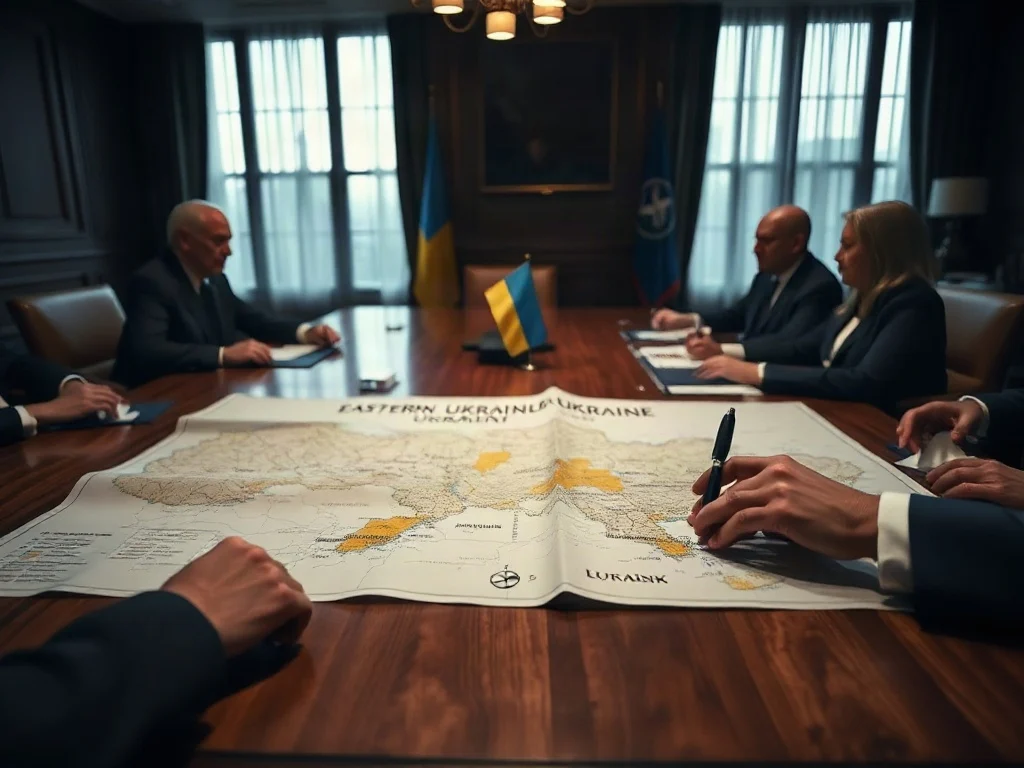
The idea of Ukraine ceding Donbas in exchange for NATO membership surfaced after Ukrainian President Volodymyr Zelensky said Washington had floated the trade. The US has not confirmed his account. A US official told the BBC that “many ideas continue to be discussed.” That leaves a significant claim without verification, and the way it is handled will shape how Kyiv, Moscow and Western capitals read the next phase of peace diplomacy. This analysis walks through the proposal as a process: what is reportedly on the table, which steps would have to happen in sequence, and where each step is likely to fail.
What Zelensky said and what remains unconfirmed
According to the BBC report, Volodymyr Zelensky said the US had floated a scenario in which Ukraine would give up the Donbas and in return receive a path into NATO. Washington did not confirm this. The statement from a US official is deliberately broad, and it fits the usual pattern of negotiations in which many options are tested privately and few are endorsed publicly.
Two points need to stay separate. The established fact is that Zelensky made the claim and that the US has not corroborated it. Everything beyond that, including terms, timing and whether any formal offer exists, is interpretation or speculation. Readers should treat the proposal as a reported idea rather than a policy.
Background: why the Donbas matters
The Donbas is an industrial region in eastern Ukraine made up of Donetsk Oblast and Luhansk Oblast. Fighting there began in 2014, when Russian-backed forces took territory after the annexation of Crimea. Efforts to end that phase, notably the Minsk agreements, produced a long-running frozen conflict rather than a settlement. Russia’s full-scale invasion in 2022, the escalation of the wider Russo-Ukrainian War, followed.
Russia has claimed to have annexed Donetsk and Luhansk, along with two other regions, but it has not captured all of that territory. Reporting indicates that Ukraine has continued to hold much of the northern part of Donetsk Oblast, including the cities of Kramatorsk and Sloviansk. Those cities anchor Ukraine’s defensive position in the east. A transfer would therefore mean more than recognizing existing front lines: it would mean giving up land Ukraine still controls.
The proposed trade, step by step
If the reported idea were ever turned into a real arrangement, it would need to move through several distinct stages. Each one has its own obstacles.
Step 1: A ceasefire and a negotiated line
Any exchange would first require a durable ceasefire and an agreed map. This is already difficult, because Moscow’s territorial demands have historically gone beyond the current line of contact. Questions such as a possible demilitarized zone, who would monitor it, and whether Ukrainian forces would withdraw from areas they hold would all have to be settled first.
Step 2: Ukrainian domestic approval
The Constitution of Ukraine provides that changes to the country’s territory can only be resolved by an all-Ukrainian referendum. Zelensky has repeatedly said that Ukraine cannot legally give up territory by decree. A vote would require a ceasefire long enough to organize it, and its outcome is uncertain. Polling by Ukrainian and international organizations has generally shown strong public resistance to ceding land, though attitudes can shift with battlefield conditions. I am not citing a specific figure because the numbers vary by pollster and date.
Step 3: Alliance consent for NATO membership
Ukraine’s NATO accession is not in Washington’s gift alone. Under Article 10 of the North Atlantic Treaty, new members are invited by unanimous agreement of existing members, and each member’s ratification process follows. A US proposal would still need every ally to agree. The enlargement of NATO has always depended on that consensus.
Step 4: Russian acceptance
Moscow has long opposed Ukrainian membership and has framed neutrality as a central demand. A deal that gives Russia territory but lets Ukraine join NATO runs against that stated position. Whether Russia would accept it, and what it would demand in addition, is unknown. This is the weakest link in the chain, because the trade only works if the party gaining territory also accepts the alliance outcome.
Why NATO membership is the bargaining chip
NATO membership matters because of Article 5, the collective defense clause under which an armed attack on one member is treated as an attack on all. For Ukraine, this is the strongest available guarantee against another Russian offensive after any settlement. Earlier assurances proved weak: the Budapest Memorandum of 1994 gave Ukraine political assurances in exchange for giving up Soviet-era nuclear weapons, but it contained no binding defense commitment. Ukrainian officials often cite it as proof that paper promises are not enough.
The alliance has also been ambiguous for years. The 2008 Bucharest summit declared that Ukraine would become a member, but it set no timetable and no mechanism. The history of Ukraine–NATO relations shows a long gap between rhetoric and action. A land-for-membership trade would attempt to close that gap, but only in exchange for a very high price.
Arguments for and against
The case for a trade
- Ending the fighting: Supporters argue that a settlement would stop casualties and civilian suffering and allow reconstruction to begin.
- Hard security: Alliance membership would offer deterrence that no bilateral guarantee can fully match.
- Realism about the front: Some analysts argue that recapturing the entire region by force is unlikely in the near term, so diplomacy must deal with the map as it is.
The case against
- Moral and legal precedent: Critics see a reward for aggression, comparable to appeasement, that could encourage future territorial claims elsewhere.
- Loss of defensible terrain: The fortified cities and high ground in northern Donetsk are militarily valuable. Giving them up could make Ukraine harder to defend, even inside NATO.
- Human cost: Hundreds of thousands of people live in the areas Ukraine still controls, and the proposal would put them under Russian authority.
- Credibility of the offer: If membership cannot be delivered because an ally vetoes it, Ukraine would have surrendered land for a promise.
Edge cases and precedents
Supporters sometimes point to divided countries that joined the alliance, with West Germany in 1955 the best-known case. That precedent is imperfect: it involved a formally divided state, not a country whose occupied land was ceded by treaty. Another comparison is Finlandization, the Cold War model of neutrality under a powerful neighbor’s shadow. That model is the opposite of what this reported idea envisions, since it would pair NATO entry with territorial loss. The mismatch shows how unusual the proposal would be if it were real.
What to watch in practice
Observers evaluating this story should monitor a few concrete indicators rather than headlines:
- Official US confirmation or denial. A formal statement would move the proposal from rumor to policy.
- Positions of key NATO members. Any hint of a veto or conditional support would signal whether the membership leg is credible.
- Russian public response. Rejection of the NATO element would effectively end the idea.
- Ukrainian political signals. Talk of a referendum, or a firm refusal from parliament, would show how much room Kyiv has.
- Battlefield changes around Kramatorsk and Sloviansk. Military pressure influences how seriously every party treats territorial concessions.
Frequently asked questions
Has the US confirmed it proposed Ukraine give up the Donbas for NATO membership?
No. Zelensky made the claim, and a US official told the BBC that many ideas continue to be discussed, without confirming this one.
Can Ukraine legally give up territory?
Under Ukraine’s constitution, changes to the country’s territory require an all-Ukrainian referendum. A transfer decided by the government alone would face a legal challenge.
Who decides whether Ukraine joins NATO?
All existing members must agree unanimously to invite a new member, and each then completes its own ratification process. No single country, including the US, can decide it alone.
Would NATO membership guarantee Ukraine’s security?
Article 5 is a strong deterrent, but it commits members to take the action each deems necessary rather than automatically sending troops. Its value lies largely in credibility.
The unanswered question that decides everything
The most important insight is structural: the reported trade depends on four separate parties, Kyiv, Washington, NATO’s other members and Moscow, each holding a veto over a different piece. A concession is only worth making if the reward can be delivered, and the reward is the part Washington cannot deliver alone. That is why the careful US wording matters as much as Zelensky’s claim.
The question to watch is whether security guarantees short of full membership, such as bilateral defense pacts or European-led force commitments, become the real substitute. If they do, the debate will shift from “Donbas for NATO” to “how much territory for how much deterrence.” My reasoned expectation, not a confirmed fact, is that any settlement will be a patchwork rather than a single grand bargain, and that the terms of Ukraine’s security will be settled long before its borders are.
Frequently Asked Questions
¿Ha confirmado Estados Unidos que propuso cambiar el Donbás por la adhesión de Ucrania a la OTAN?
No. Solo consta que Zelensky afirmó que Washington planteó ese escenario. Un funcionario estadounidense dijo a la BBC que "se siguen discutiendo muchas ideas", sin confirmar nada. Por eso conviene tratarlo como una idea reportada y no como una política oficial ni una oferta formal.
¿Por qué Ucrania no puede ceder territorio por decreto?
La Constitución ucraniana establece que cualquier cambio en el territorio del país solo puede resolverse mediante un referéndum de toda Ucrania. Zelensky ha repetido que no puede ceder tierras por decreto. Además, se necesitaría un alto el fuego lo bastante largo para organizar la votación, y su resultado sería incierto.
¿Por qué ceder el Donbás sería más que reconocer las líneas actuales?
Rusia afirma haber anexionado Donetsk y Luhansk, pero no controla todo ese territorio. Ucrania mantiene gran parte del norte de Donetsk, incluidas Kramatorsk y Sloviansk, que sostienen su defensa en el este. Una cesión implicaría entregar tierra que Kyiv aún controla, no solo aceptar el frente.
¿Puede Estados Unidos garantizar por sí solo el ingreso de Ucrania en la OTAN?
No. Según el artículo 10 del Tratado del Atlántico Norte, los nuevos miembros se invitan por acuerdo unánime de los aliados actuales, y después cada país debe completar su propio proceso de ratificación. Una propuesta de Washington necesitaría, por tanto, el consentimiento de todos los demás miembros.
¿Aceptaría Rusia un acuerdo que le dé territorio pero incluya a Ucrania en la OTAN?
Es poco probable. Moscú se opone desde hace tiempo a la adhesión ucraniana y presenta la neutralidad como una exigencia central. Además, sus demandas territoriales han ido históricamente más allá de la actual línea de contacto, de modo que ganar el Donbás podría no bastarle si Kyiv entra en la Alianza.
¿Qué obstáculos previos habría antes de cualquier intercambio territorial?
Primero haría falta un alto el fuego duradero y un mapa acordado. Habría que resolver si existiría una zona desmilitarizada, quién la vigilaría y si las tropas ucranianas se retirarían de áreas que hoy controlan. Sin estos puntos, los pasos siguientes, como el referéndum, no podrían avanzar.