
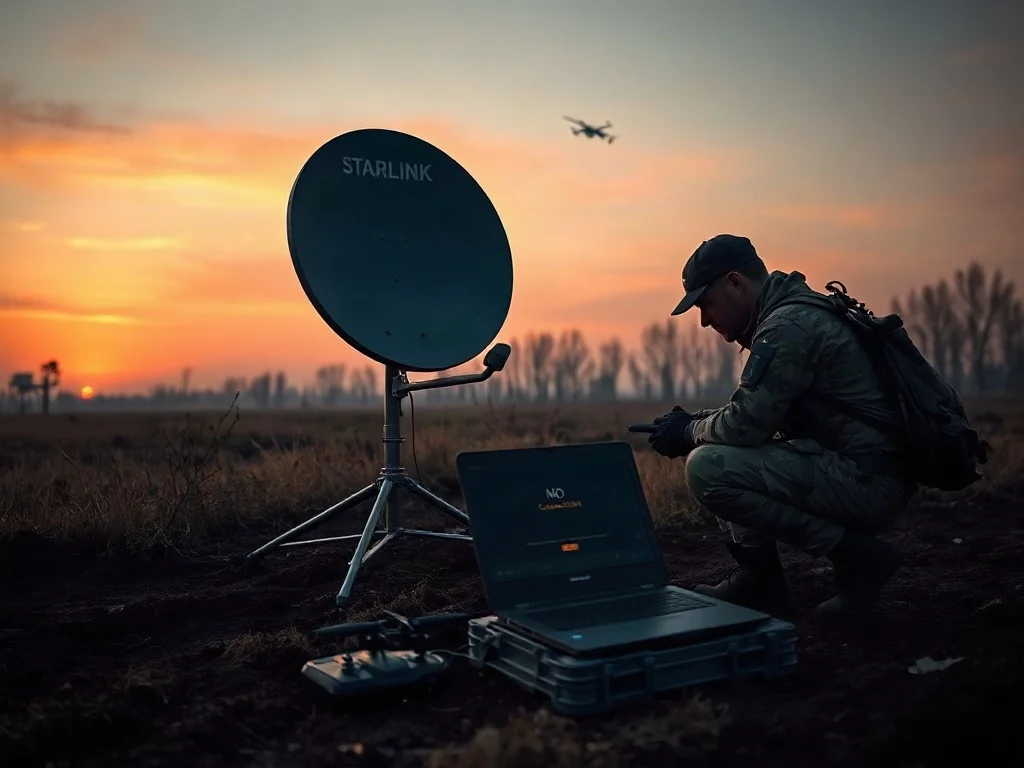
The latest Starlink disruption in Ukraine landed on the same day that US envoys sat down with Russian leader Vladimir Putin in Moscow. Kyiv says its military Starlink service was disrupted again. Later on Thursday, Jared Kushner and Steve Witkoff were due to travel to Dublin to meet Ukrainian President Volodymyr Zelensky. The timing does not prove a link, but the coincidence shows how dependent frontline command has become on one commercial network, and how exposed it is when that network falters during high-stakes diplomacy.
This analysis separates what is reported from what is inferred. The public account is thin: Ukraine says the service was disrupted, and it has not been independently verified in the material available. The structural questions behind it are better documented, and they matter more than any single outage.
What was reported, and what was not
The core facts are limited. Ukrainian officials say military Starlink connectivity was disrupted again. US envoys Steve Witkoff and Jared Kushner met Putin in Moscow, then planned to travel to Dublin to see Zelensky.
The report does not establish a cause. An outage could stem from deliberate Russian interference, a technical fault, a policy change on the provider’s side, or a combination of these. Anyone asserting a single explanation without evidence is speculating. The word again is the most informative part of the report: it implies a pattern, and patterns are what military planners must design around.
Why Starlink matters to Ukraine’s military
Background: from emergency fix to battlefield infrastructure
Starlink terminals reached Ukraine shortly after the full-scale invasion in 2022. Then-digital minister Mykhailo Fedorov publicly appealed to Elon Musk, and SpaceX began shipping equipment. What began as a civilian resilience measure became embedded in military practice during the Russo-Ukrainian War.
The appeal is technical. Starlink is a satellite internet constellation operating in low Earth orbit, which gives lower latency than traditional geostationary systems. Terminals are small, portable, and quick to deploy. For units operating where cellular towers and fibre have been destroyed, that is transformative.
What the network actually carries
Public reporting and official statements over the years have linked Starlink to several battlefield functions:
- Command and control: secure-enough links between headquarters and forward units, supporting command and control across dispersed positions.
- Drone operations: video and telemetry for unmanned aerial vehicles, including long-range reconnaissance.
- Artillery coordination: faster sharing of targeting data between spotters and fire units.
- Logistics and medical coordination: basic connectivity for units cut off from terrestrial networks.
The more functions ride on one network, the larger the consequence of each interruption. That is the central vulnerability, regardless of the cause of this outage.
The competing explanations for a Starlink outage
Hypothesis one: Russian electronic warfare
Russia has invested heavily in electronic warfare, and the conflict is widely regarded as one of the most intense electromagnetic contests in modern history. Radio jamming of satellite links, as well as interference with the Global Positioning System signals that terminals and drones rely on, is a plausible tool. Jamming is local and tactical, though. It typically degrades service in specific areas rather than producing a country-wide event, so the geography of an outage is a useful diagnostic.
Hypothesis two: provider-side or policy changes
Starlink is a commercial service controlled by a private company. Network software changes, capacity limits, account verification measures, or restrictions on which terminals may operate can all cut connectivity, intentionally or not. Ukrainian officials have previously worked with SpaceX on controlling which terminals can connect, an effort aimed at keeping the service out of Russian hands. Any such control measure carries a risk of collateral disruption for legitimate users.
Hypothesis three: ordinary technical failure
Large networks fail. Software faults, ground-station problems, and routing errors are well documented across the satellite industry. In wartime conditions, an ordinary fault gets read as an attack, which is itself an information-warfare dividend for Moscow regardless of whether it caused the outage.
The decisive analytical question is not who caused the outage, but how much of the front depends on a system that neither Kyiv nor Washington formally controls.
The governance problem: a private network in a state war
The deeper issue is sovereignty over critical infrastructure. Reporting around Elon Musk’s account of declining to extend coverage to a Ukrainian operation near Crimea in 2022 became a flashpoint. Musk has disputed aspects of how it was characterised, and the details remain contested. The episode nonetheless illustrated the structural risk: a single company and its leadership hold discretion over a capability with strategic consequences.
There are real counterarguments. Commercial provision gave Ukraine capacity it could not have procured quickly through traditional defence channels. The US government has also moved toward contracting for services via Starlink and related programmes. Dependence on a vendor is not new in defence. But the combination of vendor discretion, Russian interference, and diplomatic leverage is unusual.
Why the diplomatic timing amplifies the story
With emissaries in Moscow speaking with the Kremlin leadership, any disruption to Ukraine’s communications becomes part of a negotiating narrative. Kyiv has an incentive to highlight it, since it underlines Russian pressure and Ukraine’s reliance on Western technology. Moscow has an incentive to let it speak for itself. Observers should treat official statements from every side as positioned, not neutral.
Practical lessons for military communications planning
For defence planners, analysts, and technology firms, the episode supports several concrete principles.
- Build redundancy across media. Satellite, radio mesh, cellular, and fibre links should each be able to carry minimum essential traffic.
- Plan for degraded mode. Units should train to operate for hours without connectivity, including pre-loaded maps and fallback procedures.
- Separate critical from convenient traffic. Not every video feed deserves priority on a contested link.
- Diversify providers. Alternative low Earth orbit and national systems reduce single-vendor exposure, although none currently matches the scale of Starlink.
- Log and publish outage forensics where security allows. Without data, cause attribution becomes political.
A common mistake is to treat outages as isolated technical events. Each one is evidence about satellite communications in modern warfare: resilient on average, fragile at the margins, and contested constantly. The margins are where battles are decided.
How does Starlink work in a war zone?
Terminals communicate with satellites overhead, which relay traffic to ground stations connected to the wider internet. This architecture is resilient against physical destruction, since there are thousands of satellites, but it still depends on radio links that can be jammed and on ground infrastructure that can be restricted. The terminals’ radio emissions can also be detected, which creates a targeting risk for users who do not manage their signatures. This is why discipline in placement and use matters as much as the technology itself.
Security and ethical dimensions
Starlink is a dual-use technology, serving civilians and militaries alike. That raises questions about the legal status of such infrastructure in armed conflict and about the responsibilities of commercial operators. It also invites cyberwarfare attention: an adversary has strong incentives to probe both the space segment and the user terminals. These are open legal and policy questions, not settled doctrine.
Frequently asked questions
Why is Starlink being disrupted in Ukraine?
The report does not give a confirmed cause. Plausible explanations include Russian electronic interference, provider-side changes, or a technical fault. Attribution requires technical evidence that has not been publicly detailed.
Does Ukraine’s military rely on Starlink?
Yes, extensively, according to public statements and reporting since 2022. It supports communications, drone operations, and coordination, particularly where terrestrial networks have been damaged.
Can Russia jam Starlink?
Russia has substantial electronic warfare capability, and localised interference with satellite links is feasible. Whether any given outage results from jamming must be established case by case.
Is there an alternative to Starlink for Ukraine?
Other satellite and radio systems exist, but none currently offers the same combination of scale, low latency, and portable terminals. That gap is why redundancy, not replacement, is the realistic goal.
The signal to watch after the Moscow and Dublin meetings
The most important insight is that connectivity has become a variable in diplomacy. Whoever can degrade, protect, or withhold a communications layer holds leverage that does not appear in any ceasefire text. If outages recur around negotiation milestones, that pattern will tell analysts more than any single incident.
Three things merit attention. First, whether Ukrainian or Western officials publish a technical explanation for this disruption, or leave the cause ambiguous. Second, whether the talks produce any discussion of protecting satellite infrastructure, an issue previously absent from peace frameworks. Third, whether Kyiv accelerates diversification away from a single provider. A reasoned prediction, labelled as such: the next phase of the war’s technology contest will be fought less over individual drones than over who controls the networks those drones depend on. The unanswered question is whether a private company can, or should, be the keystone of a state’s defence.
Frequently Asked Questions
Does the timing with the Putin meeting prove the Starlink outage was deliberate?
No. The article stresses that the coincidence does not prove a link. The report gives no cause, and an outage could come from Russian interference, a technical fault, a provider policy change, or a mix. Claiming a single explanation without evidence is speculation.
How can the geography of an outage help identify its cause?
Jamming is local and tactical, so it usually degrades service in specific areas. A country-wide disruption points less to battlefield electronic warfare and more to a provider-side issue, such as a software change or a policy measure. Geography is therefore a useful diagnostic.
Why does the word 'again' in the report matter so much?
It suggests a pattern of repeated disruptions rather than an isolated glitch. Military planners must design around recurring failures, not single events. A pattern also strengthens the case that relying on one commercial network is a structural vulnerability, whatever caused this particular outage.
Could Starlink's own control measures cause outages in Ukraine?
Yes. Starlink is a private commercial service, and software updates, capacity limits, account verification, or restrictions on which terminals may connect can all cut service, intentionally or not. Ukraine and SpaceX have worked on controlling which terminals connect, to keep Russia from using the service.
Why is Starlink so useful for Ukrainian forces compared with other connectivity?
Its low Earth orbit constellation gives lower latency than geostationary systems, and the terminals are small, portable, and quick to deploy. Units where cellular towers and fibre have been destroyed can still link up for command, drones, artillery coordination, and logistics.
Has the latest outage been independently verified?
Not in the material available. The public account is thin: Ukrainian officials say military Starlink service was disrupted, but no independent confirmation or technical explanation is cited. The article therefore separates reported facts from inference and focuses on the better-documented structural risks.