
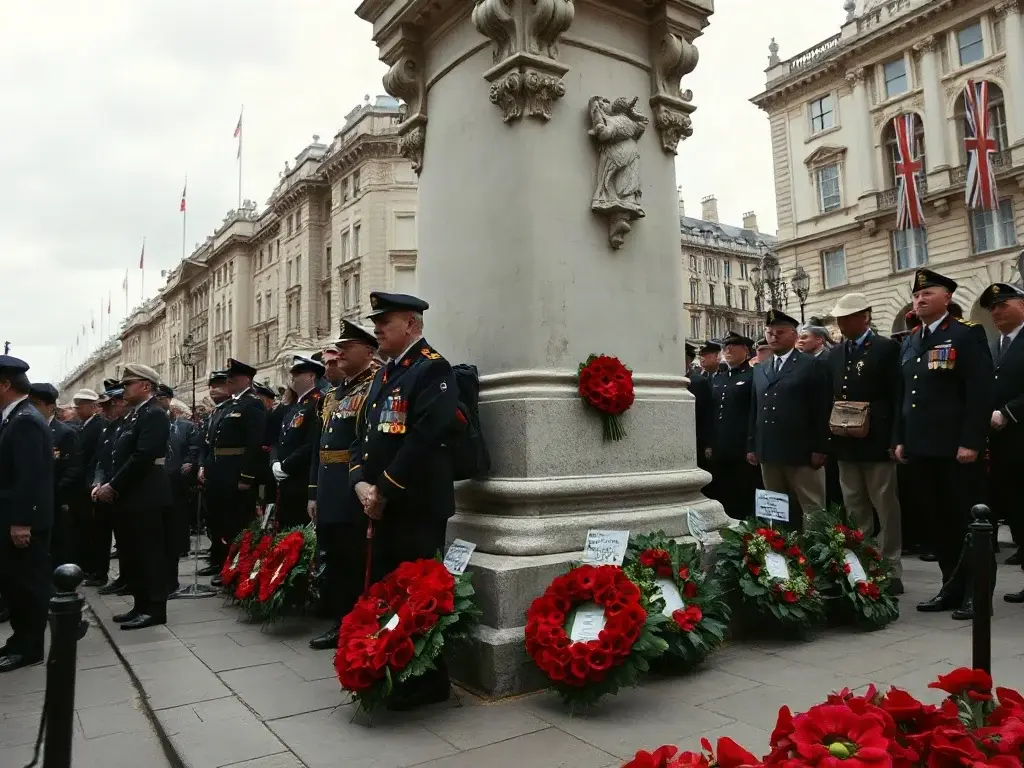
The Remembrance service at the Cenotaph is the central ritual of national mourning in the United Kingdom. This latest ceremony, led by the King, brought around 10,000 armed forces veterans to central London, including 12 who served in the Second World War. The numbers matter. The ceremony is solemn and unchanging in form, but its meaning shifts as the generation that fought in 1939-45 shrinks to a handful of marchers. This analysis looks at what the service is, why it endures, what the veteran turnout tells us, and where the tradition is heading.
What Happened at the Cenotaph
According to the report, the King led the national act of remembrance in Whitehall. Wreaths were laid at the memorial, and about 10,000 veterans took part in the tribute. Twelve of them served in the Second World War. The report supplies no more detail than that, so this article does not invent any. What we can do is set those facts against the established structure of the day.
The form of the national service is well documented. It centres on a two-minute silence at 11am, signalled by a gun. A bugler plays the Last Post, and Reveille follows the silence. Members of the Royal Family, political leaders and representatives of Commonwealth nations lay wreaths. Veterans then march past the memorial. The sovereign’s role, laying the first wreath on behalf of the nation, anchors the ceremony in the constitution as well as in sentiment.
The Cenotaph and Remembrance Sunday: Background
An empty tomb in Whitehall
The Cenotaph stands on Whitehall. Its name derives from Greek words meaning ’empty tomb’. Architect Sir Edwin Lutyens designed it. A temporary version was built for victory commemorations in 1919, and the public response was so strong that a permanent Portland stone memorial was unveiled in 1920. Its design is notable for what it omits. It carries no religious symbol and no figurative sculpture. The inscription ‘The Glorious Dead’ and the dates of the two world wars are among its few markings. That abstraction is deliberate, and it is one reason the monument can hold the grief of people of many faiths and none.
From Armistice Day to Remembrance Sunday
The ceremony grew out of the Armistice of 11 November 1918, which ended fighting in the First World War. After the Second World War, the national service moved to the second Sunday of November and was widened to honour the dead of both wars and later conflicts. The modern form of Remembrance Sunday therefore carries layers of history. It commemorates a specific armistice, and it has become a standing commitment to remember every British and Commonwealth service death.
Why 12 Second World War Veterans Is a Significant Number
The headline figure is 10,000 veterans. The more revealing figure is 12. The report does not say how that compares with earlier years, so any year-on-year claim would be speculation. The direction of travel is not in doubt, though. Veterans of 1939-45 were young adults at the time. Mortality has steadily reduced the cohort, and each ceremony makes the remaining survivors more visible and more precious to the public.
From lived memory to inherited memory
Historians and memory scholars describe a shift from communicative memory, passed on by direct testimony, to cultural memory, sustained by institutions, objects and rituals. The Cenotaph service is one of the strongest institutions of the second kind. Its challenge is to keep emotional authority when the people it honours can no longer attend. The First World War passed through this transition decades ago, and the ceremony survived it. That suggests the ritual can outlast the cohort, though the tone may change.
Who now fills the ranks
The 10,000 figure is a reminder that most marchers today served in later conflicts and operations. They include National Service veterans, Cold War personnel, and veterans of Northern Ireland, the Falklands, the Gulf, Iraq and Afghanistan. The service has quietly broadened from commemorating two great wars to recognising a continuous line of military service. That widening is one of its most important developments, and coverage that dwells only on the oldest veterans tends to understate it.
The Ceremony as State Ritual: A Critical Reading
A critic should ask what the ceremony does as well as what it honours. The Cenotaph service performs several functions at once.
- Constitutional function: the King, as head of state, leads the nation in mourning, which reinforces the link between the Crown and the armed forces.
- Civic function: politicians, faith leaders and Commonwealth representatives appear together, which makes the occasion a rare moment of shared ceremony.
- Personal function: for families of the bereaved and for veterans, the march past is a form of recognition that policy debates rarely offer.
The tradition has faced criticism. Some argue that remembrance can drift into militarism or political display, and that the focus on national ceremony can obscure the experience of civilians and of people from Commonwealth countries who served in large numbers. Defenders respond that the service’s restraint is its safeguard. There are no speeches. The silence, the music and the poem recited at the memorial leave little room for partisan messaging. Both views contain truth. The ceremony’s power depends on its austerity, and that austerity is also what makes any departure from it so noticeable.
The Role of Charities, Poppies and Public Participation
The Royal British Legion plays a central role in organising veteran participation and runs the annual poppy appeal. The remembrance poppy links the national ceremony to everyday life, because millions of people wear one in the weeks before the service. The Legion’s own site, britishlegion.org.uk, gives practical information on events and support for the veteran community.
The Commonwealth War Graves Commission (cwgc.org) maintains the graves and memorials of Commonwealth service personnel worldwide. Its work is the physical counterpart to the Cenotaph’s symbolic role, and it reflects the multinational character of the Commonwealth of Nations contribution.
Symbols, Words and Music That Carry the Service
The laying of wreaths
A wreath is an old funerary symbol. At the Cenotaph the wreaths are laid in a set order, beginning with the sovereign. This is part of the choreography. It tells viewers who is speaking for the nation, and it keeps a ceremony watched by millions orderly.
Poetry and the language of loss
The words most associated with the occasion come from Laurence Binyon‘s poem ‘For the Fallen’, in particular the line ‘We will remember them’. The line works as a promise, and a promise raises its own questions. What does it mean to keep it when the last witnesses have died?
A companion memorial
Not far from Whitehall, the Tomb of the Unknown Warrior in Westminster Abbey serves a parallel purpose. The Cenotaph honours the dead collectively, and the Tomb makes the loss personal through one anonymous soldier. Together they show how British remembrance combines abstraction with intimacy.
How to Follow or Attend the Service
The service is open to the public as spectators. It is also broadcast widely. For people planning to attend, the practical guidance is straightforward.
- Check official guidance on road closures and access points before travelling, as the area around Whitehall is heavily restricted.
- Arrive early, since viewing space along the route fills well before the 11am silence.
- Observe the silence fully, including phones off and no photography during the two minutes.
- Wear a poppy purchased through an official source to support the veterans’ charities directly.
- Read the official royal website, royal.uk, for programme details and the order of service.
A common mistake is to treat the day as a spectacle to be photographed rather than a memorial to be observed. Stewards and veterans generally ask visitors to respect the solemnity of the occasion.
Frequently Asked Questions
Who leads the Remembrance service at the Cenotaph?
The sovereign leads the national act of remembrance. In this report that was the King, Charles III, who laid a wreath alongside other senior figures.
How many veterans take part in the march past?
In the ceremony reported here, about 10,000 armed forces veterans were present, including 12 from the Second World War. The number can vary from year to year, and the report gives no comparison.
Why is the Cenotaph empty?
The word ‘cenotaph’ means ’empty tomb’. The monument commemorates the dead without containing remains, and it carries no religious imagery, so it can serve people of all backgrounds.
When is Remembrance Sunday held?
It falls on the Sunday nearest to 11 November, the anniversary of the 1918 Armistice. The two-minute silence on that day is observed at 11am.
What the Falling Number of Witnesses Means for Remembrance
The most important insight from this year’s report is that the 12 Second World War veterans are the ceremony’s most visible sign of change. The ritual has to carry memory on behalf of people who are no longer present to carry it themselves. The evidence from the First World War is encouraging. The Cenotaph service did not fade when the last veterans of 1914-18 died. It deepened and widened its scope.
What to watch next is how the service adapts without losing its austerity. Three questions deserve attention. First, how will the ceremony represent the contribution of Commonwealth and minority communities more fully? Second, how will younger generations, with no family memory of the world wars, be drawn into a tradition built on silence rather than spectacle? Third, how will recent veterans be recognised as the numbers from earlier wars decline?
A reasonable prediction is that the format will stay almost exactly as it is, since its value lies in its constancy, while the people it centres on continue to change. The real test will come in the years ahead, when no Second World War veteran is left to march and the nation must show whether ‘We will remember them’ is a lasting commitment or an echo of the generation that first spoke it.