
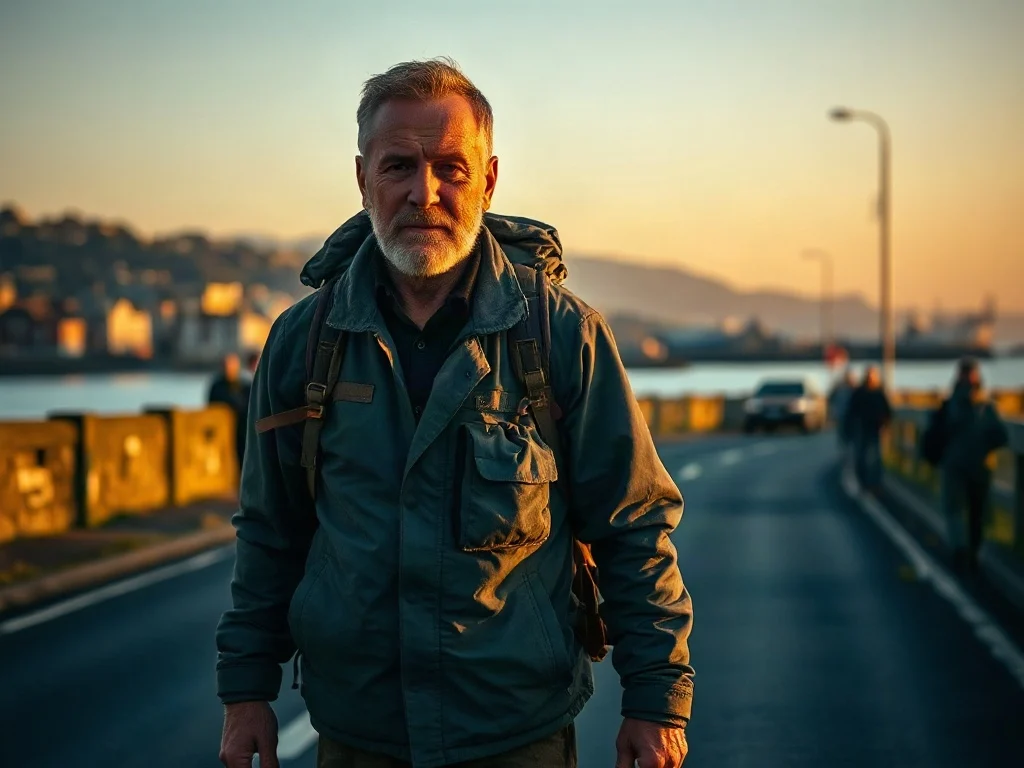
The Karl Bushby walk around the world is close to finishing. The former British paratrooper left Punta Arenas, Chile, in 1998 and has now covered roughly 36,000 miles on foot, and he is reported to be almost within sight of home after 28 years. The distance is striking. The more useful question is what a trek this long reveals about borders, endurance and the limits of a personal rule: never take a flight or a boat except where no land route exists.
This analysis separates what is documented from what is rhetoric, explains why the journey took so much longer than planned, and looks at what Bushby’s finish means for the genre of long-distance world walking. The route details of the final stretch come from the news report. Anything beyond that is flagged as interpretation.
What the Goliath Expedition Is and Why It Matters
Bushby, from Kingston upon Hull, served in the Parachute Regiment before setting out on what he called the Goliath Expedition. The concept was simple: walk from the southern tip of South America to his home city, using land and, where unavoidable, frozen water. The start was Punta Arenas in Chile, near Tierra del Fuego. Details of his life and the expedition are summarised in the Karl Bushby encyclopedia entry.
The original plan reportedly assumed about 12 years. The actual figure is more than double that. This gap is the central story, and it says more about geopolitics and bureaucracy than about stamina.
The Rule That Defines the Record
Many long walks are quietly assisted by flights, ferries or vehicle hops. Bushby’s expedition is framed as an unbroken line across the planet. That framing makes it hard to compare with other feats. It also raises the stakes of every closed border, because a refused visa cannot be solved by booking a plane ticket without compromising the premise.
Key Milestones in the Journey
The table below lists only the elements that are widely reported and consistent with the news coverage.
| Element | Detail |
|---|---|
| Start point | Punta Arenas, Chile |
| Start year | 1998 |
| Distance walked | About 36,000 miles (as reported) |
| Time elapsed | About 28 years |
| Destination | Hull, England |
| Notable obstacle | Bering Strait crossing and Russian entry restrictions |
The Obstacles That Stretched 12 Years Into 28
Jungle and Danger in the Americas
Walking north through the Americas follows the corridor of the Pan-American Highway, which has one famous break: the Darién Gap, a roadless stretch of rainforest and swamp between Panama and Colombia. Anyone committed to a continuous land route has to cross it. It is a region long associated with difficult terrain and security risks, which is why it works as a test of a walker’s judgement as much as fitness.
The Bering Strait Problem
The most consequential single episode is the crossing of the Bering Strait from Alaska toward the Chukotka region of Russia. Bushby attempted to cross the winter ice in 2006 with a companion and was reported to have been detained by Russian authorities for entering without proper permission. That set off years of visa difficulty. A walker can plan for weather and distance. A walker cannot plan for a state that declines to admit him.
This illustrates a structural point: modern world walking is limited more by paperwork than by physical geography. A person with a valid passport and no travel plan can be refused access that a 19th-century explorer would not have needed. The system of travel visas is the real terrain.
Siberia, Funding and Everyday Survival
Crossing Siberia demands seasonal planning, cold-weather logistics and long stretches between supplies. Walkers on this scale usually rely on a patchwork of sponsorship, media attention, odd jobs and local hospitality. Public reports indicate that funding and time spent waiting on permissions repeatedly slowed Bushby, though the exact financial arrangements are not independently documented here.
A Changing World Along the Route
A 28-year walk is also a 28-year record of global disruption. The COVID-19 pandemic closed borders worldwide for extended periods, and the Russian invasion of Ukraine reshaped what is possible for travellers across Eurasia. How these events specifically altered Bushby’s final route should be checked against his own accounts and the original news report, because secondary summaries often compress the timeline.
How Far Has Karl Bushby Walked, and Is the Figure Reliable?
The headline figure of 36,000 miles is plausible as an estimate but should be read as approximate. It is roughly one and a half times the Earth’s equatorial circumference, which is around 24,900 miles. That is not a contradiction. The route is not a straight line, and a path that follows roads, detours around closures and doubles back after setbacks will always exceed a geometric minimum.
It is worth being precise about what this comparison does and does not show. It does not mean he walked the equivalent of a circumnavigation in the formal sense. The definition of circumnavigation normally involves crossing all meridians and, in some records, antipodal points. Bushby’s route runs from the far south of the Americas to northwest Europe, so describing it as a walk around the world is a loose but widely used shorthand.
Where Bushby Sits Among World Walkers
Bushby is not the only person to attempt a monumental walk. George Meegan walked from Tierra del Fuego to northern Alaska in a journey of about seven years, which is a notable precedent for the first half of Bushby’s route. Jean Béliveau, a Canadian, completed a multi-year walk across several continents. Bushby’s distinguishing feature is not the speed or the distance alone, but the self-imposed no-flight constraint combined with an unusually long delay.
That difference matters for record-keeping. Bodies such as Guinness World Records have their own criteria for walking records, and a personal definition of an unbroken route does not automatically meet them. Readers should treat claims of a record cautiously unless a recognised body has ruled on the specific category.
The Final Stretch and the English Channel Question
Reaching Britain from continental Europe raises a practical puzzle. Pedestrians are not generally permitted to walk through the Channel Tunnel. For a walker bound by a no-flight, no-boat philosophy, that is an obvious tension. How he resolves the crossing, and whether he treats it as an unavoidable exception, is an interpretive question that the news report summary does not settle here. The ending he chooses will shape how purists judge the project.
What the Journey Teaches: Practical Lessons
Few readers will attempt a 28-year walk. The expedition still offers transferable lessons for long-distance and long-term projects:
- Plan for permission, not just distance. Visa windows, transit rights and political stability are the highest-variance risks.
- Define your rules in advance, and define your exceptions. A rigid rule without a stated exception clause becomes a trap when the world changes.
- Build income into the plan. Long expeditions that depend entirely on sponsorship are fragile when media interest fades.
- Document continuously. Claims of unbroken routes are only as credible as the evidence trail behind them.
- Treat delay as data. A schedule that overruns by more than 100% signals that the original assumptions, not just the execution, were wrong.
Common Mistakes Observers Make
Commentators often romanticise the length and ignore the logistics. They also tend to treat the delays as personal failure rather than as the predictable output of a system of borders. A more accurate reading is that Bushby’s persistence despite those systems is the notable fact.
Frequently Asked Questions About Karl Bushby
Where did Karl Bushby start his walk?
He began in Punta Arenas, Chile, in 1998, with the goal of walking to his home city of Hull in England.
How long has Karl Bushby been walking?
According to the news report, about 28 years, far longer than the roughly 12 years originally anticipated.
How many miles has Karl Bushby walked?
Reports put the total at around 36,000 miles. This is an estimate, and the true figure depends on how detours and route changes are counted.
Why did the journey take so long?
The main causes reported are border and visa restrictions, especially around Russia, along with funding constraints and broader events such as the pandemic.
Is it the longest continuous walk ever?
There is no universally accepted category that settles this, so the claim should be treated with caution. It is certainly among the most extended self-declared continuous walking expeditions.
What Bushby’s Homecoming Will Really Test
The most important insight is that this journey is less about walking than about access. The planet’s surface has not become harder to cross, but the legal and political layer over it has. Bushby’s 28 years are a measurable record of that friction.
Watch three things as the finish approaches. First, how he handles the final sea or tunnel crossing and whether he reconciles it with his no-flight principle. Second, whether any recognised record-keeping body evaluates the achievement. Third, whether he publishes a complete, verifiable route log that lets independent observers check the claim.
A reasonable prediction is that the homecoming will be celebrated as a human-interest story, while the deeper question stays largely unasked: if a determined, experienced walker needed more than two decades to cross a world that is physically open, what does that say about how open the world really is? The answer will matter long after the last step into Hull.