
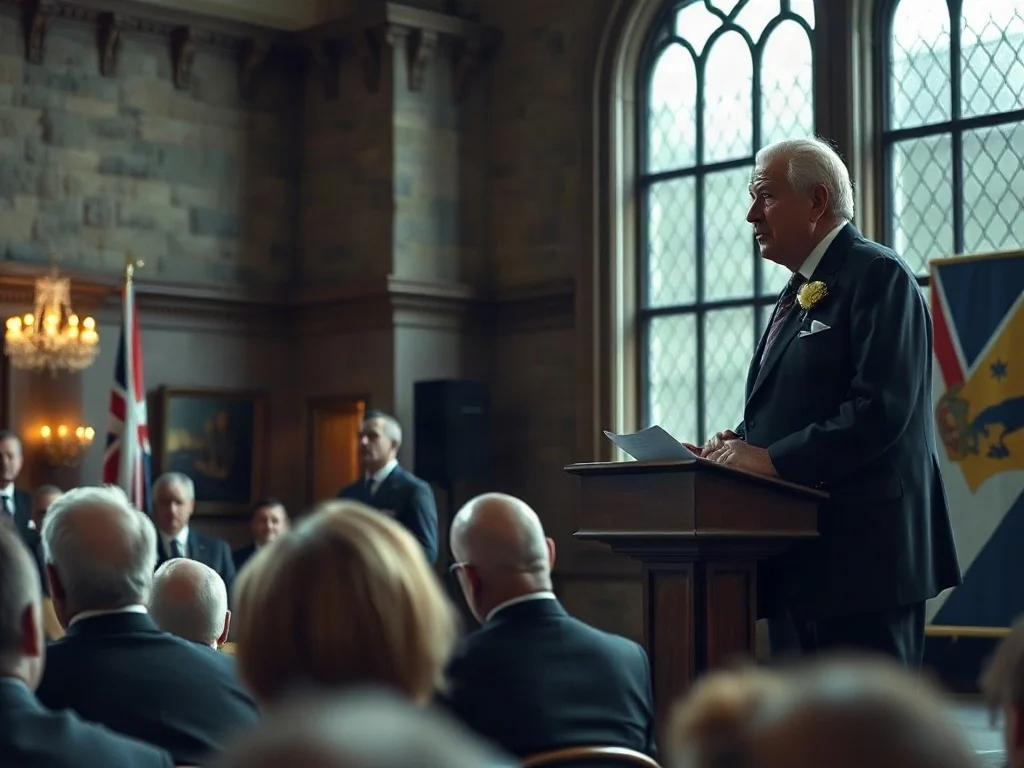
When the King describes the slave trade as a ‘shameful chapter’ in a Commonwealth address, the words carry diplomatic, legal and moral weight well beyond the speech itself. The remarks come after calls for the UK government to issue a formal apology for Britain’s historic role in the trade. The King Charles slavery apology debate therefore turns on a narrower question than it first appears: what is the difference between a monarch acknowledging a painful past and a government accepting responsibility for it? This analysis separates what is established from what is interpretation, because the reporting so far gives only the headline description of the speech and the context of the apology demands. Nothing beyond that is attributed to the King here.
What the King’s Commonwealth address actually signals
The available reporting establishes three facts. The King used the phrase ‘shameful chapter‘ about the slave trade. He did so in an address to the Commonwealth of Nations. And the speech followed pressure on the UK government to apologise formally. Everything else is inference, and the inference matters.
The wording is strong by the standards of royal speech. ‘Shameful’ is an evaluative term, not a descriptive one. It signals moral judgement rather than historical observation. Yet ‘chapter’ frames the trade as a closed episode of the past. That framing is the weak point critics tend to press: a chapter has an ending, while the consequences of slavery, in economic inequality, racial discrimination and contested memory, have not ended.
Acknowledgement is not apology
A formal apology is a specific act. It is made by an institution with authority to speak for the state, it accepts responsibility, and it usually implies some commitment to consequences. Expressions of sorrow or regret can stop well short of that. The distinction explains why a royal statement can be widely welcomed and still fail to settle the question. The scholarly literature on apologies for slavery shows the same pattern in other countries: the form of words matters because it determines what follows legally and financially.
Why the monarch cannot settle the matter alone
The UK is a constitutional monarchy. By convention, the sovereign does not make policy, and public statements on politically sensitive subjects are understood to be shaped in consultation with ministers. The exact process behind any individual speech is not public, so it would be wrong to claim certainty about it. What can be said is that a royal statement is not the same as a decision of His Majesty’s Government.
The King is also head of the Commonwealth, a voluntary association whose leadership is not hereditary, and head of state of the Commonwealth realms. These roles give Charles III a platform to speak to the people most affected by the legacy of the Atlantic trade. They give him no authority to commit the UK to an apology, a fund or a legal settlement. That gap between symbolic reach and executive power is the central tension in the story.
The historical record behind the word ‘shameful’
Few serious historians dispute the scale. The Atlantic slave trade forcibly transported an estimated 12 million people from Africa over roughly four centuries, according to the academic dataset maintained by SlaveVoyages. British vessels carried a substantial share of them, on the order of three million, though exact figures depend on the dataset version and its estimation methods. Chartered enterprises such as the Royal African Company operated under royal charter, which is why discussion of the Crown’s historical involvement is not merely rhetorical.
Abolition and the compensation problem
British law ended the trade itself with the Slave Trade Act 1807 and abolished slavery across most of the empire with the Slavery Abolition Act 1833. That history is often cited as a point of national pride, and the critique is that it is told selectively. The state borrowed to pay about £20 million in compensation to slave owners under the Slave Compensation Act 1837 arrangements, a sum then equivalent to a very large share of annual government spending. The enslaved received nothing. The loan was reportedly not fully repaid until 2015, which means modern taxpayers helped finance it. Researchers at University College London have documented slave-owning beneficiaries through the Legacies of British Slavery database.
This asymmetry, in which compensation went to owners rather than the enslaved, is the factual core of most arguments for reparatory justice. It is also why ‘shameful chapter’ reads to some as understatement.
The case for and against a formal government apology
Positions on a UK government apology for slavery divide along lines that are more principled than partisan labels suggest.
Arguments for
- Moral clarity: The state profited, legislated and enforced. An apology names that responsibility directly.
- Diplomatic credibility: Commonwealth members in the Caribbean and Africa have made reparatory justice a recurring agenda item. The CARICOM Reparations Commission has published a ten-point plan that includes a full formal apology as its first demand.
- Precedent: Other governments have gone further. Mark Rutte delivered an apology on behalf of the Dutch government in December 2022.
Arguments against
- Legal and financial exposure: Governments worry that an apology could be used to support compensation claims. Careful drafting can address this, but the concern is real in policy circles.
- Generational responsibility: Some argue that present-day citizens cannot be held accountable for acts committed centuries ago. Supporters of apology reply that states are continuous institutions and that the benefits and structures persisted.
- Risk of symbolism without substance: Some campaigners themselves are wary of apologies that replace, rather than precede, material measures.
Where British officials have stood so far
The UK’s stance has been consistent in shape if not in tone. Tony Blair expressed ‘deep sorrow’ in 2006 without a formal apology. In 2015, David Cameron visited Jamaica and urged both countries to move on from the legacy of slavery, a message that drew criticism. More recently, the UK government has been reluctant to commit to reparations in the context of Commonwealth Heads of Government Meetings, while Commonwealth leaders have agreed that discussion of reparations for slavery is warranted. Readers should check the official Commonwealth Secretariat record for exact communiqué wording, since summaries often compress it.
Against this record, a royal description of the trade as shameful is notable mostly because it contrasts with the government’s cautious posture, not because it contradicts any previous line.
Reading the speech as soft power
The Commonwealth has no binding legal power, so its influence is largely reputational. That is the sphere of soft power, and the monarchy is among the UK’s most potent instruments of it. Several Caribbean states have debated or completed the move to republic status, as Barbados did in 2021, and the question of how the Crown relates to the legacy of slavery is part of that debate. In that setting, strong language from the King is partly relationship maintenance. It is a way of showing that the institution is not defensive about its history.
The risk is that language outpaces action. If words are not followed by something tangible, such as education programmes, archival access, development partnerships or an agreed process for dialogue, they may be remembered as a substitute for engagement rather than an opening to it.
What would make an apology credible
Comparative experience suggests several markers that separate meaningful apologies from ceremonial ones. These are interpretive criteria, not rules.
- Specificity: Naming the acts and the institutions involved, rather than invoking history in general terms.
- Authority: Delivery by the body that holds responsibility, in this case the government and Parliament.
- Consultation: Involving descendant communities and Commonwealth partners in the process, not only in the audience.
- Follow-through: A defined set of measures, which might include education, memorialisation or investment, with named timelines.
- Consistency: Avoiding contradictory messages from other parts of government.
Models such as a truth and reconciliation commission are sometimes proposed as a way to build that process, though their results vary widely and they do not suit every context.
Frequently asked questions
Has the UK apologised for the slave trade?
Not in the form campaigners usually mean. Prime ministers and royals have expressed sorrow or regret at different times, but the UK government has not issued a formal state apology accepting responsibility. That is the specific demand behind the current calls.
Does the King’s speech count as an official apology?
Based on the reporting available, no. Calling the slave trade a ‘shameful chapter’ is an acknowledgement. An official apology would normally come from the government on behalf of the state.
Why does a Commonwealth address matter for this debate?
Many Commonwealth members have direct historical ties to the slave trade and its aftermath. The forum is where reparatory justice has most often been raised with the UK.
Are reparations the same as an apology?
No. An apology is an acknowledgement of wrongdoing. Reparations involve material measures, which can include financial payments, development programmes or other forms of redress. The two are linked in many proposals but are separable in policy.
The test that the speech has set
The most important insight is that the King’s words have changed the baseline of the debate without changing its mechanics. By calling the trade shameful, the monarchy has set a moral standard that is now difficult for ministers to appear to fall below. The government’s position, which relies on regret without formal apology, looks more exposed when placed beside a royal characterisation that is blunt.
Watch three things next. First, whether ministers echo the King’s language or deliberately maintain distance from it. Second, whether Commonwealth members turn the speech into a concrete request, such as a structured dialogue on reparatory justice, at the next summit. Third, whether any practical measure follows, from education to archival access. A reasonable prediction, though only a prediction, is that the pressure will move from the question of whether to apologise toward the question of what an apology would commit the UK to do. The unanswered question is whether a government that has so far preferred to speak of the past in the past tense is prepared to treat slavery’s legacy as a present obligation.
Frequently Asked Questions
Is the King's 'shameful chapter' remark the same as a formal apology from the UK?
No. A formal apology must come from an institution authorised to speak for the state, accept responsibility and usually imply consequences. The King's phrase is a moral judgement made in a Commonwealth address. It is not a decision of His Majesty's Government, so the apology question stays open.
Why can't the King simply apologise on behalf of Britain?
As a constitutional monarch, the King does not make policy, and statements on sensitive subjects are understood to be shaped in consultation with ministers. His roles give him a platform but no authority to commit the UK to an apology, a compensation fund or any legal settlement.
Why do critics object to the word 'chapter'?
A chapter implies a closed episode with a clear ending. Critics argue that the consequences of slavery, including economic inequality, racial discrimination and contested memory, are ongoing. Framing the trade as a finished chapter, they say, risks understating present-day legacies and the responsibilities that may follow from them.
Does the wording of an apology really matter legally and financially?
Yes. According to the scholarly literature on apologies for slavery, the exact form of words determines what follows. A statement of regret or sorrow may carry no obligations, while an apology accepting responsibility can open the way to legal claims, reparations or other financial commitments.
What is the Crown's historical connection to the slave trade?
Chartered enterprises such as the Royal African Company operated under royal charter, so the Crown's historical involvement is not merely rhetorical. Britain also carried a substantial share of the roughly 12 million people transported, around three million, though exact figures vary by dataset version and estimation method.
Is Britain's abolition of slavery enough to answer calls for an apology?
Critics say it is not, because the story of the 1807 Slave Trade Act and 1833 Slavery Abolition Act is often told selectively as national pride. The state also borrowed about £20 million in compensation connected to abolition, which is central to the compensation problem.