
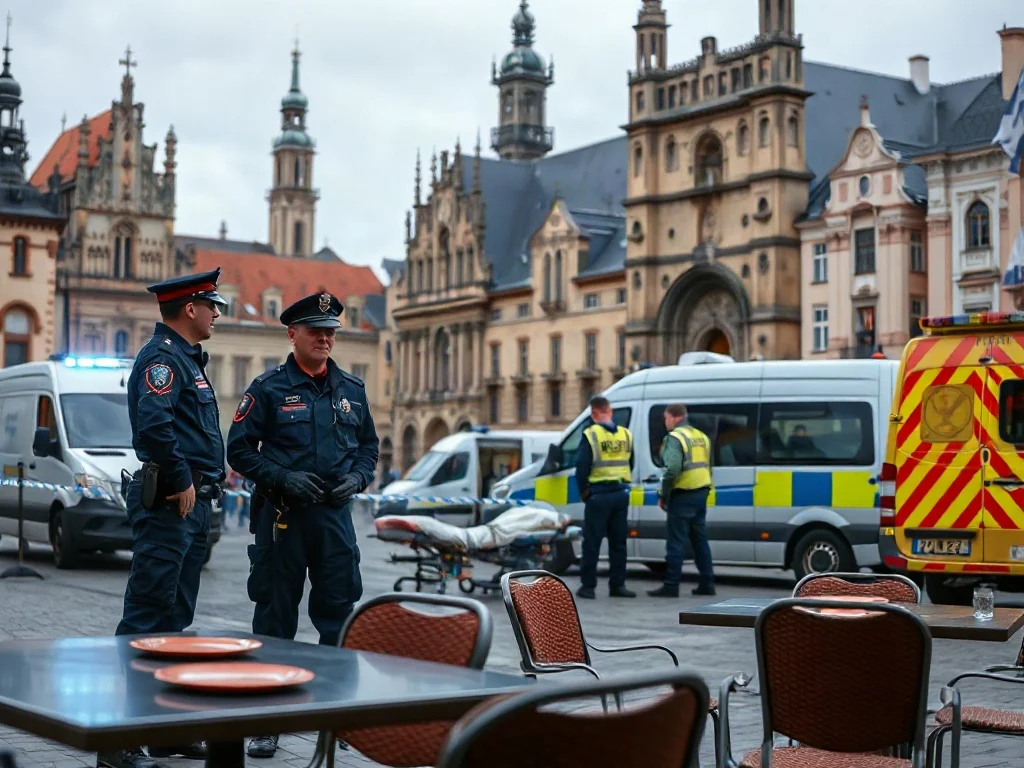
The Krakow shooting is being discussed for what was prevented as much as for what happened. Early reports describe two police officers praised for stopping a Polish gunman before he could kill more people. A colleague of a surgeon who happened to be having lunch nearby says that surgeon undoubtedly saved an officer’s life. Much of the detail is still emerging, so this analysis separates what has been reported from what can be reasonably inferred. It also explains why this combination of a fast police response and immediate trauma care keeps appearing in the better outcomes of violent incidents.
Reported summary: a surgeon having lunch near the scene is credited by a colleague with saving a police officer’s life, and two officers are hailed for preventing the gunman from killing more.
This article does not speculate about the gunman’s motive, the exact sequence of events, or casualty figures, because those details are not established in the material available. It focuses on three questions. Why do the first minutes decide survival? What does an effective police intervention look like in practice? What does the episode reveal about preparedness in Kraków and in Poland more broadly?
What has actually been reported
The confirmed core is narrow. Two officers acted decisively against an armed attacker. A surgeon who was nearby, not on duty, gave medical help. A colleague of that surgeon believes the help was the difference between life and death for an injured officer. Everything beyond that, including the number of victims, the weapon and the timeline, should be treated as unverified until police and prosecutors publish an official account.
That caution matters. Early accounts of shootings are often revised in the first days, and praise for first responders can harden into a narrative before investigators have tested it. A colleague’s statement that the surgeon “undoubtedly” saved a life is credible testimony from someone close to the facts, but it is still an interpretation. Medical records and the investigation will establish the clinical reality.
Why the first minutes decide survival after a gunshot wound
Bleeding is the main preventable killer
A gunshot wound is dangerous mainly because of bleeding. Trauma medicine widely holds that uncontrolled haemorrhage is among the leading causes of preventable death after injury. Blood loss can progress to hypovolemic shock within minutes, which is often faster than an ambulance can arrive in a crowded city centre.
This is why the concept known as the golden hour remains influential, even though researchers debate how literally the 60-minute figure should be taken. The practical lesson is less contested. Whoever is physically present when the injury occurs controls the first and most important variable: how quickly the bleeding is stopped.
What a surgeon adds, and what a layperson can add
A surgeon brings anatomical knowledge, calm under pressure and the ability to judge whether a wound needs direct pressure, packing or a tourniquet. Without equipment the surgeon’s options are still limited to improvised measures. The notable point is that the core interventions are simple enough to be taught widely. That is the premise of the Stop the Bleed campaign, which grew out of the 2013 Hartford Consensus, a US group of trauma surgeons, military medical officers and emergency responders convened after the Sandy Hook school shooting. The campaign aims to give ordinary citizens basic bleeding control skills. Its materials are available at stopthebleed.org.
Military lessons moved into civilian care
Much of today’s civilian approach derives from tactical combat casualty care, which prioritises massive haemorrhage control ahead of airway management. That reordering reflected battlefield data showing that exsanguination killed more people than blocked airways. Civilian emergency services have gradually adopted the principle, although adoption is uneven across countries and across agencies within them.
Police response to an active shooter: what the officers likely did right
The phrase “prevented the gunman from killing more” describes an outcome, not a method. In general, though, the modern doctrine for confronting an active shooter is clear. The first officers to arrive move toward the threat and stop it, rather than waiting for specialist units. This reverses the older containment-first model, which came under heavy criticism after several high-casualty attacks in which delay was found to have cost lives.
The Polish police have their own training and command arrangements, and details of their protocols for incidents like this are not something this article can assert. What can be said is that confronting an armed attacker carries a high risk to the officers themselves. If an officer was injured here, as the surgeon’s reported role implies, that fits the pattern. Early intervention reduces harm to the public while exposing the first responders.
Why the two actions are linked
The officers’ intervention and the surgeon’s treatment are not separate stories. Stopping the attacker quickly is what makes treating the wounded possible, because medics and bystanders cannot safely work in an active threat zone. Treatment of the injured officer, in turn, kept a trained responder alive, which may matter for the later investigation and for the force’s morale. Good outcomes in violent incidents tend to depend on this chain: neutralise the threat, control the bleeding, triage, transport, definitive surgery.
The role of chance, and why that is the uncomfortable part
A surgeon eating lunch nearby is luck. The most analytically honest reading of this episode is that a good result partly depended on an unplanned coincidence. That is worth saying plainly, because celebratory coverage can obscure it. Public systems should not rely on the presence of an off-duty specialist.
Two points follow. First, the bystander effect is real: people in a crowd often assume someone else will act, or fear doing harm. The surgeon’s training removed that hesitation. Second, a trained population narrows the gap between luck and design. If more people in a city centre can apply pressure or a tourniquet, the outcome depends less on who happens to be at the next table.
Legal and institutional barriers to bystander help
Good Samaritan laws vary widely. Many people hesitate to help because they fear liability, and clear legal protection can encourage intervention. Readers should check the rules in their own jurisdiction, since provisions differ and this article does not describe Polish law in detail. Guidance on first aid training is available from bodies such as the European Resuscitation Council, which focuses mainly on resuscitation but sets the framework many European first aid courses follow.
Context: gun violence and firearms regulation in Poland
Shootings of this kind are comparatively rare in Poland. Civilian access to a firearm is regulated through a permit system, described in the overview of gun law in Poland. Low frequency has a double effect. It suggests that the regulatory framework is not obviously failing, but it also means that police, paramedics and hospitals have fewer chances to rehearse real mass-casualty responses than their counterparts in countries with more incidents.
Whether the weapon in this case was legally held is a question the investigation must answer, and no reliable detail is available here. It would be a mistake to draw policy conclusions from a single incident, in either direction. A single case can motivate review. It cannot, alone, show that a licensing regime needs tightening or loosening.
Practical lessons for institutions and individuals
For workplaces, venues and local authorities
- Stock bleeding control kits next to defibrillators in public spaces, and make sure staff know where they are.
- Train beyond the obvious people. Security staff, hospitality workers and teachers are present before any emergency service can arrive.
- Rehearse the handover. Responders should know how to pass information to paramedics: time of injury, actions taken, tourniquet application time.
- Plan for the aftermath. Witnesses and responders may develop post-traumatic stress, and early support reduces long-term harm.
For individuals
- Take an accredited first aid course that covers severe bleeding, not only CPR.
- Learn the sequence: ensure safety, call emergency services, apply firm direct pressure, use a tourniquet on a limb when pressure fails.
- Do not enter an area where an attacker may still be active. Helping safely matters more than helping quickly.
Common mistakes
The usual errors are removing a dressing to check the wound, which disrupts clotting, and delaying a tourniquet because of outdated fears about limb loss. Another is treating a visually dramatic injury before a less visible but more dangerous one. Training addresses all three.
Frequently asked questions
What happened in the Krakow shooting?
Reports say that two police officers prevented a Polish gunman from killing more people, and that a surgeon who was nearby helped an injured officer. Full details, including the number of victims and the motive, depend on official findings that this article does not presume.
How can a bystander help someone with a gunshot wound?
Once the area is safe, call emergency services, apply firm direct pressure to the wound, and use a tourniquet on a limb if pressure does not stop the bleeding. Keep the casualty warm and still until paramedics arrive.
Why is bleeding control so important in shootings?
Severe blood loss can cause shock and death within minutes, often before an ambulance arrives. Stopping the bleeding early is one of the most effective interventions available outside a hospital.
Are shootings common in Poland?
Firearm attacks are comparatively unusual, and civilian gun ownership requires permits. A single incident does not by itself change that overall picture.
The real test comes after the praise
The sharpest insight from this episode is that its good outcome rests on two kinds of competence of very different reliability. The officers’ decision to confront the gunman reflects training and doctrine, which institutions can improve systematically. The surgeon’s presence at lunch reflects coincidence, which cannot be planned. A serious response to the incident would try to turn the second into the first, by making bleeding control skills and equipment so common that survival does not depend on who happens to be nearby.
Watch for three things in the coming weeks. First, the official account from investigators, which may confirm, qualify or correct the early reports. Second, whether Polish authorities review emergency response protocols or public first aid provision in light of the case. Third, whether recognition of the officers and the surgeon leads to anything beyond ceremonies, such as funded training programmes. The unanswered question is whether this will be remembered as a story of individual heroism or as the moment a city decided to depend less on it.
Frequently Asked Questions
Why can a bystander's first aid matter more than a fast ambulance after a shooting?
Severe bleeding can lead to hypovolemic shock within minutes, often before an ambulance gets through a crowded city centre. The person present when the injury happens decides how quickly bleeding is controlled. That is why basic skills such as direct pressure or a tourniquet can be decisive.
Can we say for certain that the surgeon saved the officer's life?
Not yet. A colleague who says the surgeon undoubtedly saved a life is credible, but this is an interpretation, not a clinical finding. Medical records and the official investigation will establish how serious the injuries were and what difference the help actually made.
Is the golden hour a strict 60-minute deadline?
No. Researchers debate how literally the 60-minute figure should be taken. The less contested lesson is that early intervention matters, especially stopping haemorrhage quickly. The idea remains influential because delays in bleeding control and in reaching hospital care are linked to preventable deaths.
What is Stop the Bleed and how is it related to cases like this?
Stop the Bleed is a campaign that teaches ordinary citizens basic bleeding control. It grew out of the 2013 Hartford Consensus, convened by trauma surgeons, military medical officers and emergency responders after the Sandy Hook shooting. Its premise is that simple interventions can be taught widely, not only to doctors.
Why does modern civilian trauma care prioritise stopping bleeding before airway management?
The approach comes from tactical combat casualty care. Battlefield data showed that exsanguination killed more people than blocked airways, so massive haemorrhage control was placed first. Civilian emergency services have gradually adopted this principle, though adoption is uneven across countries and agencies.
Which details about the Krakow shooting are still unconfirmed?
Only a narrow core is confirmed: two officers acted decisively against an armed attacker, and an off-duty surgeon helped an injured officer. The motive, number of victims, weapon, timeline and exact sequence of events remain unverified until police and prosecutors publish an official account.