
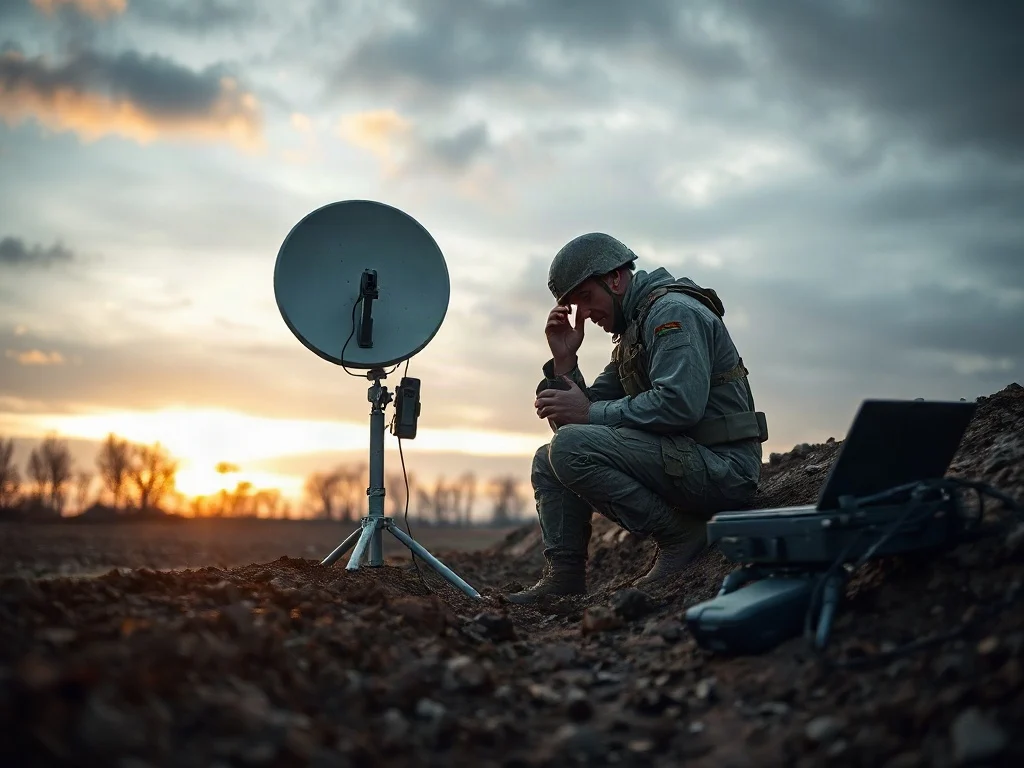
Ukrainian President Volodymyr Zelensky has urged the United States and Elon Musk to lift the remaining Starlink restrictions in Ukraine, saying they are still in force and make it harder to stop Russian attacks. He also asked both to be on the ‘right side of history’. The appeal is a reminder that a commercial satellite network has become part of Ukraine’s wartime infrastructure. This article takes a process-analysis approach: it traces how Starlink service reaches the front line, where a restriction can be applied, and why a limit that looks minor on paper can have large operational effects.
The published report gives only the outline of the dispute. This analysis therefore separates what is established from what is inference, and it does not invent technical details about the restrictions themselves.
Background: How Starlink Became Part of Ukraine’s War Effort
Starlink is a satellite internet service run by SpaceX. It uses a large constellation of satellites in low Earth orbit, so latency is much lower than with traditional geostationary satellites. Ukraine’s connection to the service began in the first days of the Russian invasion of Ukraine. In February 2022, Ukrainian digital minister Mykhailo Fedorov publicly asked Elon Musk for help, and Musk activated service for the country shortly afterward.
Terminals were then shipped in large numbers, paid for by a mix of governments, companies and private donors. The reported use of Starlink in the Russo-Ukrainian War covers everything from keeping hospitals and local administrations online to linking artillery units, reconnaissance teams and unmanned aerial vehicles. The terminals are small and portable, and they work where terrestrial networks have been destroyed or jammed. That is why Ukrainian forces came to depend on them.
The Process: How Starlink Service Reaches the Front Line
The following chain shows why a policy decision made far from the battlefield can change what a unit can do on it.
- Satellite coverage. The constellation provides the signal, and SpaceX decides where service is switched on.
- Terminal registration. Each terminal is tied to an account, a service plan and a location. This is the main point of administrative control.
- Network management. SpaceX can shape bandwidth, set regional rules and restrict particular accounts.
- Military integration. Units connect the terminals to radios, drone ground stations and the systems that make up command and control.
- Operational use. Connectivity supports targeting, coordination and situational awareness.
A restriction can be introduced at steps two or three, but its effects appear at step five. This is why such measures are hard to assess from outside.
Where a Restriction Can Bite
| Control layer | What it governs | Possible battlefield effect |
|---|---|---|
| Geographic limits | Where service works | Coverage gaps near contested areas |
| Account verification | Who may use a terminal | Legitimate units locked out if registration lags |
| Bandwidth or speed management | How much and how fast data flows | Degraded video feeds or drone control links |
| Terms of service | What uses are allowed | Uncertainty over offensive military applications |
This table is an analytical framework, not a description of the specific restrictions Zelensky referred to. The published report does not say which layer is involved, and readers should look for official clarification.
Why Restrictions Exist in the First Place
Restrictions are rarely arbitrary. At least three motives are commonly cited in public discussion of the Starlink-Ukraine relationship.
Preventing Use by Russian Forces
Ukrainian officials and several media outlets have reported that Russian units have tried to obtain Starlink terminals through intermediaries. SpaceX has said it does not do business with Russia. Controls that verify users are meant to close this loophole, and they can be justified on that basis. The difficulty is that a measure designed to exclude the adversary can also catch friendly users when the verification process is slow or imprecise.
Legal and Commercial Exposure
SpaceX is a private company subject to US export controls and sanctions law. Allowing a civilian service to be used for offensive operations raises questions under the rules of armed conflict. The question is how dual-use technology should be governed when it supports both civilian life and combat. Reasonable people disagree about where the line falls.
Escalation Risk
A well-known episode in 2022 involved a Ukrainian naval drone attack near Sevastopol. Accounts of it came largely from a biography by Walter Isaacson, and Musk later disputed parts of the story, saying service had never been active in that area. Whatever the full facts, the episode showed that a private executive’s judgment could shape military outcomes, and it made the issue politically sensitive.
What Zelensky’s Appeal Signals
The appeal is addressed to two parties. Musk controls the company’s technical and commercial decisions, while the US government holds export and security levers and has contracted for satellite services that benefit Ukraine. Reports in 2023 said the Pentagon had contracted for Starlink service on Ukraine’s behalf. By naming both the US and Musk, Zelensky is signalling that he sees the restrictions as a matter of policy as well as company decision-making.
The ‘right side of history’ phrasing is a moral appeal more than a technical argument, and it shows how personal and political the Starlink relationship has become.
The appeal also reflects asymmetric dependence. Ukraine can use alternatives, but none matches Starlink’s combination of coverage, availability and cost. That gives SpaceX leverage, and it gives Kyiv an incentive to frame the issue publicly.
Practical Implications for Military and Civilian Users
Operational Resilience
Military planners generally treat any single-supplier dependency as a risk. Practical steps include maintaining redundant links, keeping spare registered terminals, training units in degraded-communications procedures, and keeping electronic warfare conditions in mind. Jamming and interference are persistent threats whatever commercial policy does.
Common Mistakes in Assessing the Issue
- Treating all restrictions as equivalent. A geographic limit, an account block and a speed cap have very different consequences.
- Assuming a single actor controls everything. Satellite policy involves the company, governments and Ukrainian military procedures.
- Relying on anecdote. Claims about operational harm are difficult to verify independently during wartime, and both sides have incentives to shape the narrative.
What to Monitor
- Any official statement from SpaceX or Starlink clarifying the scope of the restrictions.
- Responses from US officials, particularly regarding contracts and export controls.
- Whether Ukrainian officials publish specifics about affected capabilities.
- Developments in alternative satellite providers for Ukraine and its allies.
Frequently Asked Questions
Why does Ukraine need Starlink?
Ukraine’s terrestrial networks have been damaged and jammed, and Starlink offers portable, high-speed connectivity that works without ground infrastructure. Forces use it for communication, reconnaissance and drone operations, and civilians use it to keep services running.
Who controls Starlink restrictions in Ukraine?
SpaceX operates the network and applies technical and account-level controls. Governments influence the situation through contracts, sanctions and export rules, so responsibility is shared even though the technical levers sit with the company.
Has Russia used Starlink?
There have been media and official Ukrainian reports of Russian units using terminals obtained through intermediaries. SpaceX has stated it does not sell to Russia. The extent of such use is hard to verify independently.
Can Ukraine replace Starlink?
Other satellite and terrestrial options exist, but none currently matches Starlink’s combined coverage, capacity and cost in the field. Diversification is possible, though it takes time and funding.
The Larger Question Behind the Starlink Dispute
The most important insight is that this is less a dispute about one set of restrictions than a test of who governs privately owned infrastructure that has become strategically essential. Satellite connectivity now plays the role that railways, telegraph lines and radio networks played in earlier wars, but it is owned by a company that answers to shareholders, regulators and one highly visible executive.
Watch for three developments. First, whether the restrictions are clarified or eased, and whether the US government plays a visible role. Second, whether Ukraine and its allies accelerate efforts to diversify, including government-controlled satellite capacity. Third, whether formal rules emerge for how commercial space services may be used in armed conflict. These are reasonable expectations, not confirmed outcomes. The unanswered question is whether a wartime ally can rely on a service that a private company can restrict, and the answer will shape military procurement well beyond Ukraine.
Frequently Asked Questions
Which specific Starlink restrictions is Zelensky referring to?
The published report does not specify them. It only says some restrictions remain in force and make it harder to stop Russian attacks. The article offers a framework of possible layers, such as geographic limits, account verification, bandwidth management and terms of service, but readers should wait for official clarification.
Why would a restriction that looks minor have large effects on the front line?
A rule applied at the administrative level, such as terminal registration or network management, only shows its impact during operational use. A delayed verification or reduced bandwidth can degrade drone control links, video feeds or coordination, so a small policy change can limit what a unit does in practice.
At what point in the Starlink chain can a restriction be introduced?
According to the article's process analysis, restrictions are usually introduced at terminal registration or network management. At these steps, SpaceX controls accounts, plans, locations and bandwidth. The consequences, however, appear later, when units use connectivity for targeting, coordination and situational awareness, which makes outside assessment difficult.
Why does SpaceX apply restrictions at all if Ukraine depends on the service?
Restrictions are rarely arbitrary. One commonly cited motive is preventing Russian forces from obtaining terminals through intermediaries, since SpaceX says it does not do business with Russia. The drawback is that verification meant to exclude the adversary can also lock out legitimate Ukrainian users if it is slow or imprecise.
How did Starlink first become part of Ukraine's war effort?
It began in the first days of the Russian invasion. In February 2022, digital minister Mykhailo Fedorov publicly asked Elon Musk for help, and Musk activated service shortly afterward. Terminals were then shipped in large numbers, funded by governments, companies and private donors, and used by civilians and military units alike.
Why are Starlink terminals so useful for Ukrainian forces?
The terminals are small and portable, and they work where terrestrial networks have been destroyed or jammed. The low-orbit satellite constellation also gives much lower latency than geostationary systems. This allows connectivity for hospitals and administrations as well as artillery units, reconnaissance teams and drones.