
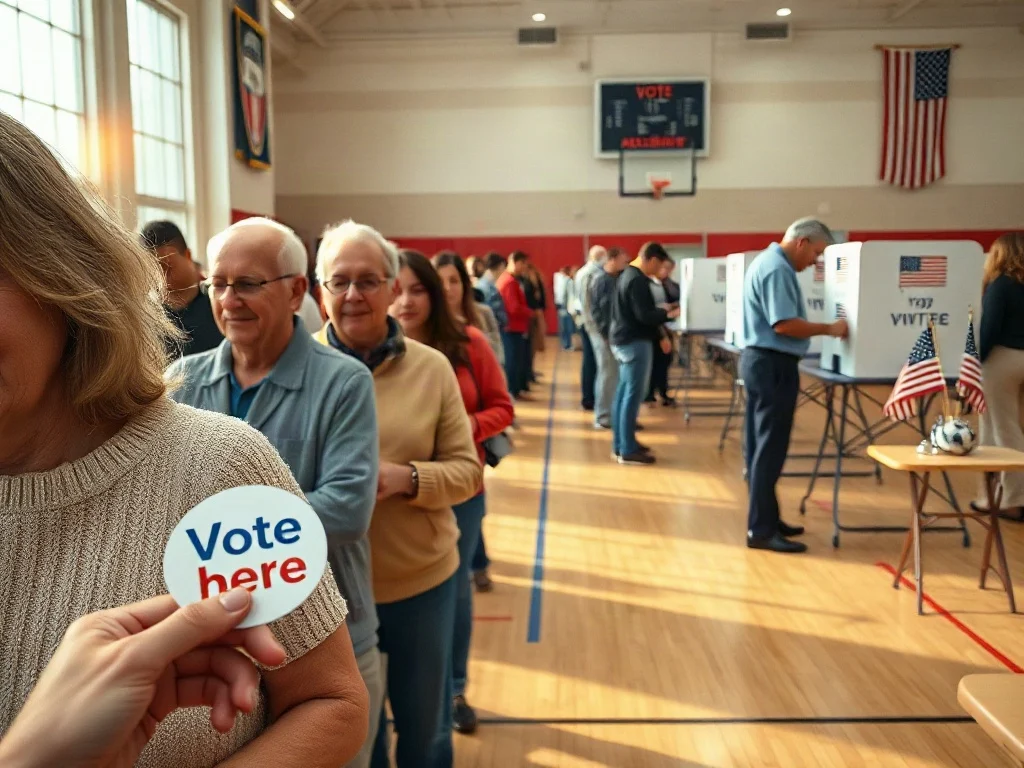
The US midterm elections arrive halfway through a presidential term, and on Tuesday they function as a national verdict on Donald Trump’s presidency. Voters will not choose a president. They will choose who controls Congress, and with it whether the White House can legislate, spend and appoint unchallenged or must answer to a rival power centre. This guide explains what is on the ballot, why the outcome matters, and which forces shape the result, without the usual horse-race noise.
What the US Midterm Elections Actually Decide
A midterm is not one election but hundreds of separate contests held on the same day. Three layers matter most.
The House of Representatives
All 435 seats in the House of Representatives are up for election, because members serve two-year terms. The Constitution is explicit about this rhythm:
The House of Representatives shall be composed of Members chosen every second Year by the People of the several States.
That is from Article One of the United States Constitution. A party needs 218 seats for a majority. The House controls spending bills, can launch investigations and holds the sole power to impeach.
The Senate
Senators serve six-year terms, staggered so that roughly one-third of the United States Senate is contested every two years. Special elections for vacated seats can add contests. The Senate confirms judges, cabinet secretaries and ambassadors under the advice and consent power, so even a one-seat shift can change what a president can achieve.
Governors and State Offices
Most states also elect a governor, along with attorneys general, secretaries of state and state legislators. These races get less attention than they deserve. State officials run elections, certify results and, in many states, shape the next round of congressional maps.
| Office | Term | Contested in a midterm | Key power |
|---|---|---|---|
| House of Representatives | 2 years | All 435 seats | Spending, investigations, impeachment |
| Senate | 6 years | About one-third of seats | Confirmations, treaties, impeachment trials |
| Governors | Usually 4 years | Most states | Election administration, state policy, vetoes |
Why the Midterms Matter for Trump’s Presidency
The core issue is whether Washington remains unified or becomes divided government. If the president’s party holds both chambers, it controls the legislative calendar, committee chairs and investigative agenda. If the opposition wins even one chamber, the balance shifts in at least four concrete ways.
- Legislation stalls. A president can still sign bills, but new priorities such as tax changes or immigration overhauls rarely pass when the other party controls a chamber.
- Oversight intensifies. Committees gain subpoena power. Administration officials can be compelled to testify, and executive-branch decisions face public scrutiny.
- Budget leverage changes. The House originates spending bills, so a hostile majority can use appropriations and debt-limit fights as bargaining tools, with the risk of shutdowns.
- Impeachment becomes possible. Impeachment starts in the House, though conviction requires a two-thirds Senate vote, a bar that has never been met against a president.
The Senate matters differently. A Senate majority lets a president keep confirming judges for lifetime appointments. Legislation faces another hurdle, the filibuster, which typically requires 60 votes to end debate. That means even a winning party often cannot pass its agenda without opposition votes.
The Historical Pattern: The Presidential Penalty
The strongest regularity in American politics is that the midterm election punishes the president’s party. Since the 1930s, the president’s party has lost House seats in nearly every midterm. The notable exceptions came in 1934, 1998 and 2002, each shaped by unusual circumstances such as an economic crisis, a backlash against impeachment and the aftermath of the September 11 attacks.
Gallup’s long-running analyses have found that presidential approval is the best simple predictor of the scale of losses, with larger losses when approval is below 50 percent. Political scientists offer competing explanations for the pattern:
- Thermostatic opinion: voters move against whichever direction government appears to be heading.
- Enthusiasm gap: the out-party’s voters, who are angrier, turn out more reliably than the in-party’s satisfied voters.
- Surge and decline: the president’s coattails lift his party in presidential years, and the lift disappears when he is not on the ballot.
None of these is a law. The 2018 elections, held under Trump’s first term, fit the pattern in the House, where Democrats gained about 40 seats, but not in the Senate, where Republicans expanded their majority. The reason was map geography: the Senate seats contested that year were disproportionately in states favourable to Republicans. History is a baseline, not a forecast.
Structural Forces: Maps, Turnout and Swing Districts
Redistricting and Gerrymandering
Congressional districts are redrawn after each census through redistricting, usually by state legislatures. The practice of drawing lines to favour one party, known as gerrymandering, reduces the number of genuinely competitive seats. The practical effect is that control of the House is often decided by a few dozen districts, not by the national popular vote. A party can win a modest national majority and still fall short of 218 seats.
Turnout
Midterm voter turnout is consistently lower than in presidential years. Recent midterms have drawn well below the presidential-year rate, although 2018 reached roughly half of eligible voters, unusually high for a midterm. Because the electorate is smaller and older, shifts in the enthusiasm of a few percentage points can change outcomes. For this reason, campaigns in the final days spend more on mobilising committed supporters than on persuading undecided voters.
Primaries and Candidate Quality
Nominees emerge through primary elections, which tend to reward ideological intensity. A candidate who wins a primary comfortably can be weaker in a swing district. Analysts who ignore candidate quality often misread competitive Senate races, where a few thousand votes decide the result.
How to Vote in the Midterms: A Practical Guide
Voting rules are set by states, not Washington, so details vary. Voters should rely on official sources rather than social media or campaign materials. The federal government’s Vote.gov and the USA.gov voting guide direct users to each state’s election office.
- Confirm your registration through your state election website. Deadlines vary, and some states allow same-day registration.
- Check your polling place and hours. Polls are not open at the same times everywhere, and assigned locations can change between elections.
- Bring required identification. Voter ID rules differ widely, from strict photo requirements to none at all.
- Know your options. Many states offer early voting or postal voting, but deadlines for returning mail ballots are strict.
- Review the whole ballot. Many states also include local offices and ballot measures that affect taxes, housing and policing.
Anyone in line when polls close is generally entitled to vote, which is why some states are slow to call results.
How to Read the Results on Election Night
Treat early numbers with caution. Counting speed varies by state, and the order in which in-person, early and mail ballots are tallied can create misleading leads that shift as counting continues. Close races may take days to resolve, especially where recounts are triggered by narrow margins.
Instead of watching the national headline, watch three signals:
- Suburban districts: these have been the main battleground in recent cycles and the clearest sign of national swing.
- Early-closing states: results from states that report quickly show whether the evening is trending toward the president’s party or away from it.
- Senate margins: one or two seats determine whether judicial confirmations continue unimpeded.
Outlets such as the Associated Press make race calls only when a result is statistically secure, so patience is not just courtesy but accuracy. The Federal Election Commission publishes campaign finance data that helps explain which races attracted outside money.
Frequently Asked Questions About the Midterms
What are the midterm elections?
They are the federal elections held two years into a presidential term, in which voters choose all House members, about a third of senators and many state officials.
What happens if the president’s party loses the House?
The president can still govern through executive actions and appointments, but the opposition gains control of committees, subpoena power and the spending process. Major legislation becomes very unlikely.
Why does the president’s party usually lose seats?
Explanations include voter backlash, lower enthusiasm among the president’s supporters and the fading of the presidential-year boost. The pattern is strong but not absolute.
Can a president be removed after a midterm?
Not directly. A House majority can impeach, but removal requires a two-thirds vote in the Senate, which no president has ever faced successfully.
The Question the Midterms Cannot Answer
The most important insight is that a midterm rarely settles a political argument. It redistributes leverage. A president who retains Congress gains time and institutional cover, but also takes full ownership of whatever comes next. A president who loses a chamber gains an opponent with a platform, but also a convenient explanation for stalled promises.
Watch three things in the weeks after the vote. First, how quickly the winning side defines its mandate, since parties often overread narrow margins. Second, whether disputes over counting or certification are resolved through routine procedure, which is itself a test of institutional confidence. Third, how early the shadow contest for the next presidential nomination begins, because midterm results strongly shape it.
The reasonable prediction, based on history, is that the president’s party will face headwinds in the House, while the Senate map will limit how much the balance can shift. The unanswered question is whether a deeply polarised electorate, with few swing voters left, still behaves like the electorates behind those historical patterns, or whether the old rules have quietly stopped working.