
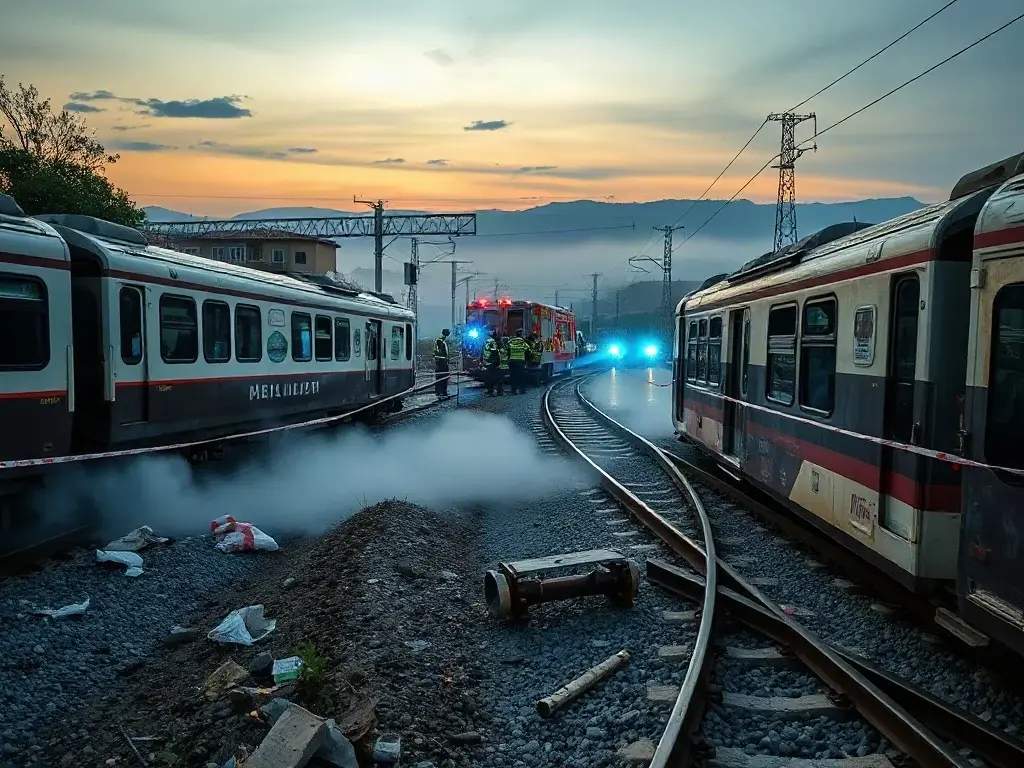
The news that the Spanish transport minister resigns only days after a collision that killed at least 69 people and injured dozens more, south of Madrid, is a political event layered on top of a safety event. The two should not be confused. A resignation is a statement about accountability. It is not a finding about causation. This analysis separates what is established from what is still unknown, and explains what the departure of a senior minister can and cannot tell the public about the state of railway safety in Spain.
The confirmed facts are limited. The collision happened south of the capital, at least 69 people died, dozens were hurt, and the minister left office within days. The reported material does not establish the cause of the crash, the responsibility of any operator or official, or the minister’s stated reasons beyond the resignation itself. Anything beyond that is interpretation, and this article labels it as such.
What is known about the Spain train crash so far
The Spain train crash is already among the deadliest rail disasters in the country’s recent history, judging by the reported death toll. For comparison, the 2013 Santiago de Compostela derailment killed 79 people, and the 2006 Valencia Metro derailment killed 43. A toll of 69 or more places this event in that same tier of national trauma, and it explains why political consequences arrived so quickly.
The word ‘collision’ matters
The reporting describes a collision, not a derailment. The distinction is technically important. A collision between trains, or between a train and an obstruction, points investigators toward different questions than a derailment does. A derailment usually directs attention to speed, track geometry and infrastructure condition. A collision directs attention to railway signalling, dispatching, protection systems and human decision-making. Until investigators publish findings, any firmer claim is speculation.
What the public does not yet know
- The precise mechanism of the collision.
- Whether train protection systems were functioning and engaged.
- Which operator, infrastructure manager or maintenance contractor, if any, bears responsibility.
- Whether the minister’s resignation reflects a personal admission, political pressure, or a deliberate attempt to protect the government and the inquiry.
Why a transport minister resigns after a rail disaster
The principle behind such resignations is ministerial responsibility: a minister answers politically for the department’s failures, whether or not they personally caused them. In practice, this convention is applied unevenly. Ministers often survive disasters that occur on their watch, particularly when blame can be assigned to an operator, a contractor or an individual employee.
That is why the question why did the Spanish transport minister resign deserves a careful answer. There are three plausible readings, and the available reporting does not allow us to choose between them.
- Acknowledged institutional failure. The minister concludes that the ministry’s oversight, investment or regulatory choices contributed to the conditions for the crash.
- Political containment. The resignation removes a lightning rod and protects the wider Government of Spain and the prime minister from sustained pressure in the Cortes Generales.
- Investigative independence. The minister steps aside so that inquiries can proceed without any perception of interference by the ministry that oversees the rail system.
These readings are not mutually exclusive, and a resignation within days of a disaster is unusually fast. Speed suggests either that the minister believed the exposure was severe, or that the political cost of staying was rising by the hour. Both are inferences, not facts.
Spain’s rail system under scrutiny
Spain operates one of the largest high-speed rail networks in the world, and its reputation for modern infrastructure is a point of national pride. State operator Renfe runs most passenger services, while infrastructure manager Adif is responsible for the tracks and signalling. This separation between operator and infrastructure manager is standard in European rail. It also means that after any serious accident, responsibility is contested between at least two institutions before the ministry is even considered.
The significance of train protection systems
The central technical question in most collision investigations is whether automatic protection worked. Systems such as ETCS and other train protection systems are designed to stop a train if a driver fails to respond to a signal or exceeds a speed limit. The Santiago de Compostela investigation became a landmark in Spanish rail policy partly because the curve where the train derailed lacked continuous automatic speed enforcement at that point. Whether comparable gaps exist in this case is unknown, but the precedent explains why investigators and critics will look there first.
Mixed networks create mixed risks
Railways that combine high-speed lines, conventional lines and commuter services carry different technology layers on different segments. Railway safety in Spain therefore depends on how well those layers interface, and interfaces are classic locations for failure. This is a structural observation about complex networks in general, not a claim about the specific cause of this crash.
The investigation: what credible answers will look like
Serious rail investigations are slow, and public pressure for immediate answers is rarely compatible with technical rigour. Under European rules, independent national investigation bodies examine serious accidents, and the European Union Agency for Railways has a coordinating role in safety oversight. Readers can consult the agency’s official site at era.europa.eu for the regulatory framework.
A credible investigation will typically examine:
- Data from onboard recorders and trackside systems.
- Signalling logs and dispatcher communications.
- Driver training, working hours and fitness records.
- Maintenance history of both rolling stock and infrastructure.
- Organisational factors, such as how safety warnings were escalated and handled.
The last item is the most politically sensitive. The Eschede disaster in Germany is a frequently cited example of a technical failure that investigators connected to broader design and inspection decisions, not simply to a single broken component. Organisational findings are exactly what can turn a resignation from a political gesture into a substantive accountability moment, or expose it as a premature one.
Resignation as accountability: strengths and limits
What a resignation achieves
A resignation signals seriousness to victims’ families and the public. It can also reduce the risk that the minister’s presence distorts the inquiry, and it creates an opening for a successor to commission reviews without defending past decisions.
What a resignation does not achieve
It does not identify the cause. It does not fix a signalling gap, a maintenance backlog or a staffing shortfall. It can also create a false sense of closure: if the political story ends with a departure, pressure for the slower, more technical reforms may fade. Critics of ministerial resignations after disasters often make this point, arguing that personal sacrifice substitutes for systemic change. That argument has force, though it is an interpretation and not a measurable result.
The risk of premature blame
There is also the opposite danger. If investigators ultimately attribute the crash to an isolated cause outside the ministry’s control, an early resignation could distort public understanding of where responsibility lies. Fast political decisions and slow technical findings are structurally mismatched, and the public tends to remember the first narrative.
What informed readers and professionals should monitor
For analysts, journalists, rail professionals and citizens trying to evaluate how this develops, a handful of indicators are more informative than the headlines:
- Publication of interim investigative findings. Look for whether they come from an independent body, and how detailed they are.
- Statements from Adif and Renfe. Check whether they address protection systems and maintenance directly or deflect to generalities. Their official sites, adif.es and renfe.com, are the primary sources for company positions.
- The identity and mandate of the successor. A continuity appointment signals a different intention than a safety-focused reformer.
- Parliamentary scrutiny. Whether committees demand documents on past safety warnings.
- Emergency speed restrictions or technical audits. Immediate network-wide measures usually indicate that authorities suspect a systemic issue.
Common mistakes in interpreting events like this
- Treating the resignation as evidence of guilt.
- Assuming the first technical theory in the media will survive the official inquiry.
- Comparing death tolls across countries without accounting for train capacity, occupancy and rescue conditions.
- Ignoring the operator and infrastructure manager while focusing only on politicians.
Likely developments in Spanish rail policy
The following are reasonable predictions, not confirmed facts. First, expect a political debate over rail investment priorities, in particular the balance between building new high-speed capacity and maintaining or upgrading older lines. Second, expect pressure for faster deployment of automatic protection on every route segment, since that was the policy lesson after 2013. Third, expect questions about whether the investigation framework is sufficiently independent of the ministry it may end up scrutinising. After the 2013 crash, similar debates followed, and the outcome depended on how much political will survived once public attention moved on.
Looking further out, the larger pressures on European rail are structural: ageing assets, rising passenger numbers as governments encourage modal shift from air and road, and the increasing complexity of digital signalling. Rail remains statistically among the safest transport modes, but safety statistics offer little comfort when a single event kills dozens. Public trust, once damaged, is rebuilt only through visible and verifiable change.
Frequently asked questions
Why did the Spanish transport minister resign?
The reporting confirms the resignation came days after the crash, but the article provided does not set out a definitive reason. Possible explanations include political responsibility, pressure from opponents or the desire to protect the integrity of the inquiry. Without an official statement or investigative findings, none of these can be treated as established.
How many people died in the Spain train crash?
At least 69 people were killed and dozens injured, according to the initial reports. Casualty figures in major accidents can change as identification and medical updates continue, so the number should be checked against official sources.
Does a minister’s resignation mean the ministry was at fault?
Not necessarily. Resignations reflect political calculations as much as proven fault. Responsibility is determined by independent investigation, and sometimes by judicial proceedings.
What will the investigation examine?
Typically signalling and protection systems, onboard and trackside data, maintenance records, staff training and working conditions, and organisational safety management. Final reports often take many months or longer.
The question the resignation leaves open
The most important insight is that this story has two clocks running at different speeds. The political clock moved in days: a disaster, then a resignation. The technical clock will move in months and possibly years, and it alone can establish why 69 or more people died. The risk is that the fast clock is mistaken for the answer.
Watch for three things: whether the investigation is demonstrably independent, whether the findings assign responsibility beyond individuals to systems, and whether the lessons translate into funded, enforceable changes to protection and maintenance. If they do, the resignation will look like the first step of genuine reform. If they do not, it will look like what many resignations become: a closing chapter on the politics while the engineering questions remain unresolved. The unanswered question is not who left office, but what the inquiry will show that could not be learned from the lessons Spain already had.
Frequently Asked Questions
¿Significa la dimisión del ministro que ya se conoce la causa del accidente?
No. Una dimisión es un acto de responsabilidad política, no una conclusión técnica. Según lo publicado, aún no se han establecido ni la causa del choque ni las responsabilidades de operadores o cargos. Eso solo lo podrá determinar la investigación oficial cuando publique sus hallazgos.
¿Por qué importa que se hable de colisión y no de descarrilamiento?
Porque orienta la investigación hacia preguntas distintas. Un descarrilamiento suele llevar a revisar velocidad, geometría de la vía y estado de la infraestructura. Una colisión apunta más a señalización, gestión de la circulación, sistemas de protección del tren y decisiones humanas. Hasta que haya conclusiones, cualquier explicación es especulación.
¿Cómo se compara este accidente con otras tragedias ferroviarias en España?
Con al menos 69 muertos, se sitúa en la misma magnitud que el descarrilamiento de Santiago de Compostela en 2013, con 79 víctimas, y por encima del metro de Valencia en 2006, con 43. Esa gravedad ayuda a explicar la rapidez de las consecuencias políticas.
¿Es habitual que un ministro dimita tras un accidente ferroviario?
No lo es. Aunque existe el principio de responsabilidad ministerial, se aplica de forma desigual. Muchos ministros siguen en el cargo tras desastres durante su mandato, sobre todo si la culpa puede atribuirse a un operador, un contratista o un empleado concreto. Dimitir a los pocos días es especialmente rápido.
¿Qué motivos pueden explicar la dimisión del ministro?
El análisis plantea tres lecturas no excluyentes: reconocer un fallo institucional en supervisión o inversión, contener el coste político para el Gobierno y el presidente, o apartarse para garantizar que la investigación avance sin sospechas de injerencia. Ninguna está confirmada por la información disponible.
¿Qué sigue sin saberse sobre el accidente?
Se desconoce el mecanismo exacto de la colisión, si los sistemas de protección del tren funcionaban y estaban activados, y qué operador, gestor de infraestructura o contratista de mantenimiento podría tener responsabilidad. Tampoco se conocen los motivos personales que el ministro haya dado para dimitir.