
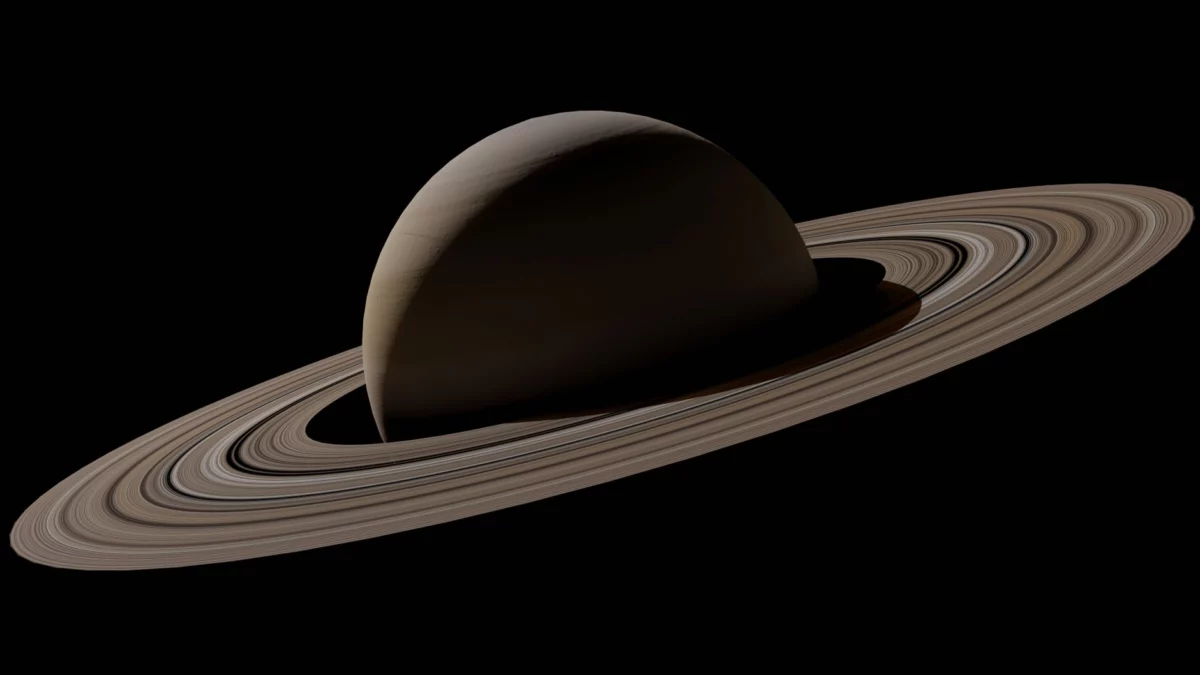
Reports of another striking geometric feature in Saturn’s atmosphere revive a question that has challenged planetary scientists for decades: how can a turbulent gas giant produce shapes that look almost engineered? The best-known example is the Saturn hexagon, a six-sided atmospheric wave surrounding the planet’s north pole. New observations of apparently regular structures are intriguing, but words such as
Frequently Asked Questions
Is Saturn’s hexagon a solid structure or a gap in the clouds?
Neither. The hexagon is a large, persistent atmospheric wave embedded in a high-speed jet stream around Saturn’s north pole. Its visible edges are formed by contrasts in cloud density, haze and wind patterns. The six-sided appearance reflects the wave’s dynamics, not a rigid object or an opening in the atmosphere.
Why does the polar jet form a hexagon instead of a circle?
Scientists think differences in wind speed between neighboring atmospheric bands can destabilize an otherwise circular jet. Under suitable conditions, the jet develops a standing wave with six dominant bends. Saturn’s rotation, wind profile and the depth of the flow help determine the number and stability of these bends.
How can Saturn’s hexagon remain stable in such a turbulent atmosphere?
The pattern can persist because it is linked to a powerful, organized jet stream rather than to individual clouds. Clouds and smaller storms change while the underlying wave remains. Saturn’s rapid rotation also organizes atmospheric motion, and the polar location may shield the hexagon from some disruptive interactions affecting weather at lower latitudes.
Why is there no equally prominent hexagon at Saturn’s south pole?
Saturn’s two poles do not necessarily have identical wind speeds, temperature gradients or atmospheric structures. A polygonal wave forms only when the surrounding jet meets particular dynamical conditions. The south pole has a large vortex, but available observations have not revealed the same stable six-sided jet pattern seen in the north.
Can laboratory experiments reproduce Saturn-like geometric storms?
Yes, rotating-fluid experiments and computer simulations can generate polygonal jets and vortices. By changing rotation rates, fluid depth and velocity differences, researchers have produced triangles, hexagons and other regular patterns. These models show that geometry can emerge naturally from fluid dynamics, although no experiment reproduces every detail of Saturn’s deep, complex atmosphere.
Do reports of new geometric features prove that Saturn has additional stable polygons?
Not necessarily. Apparent regularity may result from temporary cloud arrangements, viewing geometry, image processing or waves that do not persist. Scientists must compare observations over time, wavelengths and instruments, then measure winds and motion. A genuinely stable atmospheric polygon should retain a coherent pattern and rotate consistently rather than appearing in only a few images.