
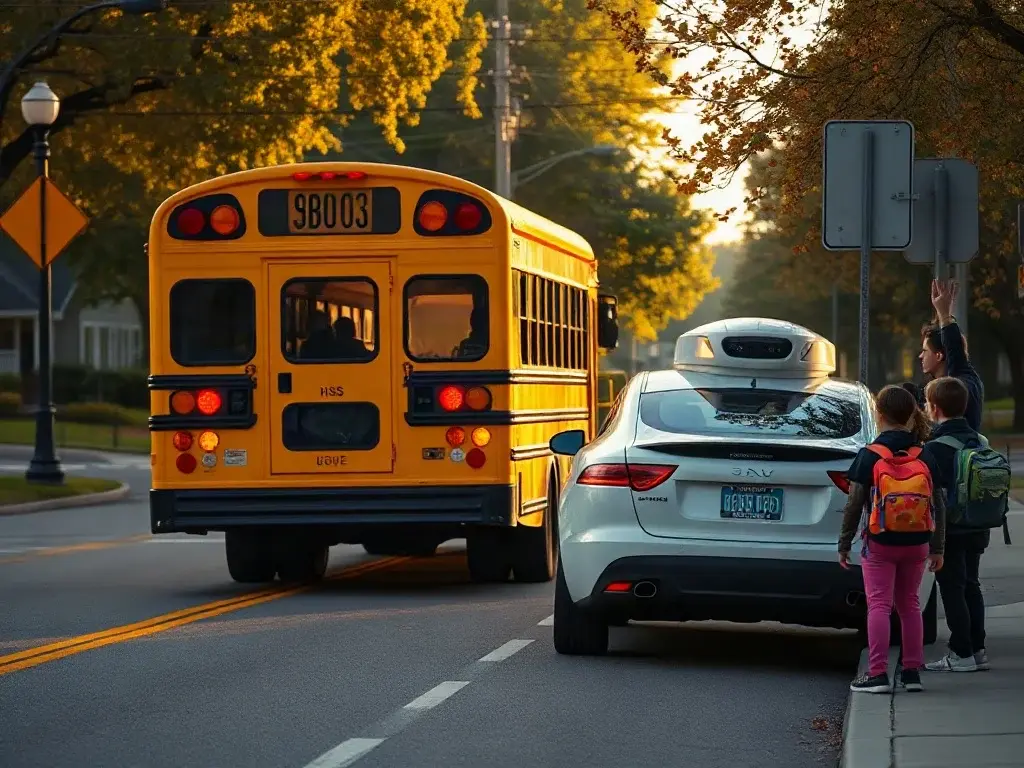
The Waymo school bus recall was supposed to close a troubling chapter for the self-driving industry. Last year, Waymo issued a software recall after several of its autonomous vehicles drove around stopped school buses. Yet reporting indicates the behavior did not fully disappear, and U.S. regulators now want more answers. This article explains what happened, why the problem is harder than it looks, and what it could mean for the future of driverless cars.
A note on sourcing: this analysis draws on the public reporting summarized in the headline, background on the regulatory process, and general knowledge of how autonomous systems work. Specific counts and dates may be updated as the investigation continues, so check primary sources before citing them.
What Happened: The Waymo School Bus Recall in Brief
The central issue is simple to state. School buses that stop to load or unload children extend a stop arm and flash red lights. In general, school bus traffic stopping laws require nearby drivers to stop and remain stopped until the bus resumes moving. Specific rules vary by state, especially on divided roads.
Public reports described Waymo vehicles driving past or around stopped buses in cities including Atlanta and Austin. In Austin, the school district reportedly documented multiple incidents and raised concerns directly with the company. Waymo then filed a voluntary software recall covering its fleet, roughly in the low thousands of vehicles according to news coverage. The latest reporting says the problems continued after the update, which prompted new questions from federal officials.
Why a Recall Does Not Mean a Car Returns to a Shop
A product recall for a robotaxi usually looks different from a traditional automotive recall. Instead of replacing a part, the company pushes an over-the-air update to the driving software. The update can be deployed quickly and at scale. That speed is an advantage, but it also makes it tempting to treat a recall as a finished fix when real-world results have not yet been verified.
Who Is Investigating and Why It Matters
The primary regulator is the National Highway Traffic Safety Administration (NHTSA), which oversees vehicle safety defects and recalls under the Federal Motor Vehicle Safety Standards framework. The agency has the power to open defect investigations, request detailed data, and press companies to expand or redo recalls. You can find its recall and investigation records on the official NHTSA website.
The National Transportation Safety Board also investigates some transportation incidents, but it issues recommendations rather than binding rules. This distinction matters. NHTSA’s Waymo investigation is the more consequential channel, because it can lead to compelled recalls or penalties if a company’s remedy is judged inadequate.
What Regulators Typically Ask
When an agency questions whether a recall worked, it generally wants to know:
- How many violations occurred before and after the software update.
- Whether the company has identified the root cause or only patched the symptom.
- How the remedy was tested, including in simulation and on public roads.
- Whether operations near schools were modified during the fix period.
- How quickly the company responded to complaints from school districts and local officials.
Why Passing a Stopped School Bus Is a Hard Problem
It is tempting to assume a machine would find this rule easy. Stop when the lights flash. In practice, a self-driving car must solve several perception and judgment problems at once.
Perception and Context
The vehicle’s sensors, including lidar and cameras feeding computer vision models, must recognize the bus, detect whether lights are flashing, and see whether a stop arm is deployed. Each of these cues can be obscured by glare, angle, other vehicles, or an unusual road layout. A bus stopped with hazard lights for a mechanical reason looks very different, in legal terms, from a bus loading children.
Legal Nuance Encoded in Software
The rules are not identical everywhere. Some states exempt opposite-direction traffic on roads separated by a physical median. A system trained to be conservative in one setting may behave unpredictably in another. This is where an edge case becomes a repeated pattern: school bus routes, stop locations, and driver behavior differ from one district to the next.
The Problem of Patching Machine-Learned Behavior
Modern driving stacks combine rule-based logic with machine learning. Fixing one failure mode can shift behavior elsewhere, and verifying the fix demands rigorous regression testing. Such testing is only as good as the scenarios included. If a rare configuration is missing from the test library, a recall can appear to work in simulation and still fail on the street.
An autonomous vehicle recall is a claim about future behavior. Only real-world data can confirm it.
Waymo Passing Stopped School Buses: Why the Stakes Are Unusually High
Most driving errors carry risk. School bus violations carry a particular kind of risk, because the people most exposed are children, who may cross the street in front of or beside a bus and are harder for drivers to see. That is why laws around buses are strict and why enforcement tends to be taken seriously.
There is also a trust dimension. Alphabet‘s subsidiary has built its reputation on safety data and on cautious expansion. Waymo publishes safety research on its safety page, and independent analysts have generally treated its crash statistics as favorable compared with human drivers in the areas it operates. Those aggregate numbers, however, do not tell a school district whether a specific scenario, such as a bus stop on a residential street at 7:45 a.m., is handled reliably.
Aggregate Safety Versus Scenario-Specific Safety
This is the heart of the debate. Supporters argue that robotaxis can reduce overall harm because they do not get drunk, tired, or distracted. Critics counter that average safety can hide dangerous failure clusters, and that regulators and communities should insist on near-perfect performance in high-consequence situations. Both positions can be true at once. A system can beat the human average and still be unacceptable around school buses.
Comparing the Regulatory Landscape
The U.S. has no single federal approval process for self-driving software comparable to aircraft certification. Instead, oversight is a patchwork of federal defect authority, state permits, and city-level pressure.
| Level | Role | Typical Tool |
|---|---|---|
| Federal (NHTSA) | Safety defects and recalls | Investigations, information requests, recall oversight |
| Federal (NTSB) | Incident analysis | Investigations and safety recommendations |
| State | Operating permits and traffic law | Permits, citations, rule changes |
| Local / school district | Reporting and public pressure | Incident logs, complaints, public statements |
Other operators have faced scrutiny too. Cruise saw its operations curtailed after a serious incident and questions about transparency, and Tesla has faced its own federal scrutiny over driver-assistance systems. The lesson from those cases is that regulators often care as much about how a company responds as about the original fault.
Practical Takeaways for Cities, Districts, and Fleet Operators
For School Districts
- Log every incident with date, time, location, bus number, and video, and share it with both the operator and regulators.
- Ask operators for written explanations of how their vehicles detect stop arms.
- Request pilot testing around bus routes before expanded service hours.
For Autonomous Vehicle Operators
- Treat school bus interactions as a distinct safety category with its own metrics, not just a subset of general traffic behavior.
- Test across varied bus models, lighting conditions, and road layouts.
- Consider temporary operational restrictions, such as geofencing school pick-up windows, while verification is in progress.
- Publish post-recall performance data so outsiders can judge whether the remedy works.
Common Mistakes
The most common error is declaring a fix complete after internal testing alone. Another is treating the recall paperwork as the end of accountability. A third is underestimating local knowledge: school districts see patterns that national dashboards can miss.
Are Self-Driving Cars Safe Around School Buses?
The honest answer is that it depends on the system, the location, and the evidence available. No public data set cleanly isolates school bus interactions for every operator. What can be said is that the Waymo case shows the technology is not yet uniformly reliable in this specific, high-stakes scenario, and that regulators are treating it accordingly.
Frequently Asked Questions
What was the Waymo school bus recall about?
It was a voluntary software recall prompted by reports that Waymo vehicles drove around stopped school buses. The company updated its driving software to correct the behavior.
Why is NHTSA still looking into the issue?
Reporting indicates that incidents continued after the recall, so regulators are asking whether the remedy was effective and whether the underlying cause was fully understood.
Can a driverless car be ticketed for passing a school bus?
Rules vary by state and are evolving. Enforcement against an autonomous vehicle operator can be legally complex, which is one reason public pressure and federal oversight play a large role.
Does an autonomous vehicle software recall mean the cars were taken off the road?
Not necessarily. Many recalls are fixed through over-the-air updates, and vehicles often continue operating while the update is deployed.
The Question That Will Define Robotaxi Trust
The most important insight from this episode is that a recall is a hypothesis, not a result. Waymo’s software update reflected a sincere attempt to fix a problem, but regulators are now testing whether the evidence supports it. That shift, from accepting company assurances to demanding proof of performance, may become the template for how autonomous vehicles are governed.
Watch for three things next. First, whether NHTSA pushes for a revised or expanded recall. Second, whether Waymo agrees to publish school-bus-specific performance data. Third, whether states and school districts begin setting their own conditions for robotaxi operation near schools. A reasonable prediction is that school zones and bus routes will become a formal benchmark for driverless certification, much as pedestrian detection became a benchmark before. The unanswered question is whether the industry will meet that standard voluntarily or only after regulators force the issue.
Frequently Asked Questions
Why did the Waymo school bus recall not fully solve the problem?
Reporting indicates the behavior continued after the software update. A recall pushed over the air can be deployed quickly, but real-world results still need verification. Regulators want to know whether Waymo found the root cause or only patched the symptom, and how the fix was tested.
Do Waymo vehicles have to go to a shop for a software recall?
No. A robotaxi recall usually means an over-the-air update to the driving software rather than a part replacement. The update can reach the whole fleet quickly, but that speed can make the recall look like a finished fix before real-world performance has been confirmed.
Can NHTSA force Waymo to redo its recall?
Yes. NHTSA can open defect investigations, request detailed data, and press companies to expand or redo recalls. If it judges a company's remedy inadequate, the process can lead to compelled recalls or penalties. That makes it a more consequential channel than the NTSB.
What is the difference between NHTSA and the NTSB in this case?
NHTSA oversees vehicle safety defects and recalls and can compel action. The National Transportation Safety Board investigates some transportation incidents but only issues recommendations, not binding rules. For the Waymo school bus issue, NHTSA's investigation is the one that can lead to enforcement.
Why is stopping for a school bus hard for a self-driving car?
The car must recognize the bus, detect flashing lights, and see whether a stop arm is deployed. Glare, angles, other vehicles, or odd road layouts can hide these cues. A bus with hazard lights for a mechanical problem is legally different from one loading children.
Are school bus stopping laws the same everywhere in the U.S.?
Not exactly. In general, nearby drivers must stop and stay stopped until the bus moves again, but specific rules vary by state, especially on divided roads. This variation adds complexity for autonomous vehicles that operate in multiple cities and must encode local legal nuance in software.