
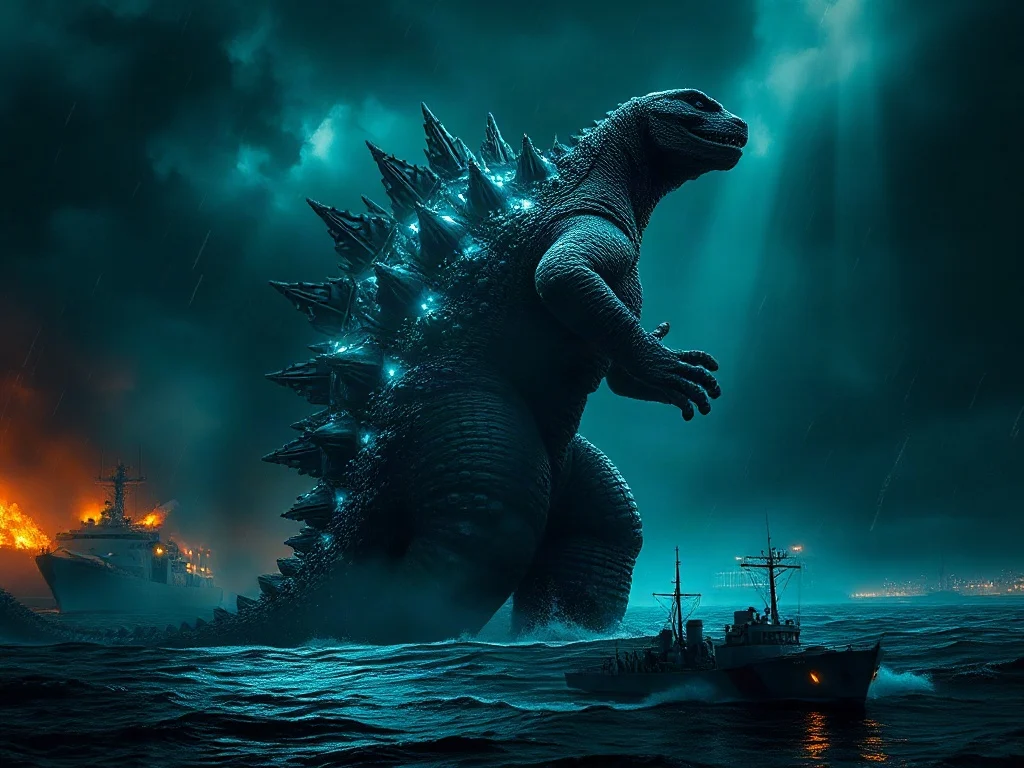
Any list of Godzilla movies ranked from worst to best has to settle an awkward question first: what is a good Godzilla film? With Godzilla Minus Zero arriving in theaters, the debate has returned, and Entertainment Weekly has looked back across the franchise. This article takes a more critical approach. It ranks the series by tier, states its criteria openly, and explains why the same character can produce both a landmark of world cinema and a toy commercial in a rubber suit.
The Godzilla franchise spans seven decades, several studios, and more than thirty live-action Toho features alongside American and animated entries. A single numbered list across that range is partly an exercise in taste. Tiers, with the reasoning shown, are more honest and more useful.
How to Judge Godzilla Films: The Criteria
Quality in this series is not one-dimensional. A film can fail as drama and still succeed as spectacle, and the reverse is also true. This ranking weighs four factors:
- Thematic purpose: whether Godzilla stands for something, such as nuclear dread, pollution, or institutional failure.
- Craft: effects, direction, and pacing, including the charm of practical suitmation.
- Human story: whether the people on screen matter or only serve as scenery for destruction.
- Influence: what the film changed for later entries.
These are editorial judgments, not measurable facts. Readers who weight spectacle over theme will reorder the tiers, and that is a legitimate difference of opinion.
The Origin: Why the 1954 Original Still Defines the Series
The 1954 original, produced by Toho and directed by Ishirō Honda, was a direct response to nuclear anxiety. It followed the 1954 Lucky Dragon 5 incident, in which a Japanese fishing boat was contaminated by fallout from a US hydrogen bomb test. Special effects pioneer Eiji Tsuburaya gave the creature its physical presence, and the film treats destruction as tragedy rather than entertainment.
That tonal seriousness is the benchmark against which every later film is measured. Many sequels abandoned it, and the strongest recent entries have deliberately recovered it.
The Bottom Tier: Films That Misread the Monster
The Cynical and the Unfocused
The weakest Godzilla films tend to fail in one of two ways. Either they treat the character as a brand to be managed rather than a symbol to be explored, or they pile on monsters without a story to hold them together.
The 1998 American Godzilla, directed by Roland Emmerich, is the clearest example. It recast Godzilla as a fast, evasive animal that behaves more like a giant iguana than a force of nature. Fans and critics rejected the design and the tone, and Toho later distinguished its own Godzilla from the American creature by renaming the 1998 version Zilla. It is a useful case study because it shows that the character’s core identity is not infinitely flexible.
Several late Showa-era entries also sit here. All Monsters Attack (1969) leans on stock footage and a child-fantasy framing, and Godzilla vs. Megalon (1973) reflects a franchise running on shrinking budgets. These films are not worthless, but they are easier to enjoy as camp than as cinema.
Polarizing Rather Than Bad
Godzilla: Final Wars (2004) is more difficult to place. It is a maximalist anniversary spectacle, loud and stylized, and it divides audiences sharply. Viewers who want gravity will find it hollow, while those who want a kaiju free-for-all may find it thrilling. It belongs in the lower middle for its lack of restraint, not for lack of ambition.
The Middle Tier: Entertaining but Uneven
The largest group of Godzilla films is also the most representative. These movies are watchable, sometimes inventive, and rarely memorable for their human drama.
The Showa-era monster-rally films, such as Destroy All Monsters (1968), deliver pure spectacle. Ebirah, Horror of the Deep (1966) is a brisk adventure that shows how comfortably the series moved toward lighter tones in the 1960s.
The American MonsterVerse belongs here too. Godzilla (2014), directed by Gareth Edwards, has real awe in its staging and scale, but it withholds the monster and gives its human characters too little to do. Godzilla: King of the Monsters (2019) reverses the problem with abundant monsters and thin characters. Godzilla vs. Kong (2021) knows exactly what it is: a crowd-pleasing clash with little pretense.
The Upper Tier: Where Godzilla Means Something
Films With a Thesis
The best entries share one trait: Godzilla is a vehicle for a specific idea. Godzilla vs. Hedorah (1971) is strange, psychedelic, and uneven, yet its pollution theme gives it more identity than many technically smoother films. Godzilla vs. Biollante (1989) engages with genetic engineering and treats its science-fiction premise as more than window dressing.
The 1954 original remains near the top for the reasons outlined above, and its American recut, Godzilla, King of the Monsters!, shows how much meaning a re-edit can strip away, even with Raymond Burr added as an English-language anchor.
Shin Godzilla and the Bureaucratic Horror
Shin Godzilla (2016), co-directed by Hideaki Anno, reframes the monster as a crisis that exposes government dysfunction. Its rapid-fire meeting scenes may alienate viewers who expect action, but the satire is deliberate, and the film is widely read as a commentary on disaster response. It is arguably the most intellectually ambitious entry since 1954.
Godzilla Minus One: The Modern Benchmark
Godzilla Minus One (2023), directed by Takashi Yamazaki, set a new standard by putting its survivors at the center. Set in postwar Japan, it asks what people owe the living and the dead, and it treats the monster as the physical form of unresolved trauma. It also won the Academy Award for Best Visual Effects, the first Oscar win for a Godzilla film, which the Academy of Motion Picture Arts and Sciences recognized at the 2024 ceremony. Its influence on how the series is discussed is hard to overstate.
Where Godzilla Minus Zero Fits
As a follow-up to Minus One, Godzilla Minus Zero carries unusually high expectations. It inherits a film that proved the franchise could be both a commercial event and a serious drama. Because the film is so new, any definitive placement would be premature, and a ranking written from headlines rather than the finished work would be speculation.
What can be said is how it should be judged. A sequel to a celebrated film faces three tests: whether it extends the theme instead of repeating it, whether its human story earns its place beside the spectacle, and whether it justifies its existence beyond brand momentum. Many franchise sequels fail the first test by restating their predecessor at larger scale. The most informative question for critics is whether Minus Zero deepens the postwar-trauma framework or merely reuses it.
A Practical Viewing Order for Newcomers
Completing all the films is unnecessary. A selective path gives a better picture of the franchise:
- Start with the 1954 original to understand the foundation.
- Watch Shin Godzilla for the satirical, modern Japanese take.
- Watch Godzilla Minus One before any sequel material.
- Sample one Showa-era monster film such as Destroy All Monsters for the playful tradition.
- Try the MonsterVerse if you want the Hollywood version of the spectacle.
The common mistake is to watch chronologically from the start. The early sequels vary widely in tone, and a newcomer can mistake a weak entry for the whole series.
What to Watch for in Any Godzilla Film
- The relationship between the human cast and the creature’s destruction.
- Whether the monster is an animal, a symbol, or a weapon.
- The balance of tokusatsu craft and digital effects.
- How the film treats historical memory, especially nuclear history.
Frequently Asked Questions
How many Godzilla movies are there?
The exact count depends on what is included. Toho has produced more than thirty live-action films, and there are also American productions and animated entries. Official Toho Godzilla resources are the best place to verify the current Japanese filmography.
What is the best Godzilla movie?
Critics most often point to the 1954 original, Shin Godzilla, and Godzilla Minus One. Which is best depends on whether you prioritize historical weight, satire, or emotional drama.
What is the worst Godzilla movie?
There is no consensus. The 1998 American film is widely criticized for misreading the character, while several low-budget Showa-era sequels are criticized for weak storytelling.
Do I need to watch the older films before Godzilla Minus Zero?
Watching Godzilla Minus One first is the sensible preparation, given that the new film is its follow-up. The rest of the franchise is optional context.
The Real Question the Next Decade Must Answer
The pattern across these films is consistent: Godzilla works best when the monster is an argument and worst when it is a logo. The 1954 film, Shin Godzilla, and Minus One are the franchise’s high points because each had something to say about its moment.
That is why Minus Zero matters beyond one release. If it succeeds, it will suggest that audiences will pay for emotional and thematic seriousness in kaiju cinema, not only for scale. If it falters, studios may retreat to the safer formula of bigger fights and thinner stories. Watch the critical reception and the box-office story together, because the gap between them will reveal what the market actually rewards. The unanswered question is whether the franchise can keep finding fresh fears for Godzilla to embody, or whether the symbol will eventually outlast its meaning.