
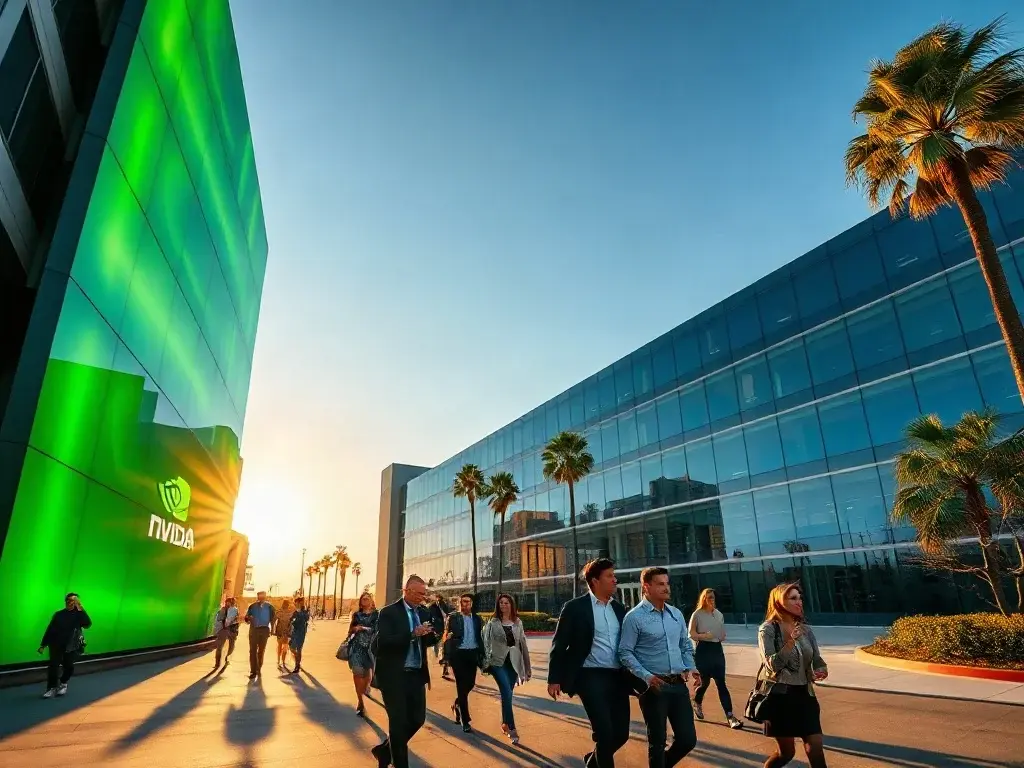
The reaction to Nvidia CEO Jensen Huang at the company’s California base has become a story in its own right. The BBC’s Lily Jamali reported from Nvidia’s headquarters on how staff and observers were responding to Huang’s return after Donald Trump said he had brokered a deal. The short report excerpt does not spell out the terms of that deal, and neither does this article. What it offers is context: why one executive and one political claim can move a company worth trillions of dollars.
What the BBC Report Actually Establishes
The available excerpt gives three facts. The BBC reported from Nvidia‘s headquarters. The focus was how people inside the company reacted to Huang’s return. And Donald Trump said he had brokered a deal.
The wording needs care. Huang co-founded Nvidia in 1993 with Chris Malachowsky and Curtis Priem and has led it ever since, according to the company’s own history. So the headline’s reference to a return does not mean he was replaced. It more plausibly describes his reappearance in the spotlight after a negotiation. Readers should rely on the full BBC report, available through BBC News, for what the broadcaster actually confirmed.
Why Nvidia Leadership Matters So Much
A founder-led company at the center of AI
Few chief executives are as closely identified with a company as Jensen Huang. Under his leadership, Nvidia grew from a maker of gaming graphics processing units into the dominant supplier of hardware for artificial intelligence. Its CUDA software platform locks developers into its ecosystem, which is a large part of its competitive moat.
When a company’s strategy, product roadmap and public identity are tied to one person, that person’s visibility is a signal to employees, customers and investors. Internal reaction to the Nvidia chief executive is therefore a proxy for confidence in the company’s direction.
The geography of the headquarters story
Nvidia is based in Santa Clara, California. Reporting from there captures the workforce’s view as well as Washington’s. Employees often hold significant equity, so shifts in political risk can feel personal as well as professional.
The Trump Deal Claim and the Policy Backdrop
The deal claim matters because Nvidia’s biggest uncertainties are political. Since 2022, Washington has tightened export controls on advanced AI chips bound for China. These rules are administered by the Bureau of Industry and Security. Nvidia has also had to design cut-down products for the Chinese market while Chinese firms such as Huawei push domestic alternatives.
Because the excerpt does not say what the deal covers, any link to chip exports, tariffs or other issues would be speculation. Policy announcements made by politicians have sometimes taken time to become formal rules, and companies typically wait for written guidance. That gap between a claim and implementation is where much of the corporate anxiety sits.
How Investors and Employees Read Signals Like This
- Market capitalization: Nvidia’s market capitalization reflects expectations of continued data center demand, so policy news moves the stock quickly.
- Supply chain exposure: Its advanced chips are manufactured by TSMC in Taiwan, which adds geopolitical risk beyond U.S. policy.
- Customer concentration: Demand from cloud providers building large language models makes growth sensitive to capital spending cycles.
Official figures are in Nvidia’s filings, accessible via its investor relations site. Readers should check them rather than rely on commentary.
Practical Lessons for Following Corporate-Political Stories
- Separate claim from confirmation. A political statement is not the same as a signed agreement or a published rule.
- Look for primary documents. Regulatory notices and company filings outrank commentary.
- Watch for second-order effects. Suppliers, rivals and customers often react before the company does.
- Treat morale reports as qualitative. A reporter’s view of staff mood is a snapshot, not data.
Frequently Asked Questions
Who is the CEO of Nvidia?
Jensen Huang is Nvidia’s co-founder and chief executive. The company has described him as leading it since its 1993 founding.
Did Trump broker a deal involving Nvidia?
The BBC excerpt says Trump claimed he brokered a deal. It does not detail the terms, so check the full report and official statements.
Why does Nvidia attract so much political attention?
Its chips power advanced AI, which governments treat as strategically important, making its sales a matter of national policy.
What to Watch Next
The key insight is that Nvidia’s fortunes now depend as much on diplomacy as on engineering. A founder who is both its chief technologist and its chief negotiator carries that risk personally. The unanswered question is whether any claimed deal becomes written, durable policy or remains a headline subject to reversal. Watch for formal guidance from U.S. regulators, Nvidia’s next earnings commentary, and any response from Beijing. A reasonable expectation, though not a certainty, is that Nvidia will keep diversifying its markets and products to reduce its exposure to a single political decision. Until the terms are public, the mood at Santa Clara is a clue, not an answer.