
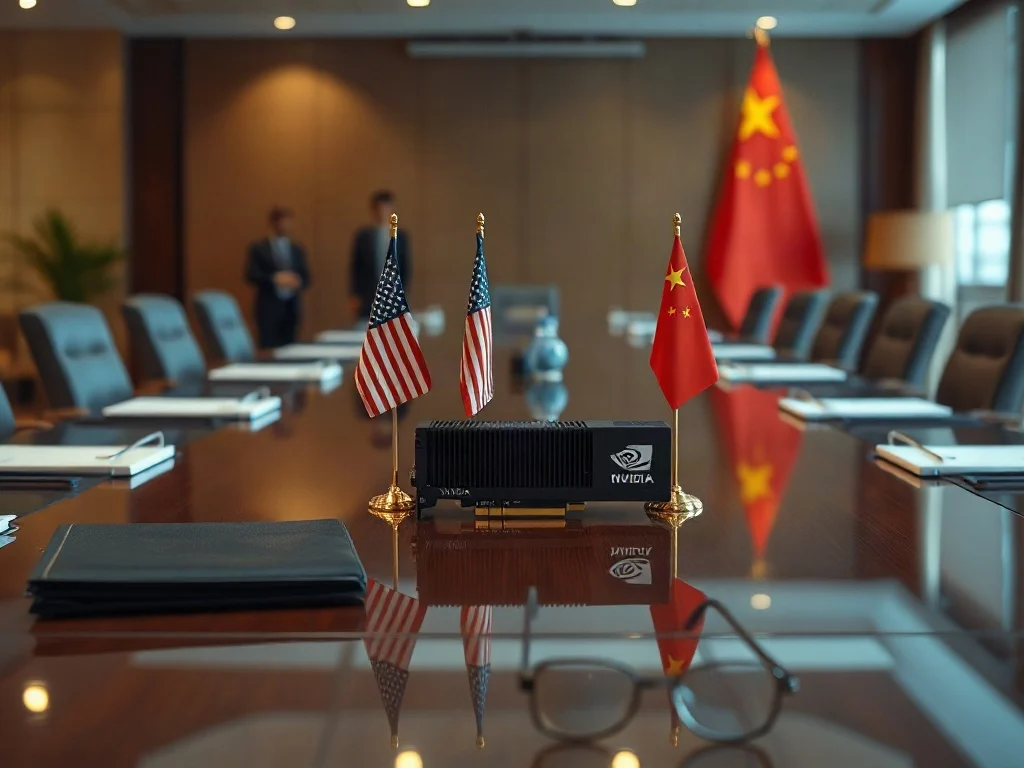
As Donald Trump and Xi Jinping sit down for talks, the Nvidia spy scandal has landed on the table as an unwelcome complication for China’s artificial intelligence plans. According to the report that prompted this analysis, Beijing’s concern is not only the allegations themselves. It is that the affair could hand Washington’s hawks a fresh argument for tighter limits on the sale of advanced chips. The public details of the case are still limited, so this article does not speculate about who did what. It explains the process by which a security scandal can turn into a trade restriction, and why that process matters for China’s AI sector.
Why the Nvidia Spy Scandal Matters at the Summit
Leader-level meetings between Trump and Xi usually revolve around tariffs, rare earths, and market access. Advanced computing has become a fourth pillar of the relationship. The reason is simple: modern AI models depend on enormous quantities of graphics processing units, and the most capable ones are designed by Nvidia, a US company.
A scandal that links Nvidia’s products or personnel to alleged spying changes the political framing. Chip sales stop looking like ordinary commerce and start looking like a national security question. That is the dynamic China reportedly fears, because it strengthens the hand of officials and lawmakers who already favor stricter controls.
Background: How US Chip Export Controls Reached This Point
The 2022 and 2023 rule changes
In October 2022, the US Commerce Department’s Bureau of Industry and Security (BIS) announced rules restricting exports of advanced computing chips and chipmaking equipment to China. The rules sit within the broader framework of export control law and the Export Administration Regulations. BIS tightened them again in October 2023 to close gaps that let slightly modified chips through. Primary documentation is published on the BIS website.
The cat-and-mouse cycle
Nvidia responded to the first rules by designing China-specific products that sat just under the thresholds, including the A800, H800, and later the H20. Each time, regulators reassessed whether the performance cap was set correctly. Companies such as Huawei were placed on the Entity List, and the broader China-US trade war kept technology policy tied to wider bargaining.
Policy in 2025 was reported to be volatile. Licensing requirements for the H20 were reported to have been imposed, then eased, with Nvidia describing significant financial effects from the interruption. Chinese regulators also publicly questioned the security of Nvidia’s China-market chips. Treat these as reported developments and verify the latest status before relying on them, since the rules have changed repeatedly.
How a Scandal Becomes a Restriction: A Step-by-Step Process
Policy changes rarely come from a single headline. The path from allegation to rule tends to follow recognizable stages, though the order and speed vary.
Step 1: An incident reframes the risk
An allegation involving industrial espionage, the theft of a trade secret, or the diversion of controlled hardware shifts the debate. The question stops being whether the controls are economically wise and becomes whether they are being evaded or exploited.
Step 2: Lawmakers and agencies seek leverage
Members of Congress who favor tougher measures cite the incident in letters, hearings, and draft bills. Agencies may open inquiries into compliance. Even without new law, scrutiny of licensing decisions rises.
Step 3: Industry and diplomatic counter-pressure
Chipmakers argue that cutting off a large market funds competitors and weakens US research budgets. Jensen Huang has repeatedly argued in public that excessive restrictions could backfire by accelerating Chinese substitutes. Diplomats weigh whether tougher rules would jeopardize other negotiations, such as trade truces.
Step 4: The administration chooses a response
The realistic options form a spectrum:
- Enforcement-only: prosecute individuals or intermediaries while leaving rules unchanged.
- Targeted tightening: add entities to lists, lower performance thresholds, or require stricter end-use checks.
- Broad restriction: restrict an entire product class or require licenses for all sales.
- Bargaining use: keep access as a concession to be traded in negotiations.
Step 5: Implementation and adaptation
Once rules are published, companies redesign products, buyers look for intermediaries, and regulators detect new loopholes. The cycle then begins again. Smuggling is a persistent enforcement problem for any high-value, small-form-factor item.
Why China’s AI Sector Is Sensitive to Chip Restrictions
The compute bottleneck
Training and running a large language model requires thousands of accelerators working together in a data center. Fewer or slower chips mean longer training runs, smaller models, or higher costs. Chinese labs have shown they can partly compensate with algorithmic efficiency, as the attention around DeepSeek demonstrated. Efficiency gains do not remove the need for hardware at scale, however, especially for serving millions of users.
Domestic alternatives and their limits
China has invested heavily in homegrown chip design and manufacturing. Huawei designs AI accelerators, and SMIC manufactures advanced chips for domestic customers. Three obstacles remain widely discussed by analysts:
- Manufacturing capacity: access to cutting-edge lithography equipment is restricted, limiting yield and volume compared with TSMC.
- Memory: high-bandwidth memory is a critical component and is also subject to controls.
- Software ecosystem: Nvidia’s CUDA platform has years of developer tooling behind it, and migrating away carries real engineering costs.
This is why even a marginal tightening, or just uncertainty, can disrupt purchasing plans for Chinese cloud and AI companies.
Competing Interpretations of the Scandal’s Impact
Analysts disagree about what the affair will actually change. It helps to separate the plausible readings.
- The escalation view: the scandal supplies political cover for tighter controls, and China’s concern is justified.
- The enforcement view: authorities treat it as a compliance matter, producing audits and prosecutions rather than new rules.
- The bargaining view: because Trump has treated chip access as negotiable in the past, the scandal may simply raise the price Beijing must pay for easier access.
- The self-reliance view: Beijing may use the episode to justify discouraging purchases of Nvidia products and favor domestic suppliers, regardless of what Washington does.
None of these is established fact. They are scenarios, and the evidence for each will depend on how the case develops and on what the two leaders agree or fail to agree on.
Practical Implications for Companies and Investors
Organizations exposed to the AI hardware supply chain can reduce risk without guessing the outcome. Useful monitoring and preparation steps include:
- Track primary sources: follow BIS rule notices and Entity List updates rather than relying on secondary summaries.
- Audit the supply chain: verify end users and resellers, since diversion through intermediaries is the usual trigger for enforcement action.
- Model scenarios: plan for three cases, no change, targeted tightening, and a broad license requirement, and estimate the revenue or compute impact of each.
- Diversify compute: for AI developers, avoid single-vendor dependence where feasible, including testing frameworks that run on multiple accelerators.
- Separate sourcing from rhetoric: summit statements are signals, not rules. Only published regulations bind companies.
A common mistake is treating each headline as a policy change. Many reported measures are proposals or negotiating positions that never become binding.
What Could Change Over the Next Few Years
Several trends are reasonable to expect, though none is certain. Enforcement against smuggling and diversion is likely to become more technical, with greater emphasis on location verification and customer vetting. Pressure in Congress for codifying controls in statute, rather than leaving them to executive discretion, could grow, making them harder to trade away at summits. China, for its part, will probably keep pushing both domestic substitution and diplomatic efforts to ease restrictions.
The economic stakes cut both ways. Restrictions can slow Chinese model development at the frontier, but they can also shrink a major revenue source for US chip firms and accelerate the build-out of competing ecosystems. Which effect dominates remains an open empirical question.
Frequently Asked Questions
What is the Nvidia spy scandal?
It is the controversy referenced in recent reporting around the Trump-Xi meeting, which Beijing fears could increase US pressure to restrict advanced chip sales. Because details are still emerging, readers should check current coverage from established news organizations for specifics.
How do US chip export controls affect China’s AI development?
They limit access to the most powerful accelerators and to the equipment needed to manufacture them. That raises costs and slows large-scale training, although Chinese firms are adapting through efficiency improvements and domestic chips.
Can a single scandal change export policy?
It can influence the debate and shift political momentum, but rule changes typically require agency action, interagency review, and weighing of diplomatic consequences. A scandal accelerates or stalls decisions more often than it creates them from nothing.
Will China stop buying Nvidia chips?
That is uncertain. Chinese regulators have previously raised security questions about Nvidia products, and Beijing encourages domestic alternatives. But demand for Nvidia‘s software ecosystem and performance remains strong where purchases are permitted.
The Signal to Watch After the Handshake
The most important insight is that chip policy has become a shared hostage of security politics and summit diplomacy. A scandal does not need to be proven in every detail to alter outcomes, because its effect works through perception and political incentives. If Washington responds with enforcement alone, the episode may fade. If it responds with new rules, Beijing’s fear will have been justified, and its push for self-reliance will intensify.
Watch three things in the coming months: whether BIS publishes new rules or additions to the Entity List, whether any chip-access concessions appear in summit follow-up statements, and whether Chinese regulators discourage purchases of Nvidia hardware. The unanswered question is whether export controls remain a durable security tool or become one more bargaining chip, because the answer will shape where the world’s most advanced AI is built.
SEO DATA
Primary Focus Keyphrase: Nvidia spy scandal
Related Keyphrase 2: China AI chip restrictions
Related Keyphrase 3: how US chip export controls affect China’s AI development
Related Keyphrase 4: why does the Nvidia scandal matter for China
Related Keyphrase 5: Trump Xi meeting chip export controls
Primary Keyphrase Synonyms: Nvidia espionage controversy, Nvidia spy case, Nvidia spying affair, Nvidia chip espionage scandal, Nvidia security scandal
SEO Title: Nvidia Spy Scandal: Why It Threatens China’s AI Chip Access
Meta Description: The Nvidia spy scandal lands as Trump and Xi meet. See how scandals become chip export restrictions and what it means for China’s AI plans.
URL Slug: nvidia-spy-scandal-china-ai
Image Filename: nvidia-spy-scandal-china-ai-chips.jpg
Image ALT Text: Nvidia AI graphics card on a table between US and Chinese flags in a conference room
Image Title: Nvidia spy scandal and China’s AI chip access
Image Caption: The Nvidia spy scandal adds pressure to chip export talks between the US and China.
Search Intent: Informational (news-driven, with some commercial investigation interest)
Frequently Asked Questions
Why would a spy scandal lead to stricter chip export controls?
A spy allegation shifts the debate from economics to national security. Lawmakers who already favor tighter limits can cite the incident in letters, hearings and draft bills, and agencies may examine licensing and compliance more closely. That added scrutiny can turn into formal restrictions even without new legislation.
Does the article say who is responsible for the Nvidia spy scandal?
No. The article notes that public details are still limited and deliberately avoids speculating about who did what. Its purpose is to explain how a security scandal can become a trade restriction, and why that process matters for China's AI sector, rather than to assign blame.
What are the A800, H800 and H20 chips?
They are China-specific products Nvidia designed to sit just under US performance thresholds. The A800 and H800 answered the 2022 rules, and the H20 came later. Each time, regulators reassessed whether the caps were set correctly, which created a repeated cat-and-mouse cycle between companies and Washington.
How might tighter controls hurt US companies as well as China?
Chipmakers argue that losing a large market funds competitors and shrinks the budgets that pay for US research. Jensen Huang has said excessive restrictions could backfire by speeding up Chinese substitutes. Diplomats also worry that tougher rules could jeopardize other talks, such as trade truces.
Can I rely on the 2025 H20 licensing details in the article?
Treat them with caution. The article describes the imposition and easing of H20 license requirements, and Chinese regulators' public security questions about Nvidia chips, as reported developments. Because the rules have changed repeatedly, readers should check the BIS website and current sources for the latest status.
Are there responses to the scandal short of new export rules?
Yes. The article describes a spectrum of administration responses. The mildest is enforcement-only: prosecuting individuals or intermediaries while leaving the existing rules unchanged. Heavier options involve tightening the rules themselves, and the choice depends on industry pushback and diplomatic concerns.