
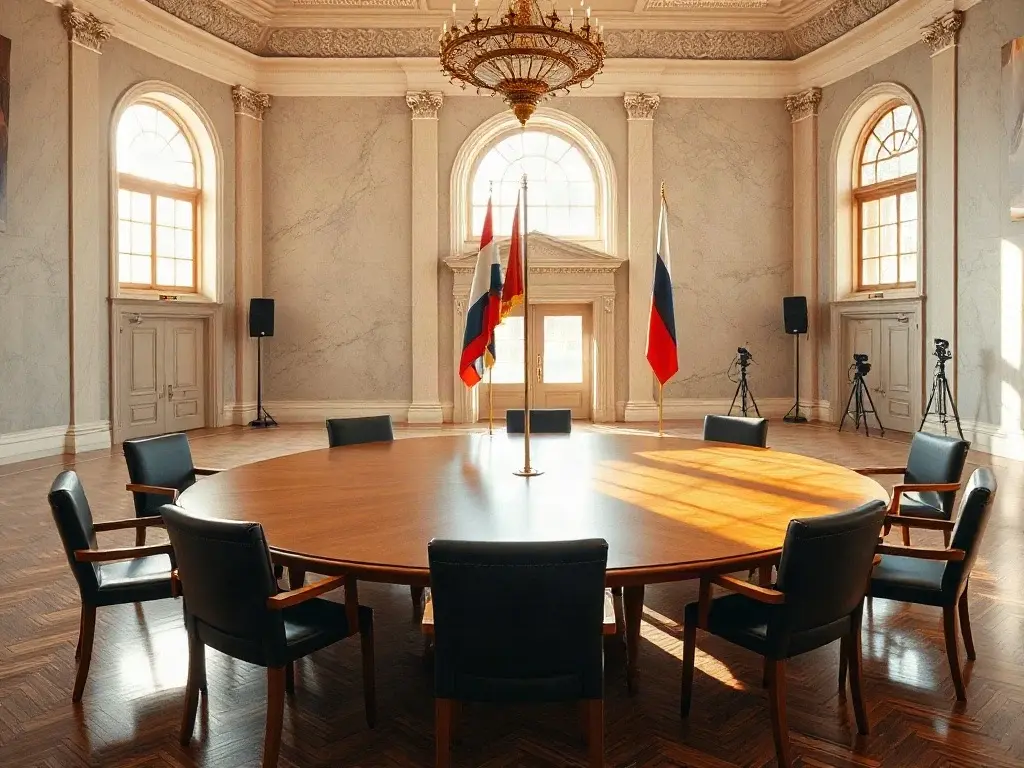
The US China Russia trilateral meeting is being described by the BBC as historic and unprecedented. In a video explainer, the BBC’s Laura Bicker, Steve Rosenberg and Nada Tawfik set out what viewers need to know before the three-way encounter. The video’s short summary does not list an agenda, a venue or a communiqué, so this article does not invent them. It offers a process analysis instead: how a meeting like this is assembled, what each side is likely to want, and how to judge whether it changes anything.
The distinction matters because summits are easy to over-read. A photograph of three powers in one room is a signal. Whether it becomes a settlement depends on a slower sequence of steps, which this article walks through.
What We Know About the US China Russia Trilateral Meeting
The confirmed facts are thin. The BBC frames the event as a first of its kind, and it involves the three states with the largest nuclear arsenals and, together with the UK and France, permanent seats on the United Nations Security Council. Whether “unprecedented” refers to the format, the level of attendance or the subject matter is something the original coverage should clarify.
There are earlier three-power precedents. The wartime Yalta Conference and Potsdam Conference brought leaders together, but those were Allied meetings with a different membership. Cold War diplomacy was largely bilateral: Washington and Moscow negotiated arms limits, while Washington and Beijing opened relations after the Sino-Soviet split. A standing three-way channel among the US, China and Russia has no direct historical equivalent.
How a Trilateral Summit Comes Together: A Step-by-Step Process
Meetings between rivals rarely begin with the principals. Understanding the sequence helps readers separate theatre from substance.
Step 1: Establishing a Shared Problem
Each government must first accept that a problem exists which none can solve alone. Today the strongest candidate is arms control. The United States and Russia hold roughly 90 percent of the world’s nuclear warheads, according to widely cited estimates from the Federation of American Scientists and the Stockholm International Peace Research Institute (SIPRI). China’s arsenal is much smaller but growing. The US Department of Defense’s 2024 China Military Power Report put it at more than 600 operational warheads.
Step 2: Quiet Preparatory Contacts
Officials and envoys usually test positions privately. They agree on who will attend, how the meeting is described publicly and which topics are off the table. The BBC’s decision to publish an explainer “ahead of” the meeting suggests this stage has already passed, but the public detail is limited.
Step 3: Agreeing the Format
The format matters as much as the agenda. A leaders’ summit, a ministerial meeting and an expert working group each carry different expectations. A short opening session might produce only a joint statement of intent. A longer process might create working groups on specific issues.
Step 4: The Meeting Itself
Observers should watch tone, duration, whether bilateral side meetings occur and whether each delegation describes the same event in the same way. Divergent readouts are a common sign that no real agreement was reached.
Step 5: Follow-Through or Fade
The test comes afterwards. Does a second meeting get scheduled? Are technical teams named? Do any commitments appear in writing? Many high-profile summits end at this step.
Why Each Power Comes to the Table
The three governments are unlikely to share motives. The table below summarises plausible interests, drawn from long-standing public positions rather than from the BBC video.
| Country | Likely priorities | Main constraint |
|---|---|---|
| United States | Limits on nuclear and missile competition, a say in the future of strategic stability, trade and technology issues | Domestic politics and alliance commitments in Europe and Asia |
| China | Recognition as an equal great power, protection of its position on Taiwan, resistance to limits on a smaller arsenal | Reluctance to accept caps while its stockpile is still expanding |
| Russia | Sanctions relief, security guarantees, a role as a peer of Washington and Beijing | Isolation and economic strain linked to the Russo-Ukrainian war |
Beijing and Moscow have also drawn closer. The China–Russia relationship was described in a February 2022 joint statement as having “no limits”. Analysts disagree about how deep that alignment runs. Some see a durable partnership. Others see an asymmetric relationship of convenience in which Russia is increasingly the junior partner. A three-way meeting tests which reading is closer to the truth.
Why the Meeting Matters for Nuclear Arms Control
The most concrete reason a trilateral format matters is the erosion of the old bilateral architecture. Treaties such as the INF Treaty have collapsed, and New START, which capped deployed strategic warheads at 1,550 per side, was due to expire in February 2026. Russia suspended its participation in 2023. Without limits and inspections, each side must plan around worst-case assumptions about the others.
A US-Russia deal can no longer settle the question, because a third major power is building up. Washington has argued that China should join future talks, while Beijing has said its arsenal is far smaller and that it will not negotiate on the same terms. That disagreement is the central obstacle, and any trilateral meeting will either narrow it or expose it.
Beyond Warheads
Modern strategic stability involves more than numbers. It also covers hypersonic weapons, missile defence, cyber operations against command systems and space assets. These categories were not part of earlier treaties, so verification mechanisms for them barely exist.
How to Judge Whether the Meeting Succeeds
Readers can apply a simple checklist once the readouts appear.
- Is there a written text? A joint statement, even a vague one, is more meaningful than separate press remarks.
- Is there a next date? Scheduled follow-up meetings suggest a process rather than a photo opportunity.
- Are working groups named? Technical teams do the real bargaining on definitions, verification and data exchange.
- Do the three accounts match? Consistent descriptions point to genuine overlap.
- Does behaviour change? Watch missile tests, military exercises and sanctions announcements in the following weeks.
Common Mistakes When Reading Summits
- Treating attendance as agreement. Rivals meet because the cost of not talking is rising, not necessarily because they have converged.
- Assuming symmetry. The three countries differ in arsenal size, economic leverage and alliance networks, so “equal” terms may look unequal to each of them.
- Ignoring spoilers. Events in Ukraine, the Taiwan Strait or the South China Sea can derail progress quickly.
Risks, Limits and Expert Disagreement
Experts differ on whether a trilateral format is a breakthrough or a complication. Optimists argue that bringing all three into one room is the only realistic route to updating arms control for a world that is no longer bipolar. They point to the logic of mutual assured destruction, which has historically pushed rivals towards limits. Sceptics note that three-body bargaining is harder than two-body bargaining. Each side must weigh not only what the other two do, but also how they might coordinate against it. China and Russia may present a united front, which would leave Washington negotiating against a bloc.
There are also risks of perception. US allies in Europe and Asia may worry that great powers are deciding matters over their heads, a concern with echoes of Yalta. Smaller nuclear states, and the wider Non-Proliferation Treaty community, may see a closed three-power club as a sign that disarmament commitments are being sidelined.
Frequently Asked Questions
Why does the US China Russia meeting matter?
It brings together the three most militarily powerful states at a time when the main arms control treaties have lapsed or been suspended. Any understanding, even a limited one, could affect nuclear risk, trade tensions and conflicts in Europe and Asia.
Is this the first meeting between the three countries?
The BBC describes it as unprecedented in its format. Leaders of these countries have met in other settings, including multilateral summits, but a dedicated three-way meeting on this scale is described as new.
Will the meeting produce a treaty?
Very unlikely in the short term. Treaties usually take years of technical negotiation. A realistic first outcome is an agreement to keep talking and to set up working-level channels.
Where can I watch the BBC explainer?
The video is published by BBC News and features Laura Bicker, Steve Rosenberg and Nada Tawfik.
The Real Test Comes After the Cameras Leave
The most important insight is that the first three-way summit between these powers is an opening move, not a resolution. A single meeting cannot reconcile a growing Chinese arsenal, a Russia under sanctions and a United States trying to manage both. What it can do is establish whether a standing channel is possible. In a world in which nuclear arms competition is resuming without the guardrails of the late twentieth century, even a modest channel would be significant.
Watch three things in the coming months: whether a second round is scheduled, whether China accepts any form of data exchange on its arsenal, and whether the war in Ukraine is treated as a separate track or allowed to block everything else. The unanswered question is whether three rivals that each distrust the other two can build a process durable enough to survive the next crisis. If the answer is yes, this meeting will be remembered as a turning point. If not, it will be remembered as a photograph.
Frequently Asked Questions
Does the BBC video say what the three leaders will actually discuss?
No. The video's short summary does not list an agenda, venue or communiqué, and this article avoids inventing them. Arms control is described only as the strongest candidate for a shared problem, based on public positions, so readers should wait for official readouts before assuming any topic.
Why is arms control considered the most likely topic?
The United States and Russia hold roughly 90 percent of the world's nuclear warheads, according to FAS and SIPRI estimates. China's arsenal is smaller but growing, with the Pentagon's 2024 report citing more than 600 operational warheads. That makes a two-party framework look increasingly incomplete.
How is this different from Yalta and Potsdam?
Yalta and Potsdam were wartime Allied meetings with a different membership, and Cold War diplomacy was mostly bilateral. Washington and Moscow negotiated arms limits, while Washington and Beijing opened relations separately. A standing three-way channel among the US, China and Russia has no direct historical equivalent.
How can I tell whether the meeting produced real agreement?
Watch whether each delegation describes the event in the same way, since divergent readouts often signal no real deal. Also look at tone, duration, side meetings, and whether commitments appear in writing, technical teams are named or a second meeting is scheduled.
Why do many high-profile summits fail to change anything?
The article notes that the real test is follow-through. A photograph of three powers in one room is a signal, but a settlement depends on slower steps such as working groups, written commitments and further meetings. Many summits stop before reaching that stage.
Do the three countries want the same things from the meeting?
Unlikely. The US is described as prioritising limits on nuclear and missile competition, strategic stability, trade and technology. China seeks recognition as an equal great power, protection of its Taiwan position and resistance to limits on its smaller arsenal. Each faces different domestic and alliance constraints.