
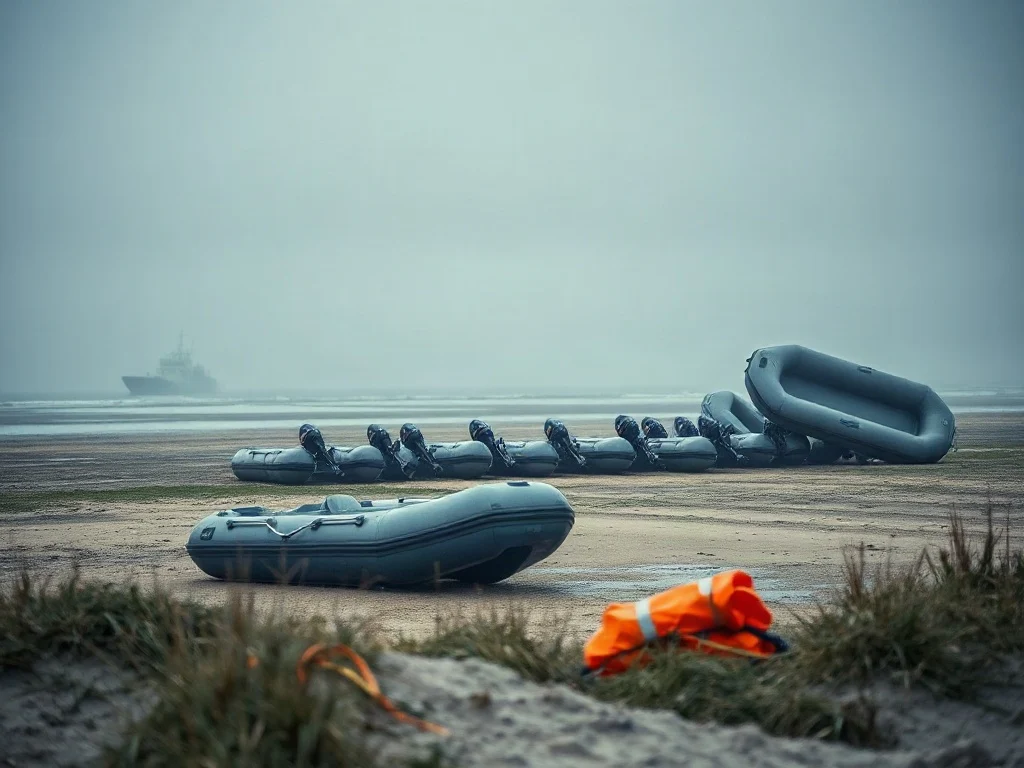
A BBC investigation has put a small boats supplier under the spotlight. Reporters confronted Marvin Reuter, a German man suspected of supplying migrant smuggling gangs, after claims that nearly a third of Channel crossings in early 2026 allegedly involved boats or engines from his firm. These are allegations and suspicions, not proven facts, and the BBC’s reporting as summarised here does not establish guilt. If the figure holds up, it points to a much more concentrated supply chain than the public image of a chaotic, fragmented trade suggests.
Why the Supply Chain Matters More Than the Beach
Most debate about Channel migrant crossings focuses on what happens on the French coast or in UK waters. Yet every crossing depends on equipment that must be manufactured, bought, stored and moved long before it reaches a launch point. Seen this way, human smuggling is a logistics business, and logistics can be disrupted upstream.
The vessels are typically light inflatable boats powered by an outboard motor. Both are legal, widely traded goods. That is the central difficulty for investigators: nothing about a dinghy or an engine is illegal in itself, so prosecutors must show that a seller knew, or should have known, where the equipment was going.
What the Allegation Says
According to the BBC’s headline claim, a single firm’s products were allegedly linked to almost one in three crossings in early 2026. The article summary does not set out how that share was calculated, so readers should treat the figure as an allegation until the methodology and any official response are published.
Background: A Crisis Shaped by Enforcement Cycles
Crossings in small boats rose sharply after 2018 and passed 45,000 in 2022, the highest annual total on record. The UK’s Home Office, Border Force and the National Crime Agency have worked with French police and Europol to target smuggling networks, while Frontex tracks wider European routes.
Law enforcement has repeatedly found that pressure on one part of the chain shifts activity elsewhere. Crackdowns around Calais have pushed launches along the coast, and smugglers have adapted by changing boat designs, engine sizes and passenger numbers. A concentrated supplier would be a potential choke point, but also a single point of failure that gangs would try to replace quickly.
Why Suppliers Are Hard to Prosecute
Legal Hurdles
The principle of the presumption of innocence applies fully here. A firm can sell lawful goods to intermediaries without knowing the end use. Proving criminal intent usually requires evidence such as messages, payment patterns, unusual bulk orders or deliveries to known smuggling hubs.
Cross-Border Complications
A German business, French launch sites and UK enforcement mean three legal systems are involved. Jurisdiction, evidence sharing and extradition can slow cases for years. Payments may also pass through informal channels that complicate efforts against money laundering, and the wider picture fits the pattern of organised crime.
What Investigators and Retailers Can Do
- Monitor bulk purchases: unusual orders of identical inflatable boats and engines are a recognised red flag.
- Strengthen know-your-customer checks: sellers can verify buyers and flag orders inconsistent with normal leisure or commercial demand.
- Share intelligence: links between manufacturers, couriers and launch sites are easiest to see when agencies pool data.
- Follow the money: payment trails often reveal more than the boats themselves.
A common mistake is to assume that removing one supplier ends the trade. Evidence from earlier enforcement cycles suggests networks substitute suppliers quickly unless several links are hit at once. Policymakers should also be wary of a single headline statistic and ask how attribution was established, whether boats were matched by serial number or design, and what share of crossings could not be attributed at all.
Frequently Asked Questions
Who is Marvin Reuter?
He is a German man whom the BBC says is suspected of supplying migrant smuggling gangs, and whose firm is alleged to be linked to boats or engines used in nearly a third of early 2026 crossings. The claims are allegations.
Is it illegal to sell inflatable boats and engines?
No. These are lawful products. Liability generally depends on proving that a seller knowingly supplied smuggling operations.
Would stopping one supplier stop the crossings?
Probably not on its own. Smuggling networks have historically adapted, though disrupting a dominant supplier could raise costs and cause delays.
The Question That Will Decide What Happens Next
The most important insight is that attention is moving from the beaches to the factories, warehouses and payment systems behind them. If authorities can show that one firm sat so centrally in the trade, supply-side enforcement could become a major tool alongside patrols and border deals. Watch for three things: any formal response from the company, whether German and UK prosecutors open or confirm investigations, and whether crossing patterns change if supply is disrupted. The unanswered question is whether the concentration is real. If it is, the trade is more vulnerable than assumed. If it is not, the claim shows how hard it is to measure an illicit supply chain from the outside.
Frequently Asked Questions
Does the BBC report prove that Marvin Reuter or his firm broke the law?
No. The claims are allegations and suspicions, not proven facts. The presumption of innocence applies, and the summary of the reporting does not establish guilt. Prosecutors would still need evidence of criminal knowledge or intent, and the firm's response and the investigation's methodology have not been fully set out.
Why is it so hard to prosecute someone for selling dinghies and outboard engines?
Inflatable boats and engines are legal, widely traded goods. A seller can supply intermediaries without knowing their end use, so prosecutors must show the seller knew or should have known the equipment was bound for smugglers. This usually needs messages, payment patterns, unusual bulk orders or deliveries to known smuggling hubs.
Would shutting down one supplier stop Channel crossings?
Probably not for long. Past enforcement cycles show that smuggling networks replace suppliers quickly unless several links in the chain are hit together. A concentrated supplier could be a choke point, but it is also a single point of failure that gangs would try to substitute rapidly.
How reliable is the claim that nearly a third of crossings used this firm's products?
It should be treated cautiously for now. The summary does not explain how the share was calculated. Key questions include whether boats were matched by serial number or design, and what proportion of crossings could not be attributed at all. Methodology and any official response would help test the figure.
Why do three countries' legal systems complicate a case like this?
A German business, French launch sites and UK enforcement involve three jurisdictions. Evidence sharing, jurisdiction disputes and extradition can slow cases for years. Informal payment channels also complicate money-laundering investigations, so cooperation between agencies such as the NCA, French police and Europol becomes essential.
What practical steps can retailers and investigators take to disrupt the boat supply chain?
Retailers can run stronger know-your-customer checks and flag orders inconsistent with normal leisure or commercial demand. Investigators can monitor bulk purchases of identical boats and engines, pool intelligence across agencies on manufacturers, couriers and launch sites, and follow payment trails, which often reveal more than the boats.