
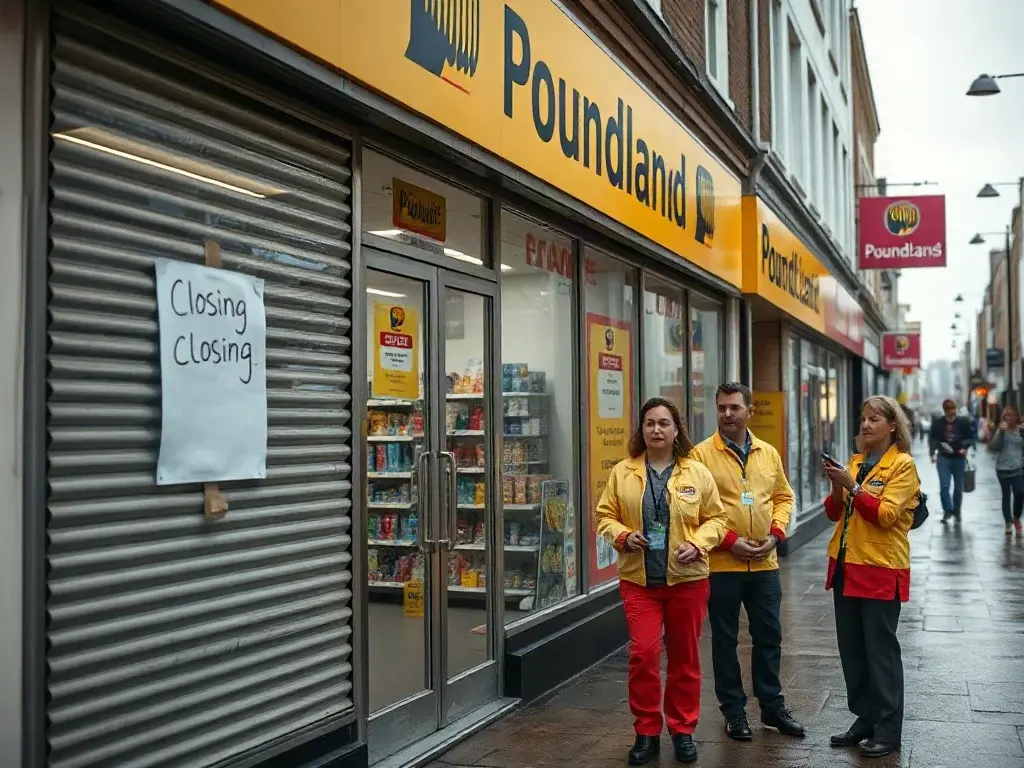
The Poundland administration marks one of the most significant retail failures in recent British history. The discount chain has collapsed after its owners failed to find a buyer, putting around 11,000 jobs at risk. For staff, suppliers, landlords and shoppers, the immediate question is what happens next. The longer-term question is what the failure of a business built on low prices says about the state of the UK high street. This article explains the process, the likely consequences and the warning signs behind the collapse.
How Poundland Reached Administration
Poundland opened its first store in Burton upon Trent in 1990 and grew into a national chain built on a single-price promise. It was later acquired by Steinhoff International, whose accounting scandal left the wider group in financial difficulty. The business then became part of Pepco Group, and its ownership has changed since.
According to the news report, the owners tried to sell the business as a going concern and found no buyer. Without a rescue deal or new funding, administration became the only route left. Administration does not necessarily mean every store closes at once, but it does mean the business is now under the control of insolvency practitioners rather than its former owners.
What Administration Means in Practice
The legal process
When a company enters administration, an appointed administrator takes control. Their duty is to pursue the best outcome for creditors. That can mean rescuing the company, selling it in whole or in part, or selling off its assets. Broader insolvency law sets the order in which creditors are paid, and ordinary suppliers and unsecured creditors often recover only a fraction of what they are owed.
Possible outcomes for stores
- Sale of the business: a rival or investor buys the brand and a reduced store estate.
- Sale of individual leases: competitors take over the most profitable sites.
- Wind-down: stock is sold off and all stores close.
In administrations, the most likely result is a partial rescue in which loss-making stores close and viable ones are sold or reopened under new ownership.
Poundland Jobs at Risk: What Employees Should Know
With 11,000 Poundland jobs at risk, the human cost is the most urgent part of the story. A layoff on this scale would hit communities where discount stores are often one of the few large local employers.
Employees made redundant when an employer becomes insolvent can usually apply to the government for statutory redundancy pay, notice pay and some unpaid wages through the Insolvency Service. The official guidance is on GOV.UK pages covering redundancy rights and how to claim redundancy pay when an employer cannot pay. Staff should keep payslips and contracts and follow the administrators’ instructions on claims.
Why the Discount Model Came Under Pressure
Poundland’s collapse is not simply a story of a weak brand. Several pressures hit discount retailers at the same time.
- Cost inflation: a fixed or tightly capped price point leaves little room when inflation raises the cost of goods, freight and energy.
- Labour costs: increases in the minimum wage and employer National Insurance contributions weigh heavily on labour-intensive store networks.
- Competition: chains such as B&M, Home Bargains and Aldi offer broader ranges, often in better-located stores.
- Legacy leases: long commitments on weaker sites make it hard to adapt quickly.
There is a genuine debate among analysts about the relative weight of these factors. Some blame the macroeconomic environment, while others point to management and strategy. Both explanations are probably partly right, and the full picture will only emerge from administrators’ reports and company filings.
A Pattern of High Street Failures
Poundland joins a list of well-known names that have failed, including Woolworths, BHS, Poundworld and Wilko. The Wilko and Poundworld cases are the closest comparisons because they were also low-price general merchandise retailers. In those cases, administration led to rapid store closures and only partial rescues of brands and sites.
The lesson is that a recognisable name does not guarantee survival. A high street chain needs a cost base that matches its sales, and few discounters have achieved that in recent years.
What Shoppers, Suppliers and Landlords Should Do
- Shoppers: check the terms on gift cards, refunds and vouchers, as administrators often stop accepting them.
- Suppliers: register as creditors promptly and review credit exposure to other struggling retailers.
- Landlords: assess which units might be bought by rival discounters and which may stay empty.
Frequently Asked Questions
Will all Poundland stores close?
Not necessarily. Administrators may sell some or all of the business, and the outcome depends on whether any buyers emerge for the brand or individual leases.
What happens to employees when a company goes into administration?
Staff usually remain employed until administrators decide otherwise. If they are made redundant, they can claim statutory payments through the government’s redundancy scheme.
Can I still use a Poundland gift card?
This depends on the administrators’ decision, which can change quickly. Check official company announcements before relying on a card.
The Question the Collapse Leaves Open
The most important insight is that Poundland’s failure is as much a story about fixed-price retail in a high-cost economy as about one company. A chain that failed to find a buyer was judged unattractive even by professional investors, which suggests that the problem lies in the economics of its estate and model, not only in its balance sheet.
The next developments to watch are whether any bidder emerges for the brand, how many stores are sold rather than closed, and how quickly redundancy claims are paid. A reasoned prediction, rather than a confirmed fact, is that the best sites will be absorbed by competitors while weaker locations go dark. If so, the lasting effect may be fewer, larger and more efficient discount stores, and a significant number of lost jobs that no rescue deal will restore.
Frequently Asked Questions
Will all Poundland stores close immediately now that it is in administration?
Not necessarily. Administration puts the business under the control of insolvency practitioners, who look for the best outcome for creditors. That could be a sale of the whole business, a sale of individual leases, or a wind-down. A partial rescue, with loss-making stores closing and viable ones surviving, is considered the most likely result.
Can Poundland staff claim redundancy pay if they lose their jobs?
Usually yes. Employees made redundant because their employer is insolvent can apply to the government through the Insolvency Service for statutory redundancy pay, notice pay and some unpaid wages. Staff should keep payslips and contracts and follow the administrators' instructions on how to make their claims.
Why did a low-price retailer like Poundland fail when shoppers still look for bargains?
Cheap prices do not guarantee profit. A fixed price point leaves little room when the costs of goods, freight and energy rise. Higher minimum wage and employer National Insurance costs add pressure, while rivals such as B&M, Home Bargains and Aldi offer wider ranges. Long leases on weak sites also limit how quickly it can adapt.
What happens to suppliers and other creditors owed money by Poundland?
Insolvency law sets the order in which creditors are paid. Ordinary suppliers and other unsecured creditors often recover only a fraction of what they are owed, and sometimes very little. The administrator's duty is to maximise returns for creditors as a whole, not to protect any single supplier or landlord.
Is the Poundland collapse caused by the economy or by poor management?
Analysts disagree. Some stress the economic environment, including inflation and higher employment costs, while others point to management decisions and strategy. The article suggests both explanations are probably partly right, and the full picture will only emerge from administrators' reports and company filings.
How does Poundland's failure compare with earlier cases such as Wilko and Poundworld?
Wilko and Poundworld are the closest comparisons because they were also low-price general merchandise retailers. Poundland now joins a list of failed high street names that includes Woolworths and BHS, which suggests that the pressures on discount chains are structural rather than unique to one company.