
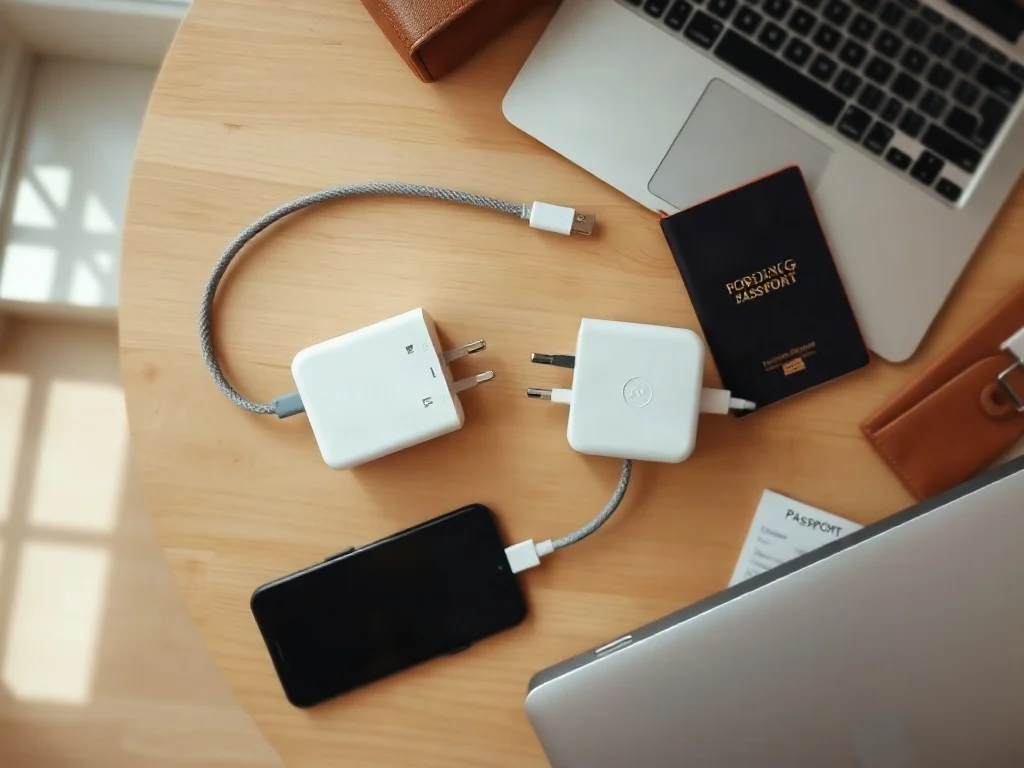
Choosing the best travel adapters comes down to a handful of technical details that most product listings gloss over: which plug shapes your destinations use, how much power your devices draw, and whether the adapter handles modern fast charging safely. Roundups that put 20+ models through hands-on testing, like the 2026 edition behind this guide’s topic, show how much quality varies among products that look nearly identical. This guide explains the engineering behind those differences so you can judge any adapter yourself, whether you are flying to London, Tokyo, or Cape Town.
This article does not repeat anyone’s ranking or invent test results. It gives you a framework for deciding what to buy and how to use it, based on published standards and well-established electrical principles.
What a Travel Adapter Actually Does
A travel adapter changes the physical shape of a plug so it fits a foreign wall socket. It does not change voltage or frequency. That distinction causes most travel charging problems.
Worldwide, mains electricity varies by country. North America generally uses 120 V at 60 Hz, most of Europe and the UK use around 230 V at 50 Hz, and Japan uses 100 V. The utility frequency also differs between regions. Because the standards differ so widely, a plug that fits is not automatically safe for the device on the other end.
Fortunately, most modern electronics use a switched-mode power supply that accepts a wide input range. Check the small print on your charger. If it reads 100-240 V, 50/60 Hz, it is dual-voltage, and a plain plug adapter is all you need.
Adapter vs. converter: the key difference
A voltage converter or transformer physically changes the voltage. You need one only for single-voltage devices, which are typically heating appliances such as older hair dryers, curling irons, and some electric shavers. Many of these now offer a dual-voltage switch, so check the label before buying extra hardware.
Rule of thumb: if the label says 100-240 V, buy an adapter. If it lists only 120 V and you are heading to a 230 V country, leave the device at home or use a purpose-built converter.
Which Plug Types Do You Need?
The AC power plugs and sockets in use worldwide are grouped into lettered types. The International Electrotechnical Commission publishes an official reference through its World Plugs guide, which is the best place to verify a specific country before you travel.
| Plug type | Common regions | Notes |
|---|---|---|
| A / B | US, Canada, Mexico, parts of Japan | Defined in the NEMA connector family; type B adds a grounding pin |
| C / E / F | Continental Europe | The Europlug fits many sockets; Schuko sockets are often recessed |
| G | UK, Ireland, Singapore, Malaysia, Hong Kong | Based on BS 1363, with a built-in fuse |
| I | Australia, New Zealand, China (partly) | Angled flat pins |
Other regions use types D, J, K, L, M, N, and O. Italy, Switzerland, Denmark, South Africa, Brazil, and Thailand are the usual examples. If your itinerary includes any of these, a single-region adapter will not be enough.
What to Look for in the Best Travel Adapters in 2026
Power rating and heat
Every adapter has a maximum current and voltage rating, usually printed on the body. Laptops, phone chargers, and camera batteries sit well within typical limits. Cheap adapters can still run hot or loosen over time if the internal contacts are poorly made. A hands-on test that measures surface temperature under load can reveal weaknesses that a spec sheet never will. When you shop, prefer adapters with clearly stated ratings and recognizable safety certifications, and avoid anonymous listings with vague claims.
USB-C Power Delivery and GaN charging
The biggest shift in travel adapters over the past few years is the built-in charger. Many modern units combine plug-shape conversion with USB-C ports that support USB Power Delivery. The USB Power Delivery specification scales to 100 W under its earlier revisions and up to 240 W with the Extended Power Range added in revision 3.1, which is enough to charge most laptops from a single port if the cable is rated for it.
Compact designs are usually made possible by gallium nitride (GaN) components, which switch efficiently and generate less heat than traditional silicon. A GaN travel charger can replace several bulky bricks. The trade-off is price, and not every GaN product is well engineered. Quality still depends on the design and components.
Port sharing behavior
A charger advertising 100 W total rarely delivers 100 W to every port at once. When you plug in a laptop and a phone, the output typically splits between them. Check the manufacturer’s allocation table. A laptop that needs 65 W will charge slowly or not at all if a second device pulls part of the budget.
Fit, grounding, and socket compatibility
Fit matters more than most buyers expect. In recessed European sockets, wide adapter bodies may not seat fully, and in the UK, heavy adapters can sag out of loose wall outlets. A reliable adapter should hold firmly, keep the grounding connection where applicable, and not block neighboring outlets on a power strip. Remember that a ground connection is not always preserved when a grounded plug passes through a two-pin adapter. This is generally fine for double-insulated electronics but worth understanding for metal-bodied equipment.
Fuses and surge protection
A replaceable fuse is a meaningful safety feature, especially for higher-current devices. Some adapters also include surge protection. This can help in regions with unstable power, though the protection level varies widely and is often poorly documented. Treat marketing claims cautiously unless they cite a specific, verifiable standard.
How a Rigorous Adapter Test Should Work
When a publication tests more than 20 adapters, the useful insights come from comparing like with like. A credible methodology covers several things:
- Socket fit: testing in recessed, loose, and standard outlets, since real hotel rooms and airports vary.
- Measured output: using a USB power meter to verify wattage rather than trusting packaging.
- Thermal behavior: checking how hot the unit gets during sustained laptop charging.
- Port interaction: measuring what happens when multiple devices are connected at once.
- Build quality: assessing prong stability, sliding mechanisms, and how well the unit survives a bag.
Use these same criteria when you read reviews. A review that only photographs the product and lists features is not a test.
Practical Packing Strategies
Match the setup to the trip
For a single-country trip, a lightweight country-specific adapter is often the most reliable and cheapest choice. For multi-country itineraries, a universal adapter with sliding or interchangeable plugs reduces the risk of arriving with the wrong shape. Frequent travelers often carry one high-wattage GaN charger plus a small set of cables rather than multiple chargers.
Carry a power bank, but know the rules
A power bank is a useful backup when outlets are scarce, but the lithium-ion batteries inside are regulated by airlines. Power banks must generally travel in carry-on luggage, and capacities above about 100 Wh typically require airline approval. Check your airline’s current policy before you fly.
Cables are half the equation
An excellent charger paired with a weak cable wastes capability. To charge a laptop at higher wattages you need a cable rated for the power level. Many cables in the wild support only 60 W. Standards like Thunderbolt add data capability but not necessarily higher charging power, so check the specs rather than assuming.
Common Mistakes to Avoid
- Assuming an adapter converts voltage. It does not.
- Plugging a 120 V-only hair dryer into a 230 V outlet through a plain adapter.
- Buying a charger with a high headline wattage without checking per-port output.
- Stacking multiple adapters to bridge incompatible standards.
- Overlooking wattage limits on adapters when running several devices from one power strip.
- Relying on a single adapter for the whole group when traveling with family.
Frequently Asked Questions
Do I need a voltage converter or a travel adapter?
Most phone, tablet, camera, and laptop chargers accept 100-240 V, so a plug adapter is enough. You need a converter only for devices labeled with a single voltage, and those are usually heating appliances.
What is the best universal travel adapter for Europe and the UK?
Look for a model that supports types C, F, and G with a fused UK plug, secure socket fit, and ideally USB-C PD output. Verify its rating against the devices you plan to charge, and confirm destination socket types with the IEC reference.
Can one universal travel adapter work in every country?
Not always. Most cover the major types such as A, C, G, and I, but countries using types D, J, K, L, M, N, or O may require additional plugs. Check your destinations in advance.
Is a GaN travel charger worth it?
If you carry a laptop and a phone, probably yes. GaN chargers are smaller and run cooler than conventional ones at the same wattage, though price and per-port power allocation deserve a close look.
Will a travel adapter protect my devices from power surges?
Only if it explicitly includes surge protection, and even then the level is often unspecified. A plain adapter provides no protection.
Where the Adapter Market Is Heading
The most important insight from this analysis is that the adapter is becoming the least interesting part of the product. The plug-shape problem was solved long ago, and the real differentiation is now in the charger inside: efficiency, power allocation, and thermal design. A good rule is to evaluate the power electronics first and the plug mechanism second.
Several developments are worth watching. The first is the continued spread of high-wattage USB-C charging, which should make dedicated laptop bricks increasingly unnecessary for travelers. The second is whether regulators and certification bodies tighten labeling requirements, since inflated wattage claims remain a problem in the budget market. The third, and the one I would watch most closely, is whether manufacturers begin publishing standardized per-port output data. If they do, the next generation of adapter reviews will be far easier to trust, and far harder to game. Until then, the best protection you have is a short checklist: confirm your devices are dual-voltage, verify the plug types, read the per-port wattage, and buy from brands that document their ratings.