
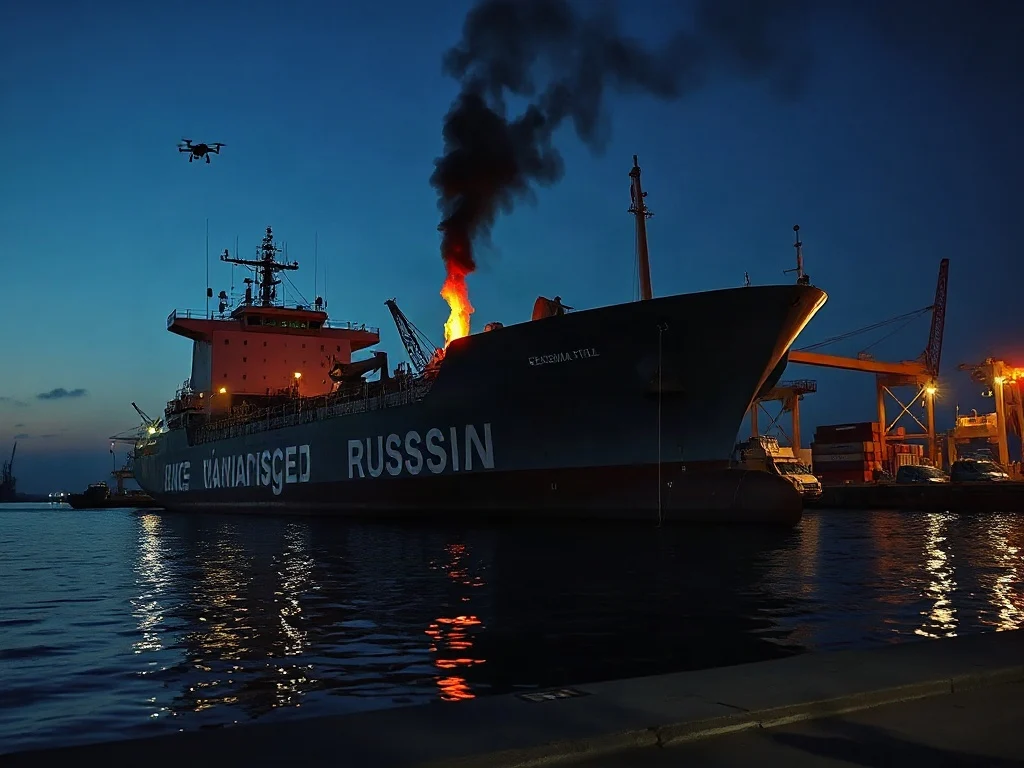
The Russian ship attack in Benghazi landed like a thunderclap over a port city that has spent more than a decade at the edge of other people’s wars. Authorities in eastern Libya said a Russian vessel docked in Benghazi was hit on Sunday in a suspected drone strike. The blast caused no casualties. Nobody has claimed responsibility. The incident arrives as Ukraine intensifies long-range strikes on Russia far beyond the front lines, and that timing is why a single explosion at a Libyan quay deserves close attention.
What We Know About the Benghazi Port Incident
The confirmed facts are thin. Eastern Libyan authorities say a Russian ship was struck while berthed, that an explosion followed, and that nobody was hurt. The cause is described only as a suspected drone attack. The vessel’s cargo, the exact point of impact and the type of munition have not been established in the reporting available so far, and any claim beyond that is speculation.
That caution matters. Early accounts of maritime incidents are often revised, and a suspected drone strike on a Russian vessel could still turn out to involve a different mechanism, such as a limpet charge, sabotage from inside the port, or an accident.
Why Benghazi Matters: A Divided Libya and a Russian Foothold
Libya has been split since the Second Libyan Civil War. The internationally recognized Government of National Unity governs from Tripoli, while the east of the country, the historic region of Cyrenaica, is dominated by the Libyan National Army under Khalifa Haftar. The United Nations Support Mission in Libya continues to work toward political reunification.
Moscow’s Long Courtship of Eastern Libya
Russia has cultivated Haftar’s camp for years. The Wagner Group was reported to have deployed fighters in support of his forces, and Russian-linked personnel have remained in the country in various forms. After the upheaval in Syria cast doubt on the future of the Russian naval facility in Tartus, media and analyst reports pointed to eastern Libyan ports, including Tobruk, as possible alternatives for Russian naval access in the Mediterranean Sea. Those reports describe interest and negotiation, not a confirmed permanent base.
Ukraine’s Expanding Reach: Context, Not Proof
Since the Russian invasion of Ukraine, Kyiv has built an increasingly capable arsenal of long-range systems. Ukrainian forces have struck the Black Sea Fleet with unmanned surface vehicles, and the June 2025 Operation Spiderweb showed how cheap drones can reach strategic targets deep inside Russia.
That context makes Ukraine an obvious suspect in public debate, but it is not evidence. Benghazi lies roughly 2,000 kilometres from Ukraine’s coast, and no party has produced forensic findings linking the strike to Kyiv.
Who Could Be Behind the Strike? Competing Explanations
- Ukrainian action: It would fit the pattern of widening pressure on Russian assets, but it would also mean an unprecedented operational reach into Libya.
- Local or regional rivalry: Armed factions in Libya use combat drones, and a strike could be aimed at Haftar’s patron rather than at Russia’s war effort.
- Sabotage or accident: Explosions in ports have many causes, and a drone attribution can be a first assumption that later proves wrong.
- Deliberate ambiguity: When no one claims an attack, uncertainty itself can serve as a signal.
Risks for Shipping, Ports and Russia’s Mediterranean Strategy
If the strike was deliberate, it suggests that ports hosting Russian-linked vessels are no longer insulated by distance. Insurers and operators dealing with Russia’s oil trade and its so-called shadow fleet may reassess risk premiums, though no data yet shows such a shift. For Haftar, the incident exposes a dilemma: hosting Russian ships brings influence and revenue, but it also draws his territory into a conflict he did not start.
What Professionals Should Monitor
- Official statements from Moscow, Kyiv, Benghazi and Tripoli, and whether any of them confirm the vessel’s identity and cargo.
- Satellite imagery of the berth to assess damage and any change in vessel movements.
- Debris analysis, if released, that could reveal the weapon type.
- Follow-up incidents at other Libyan or Mediterranean ports.
- Changes in insurance guidance for vessels calling at eastern Libyan harbours.
Frequently Asked Questions
Who attacked the Russian ship in Benghazi?
No one has claimed responsibility, and no public evidence identifies the attacker. Eastern Libyan authorities have described only a suspected drone attack.
Were there any casualties?
Authorities reported a blast but no casualties.
Why is Russia present in Libya?
Russia has backed eastern Libyan forces, sought commercial and military access, and reportedly viewed Libyan ports as a way to project power in the Mediterranean and into Africa.
Does this prove Ukraine is striking targets in Africa?
No. Ukraine’s long-range campaign supplies context, but attribution remains unconfirmed.
The Question the Benghazi Blast Leaves Hanging
The most important insight is that the Mediterranean is becoming a secondary theatre in a war centred on Ukraine, and divided Libya is a fragile place to host it. Watch for three things: whether anyone claims the strike, whether Russian vessels keep calling at eastern Libyan ports, and whether Haftar’s camp publicly distances itself from Moscow or doubles down. A reasonable prediction, and only that, is that if similar incidents follow, Libya’s rival governments will find it harder to stay neutral. The unanswered question is whether this was a message to Russia, to Haftar, or to both.