
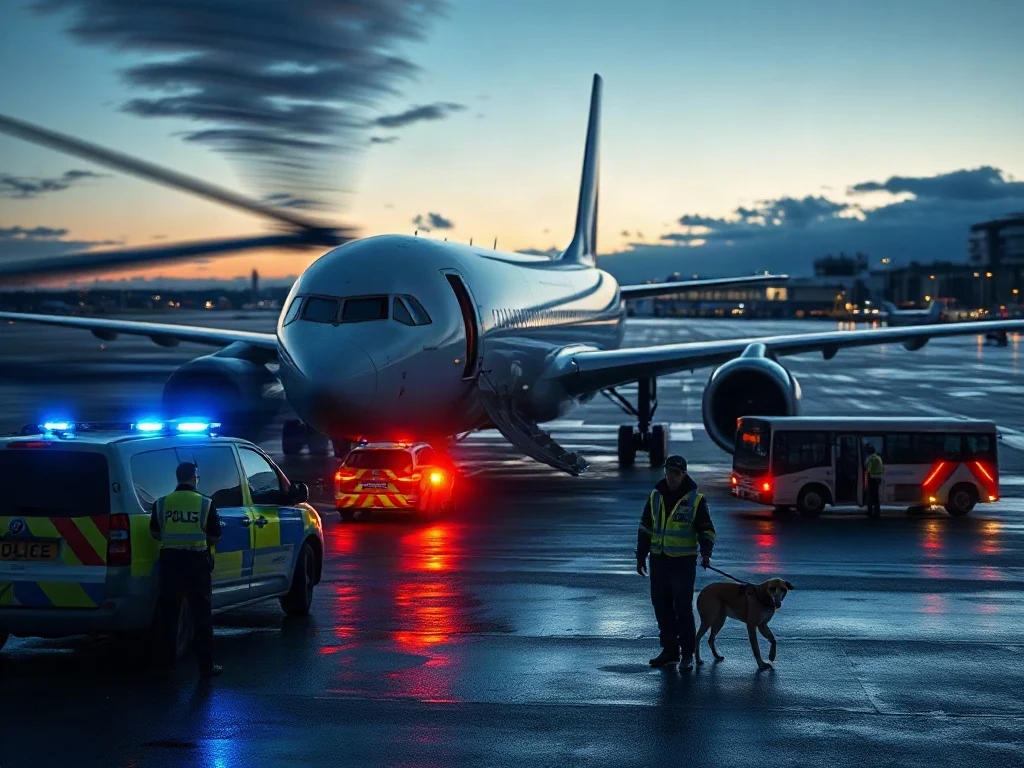
The reports of flight bomb threats in Europe are short on detail but significant in pattern: seven flights were targeted by suspected bomb threats, and aircraft in Poland, Spain, Bulgaria and Italy were checked for explosives after what were described as separate threats. This analysis separates what is known from what is not, explains how aviation security processes handle such warnings, and assesses whether the episode points to a coordinated campaign or to the familiar background noise of hoax calls.
The distinction matters. A bomb threat is cheap to make and expensive to answer. Every one forces an aviation system built on caution to act as though the danger may be real.
What the Reports Establish and What They Leave Open
The confirmed core is narrow. Seven flights were the subject of suspected threats. The affected aircraft were in four countries. The threats were described as separate, and the planes were checked for explosives. Beyond that, important questions remain open, and I will not fill the gaps with speculation:
- Whether any suspicious item was found on any aircraft.
- How each threat was delivered, whether by phone, email, social media or a message to an airline.
- Whether the threats share wording, origin or timing.
- Which operators were affected and how long the delays lasted.
Readers should check these points against statements from national police, airport operators and the airlines concerned. Until then, the word suspected in the headline should be taken literally: these are threats under investigation, not proven attacks and not proven hoaxes.
How Aviation Security Handles a Bomb Threat
Responses to threats against aircraft follow frameworks that are broadly harmonised internationally. The Convention on International Civil Aviation underpins ICAO standards, including security provisions in Annex 17. In Europe, the European Union Aviation Safety Agency handles safety, while aviation security rules are set largely through EU regulation and implemented by national authorities. The ICAO website at icao.int and EASA at easa.europa.eu publish the official frameworks.
Step One: Threat Assessment
When a warning arrives, the first task is to judge credibility, not to search. Assessors consider whether the caller or sender named a specific flight, whether the message shows operational knowledge, and whether it resembles earlier hoaxes. This produces a graded response, but the grading is conservative. A specific threat against a flight that is already airborne or about to board is rarely dismissed outright.
Step Two: Search and Screening
If the aircraft is on the ground, it is typically moved to an isolated stand, passengers and baggage are offloaded, and specialists search the cabin, hold and accessible compartments. This work combines human searchers, detection dogs and technical explosive detection equipment. Where something suspicious is located, bomb disposal teams take over.
| Phase | Main question | Typical consequence |
|---|---|---|
| Assessment | Is the threat specific and credible? | Decision to delay, divert or proceed |
| Isolation | Can the aircraft be separated from people and infrastructure? | Remote stand, apron closure |
| Search | Is there any item or anomaly? | Disembarkation, baggage reconciliation |
| Clearance | Is the aircraft safe to re-enter service? | Rescreening, boarding, new departure slot |
Why Hoaxes Still Carry Real Costs
The temptation is to treat a suspected hoax as a nuisance. That underestimates the damage. Each search can mean cancelled or delayed rotations, missed connections, crew duty-time limits being exceeded, and airport resources diverted from other work. Because aircraft operate in tightly linked schedules, one grounded plane can disrupt several later flights.
There is also a psychological cost. Passengers who are evacuated or held on the ground carry that experience into their next journey, and regular threats gradually normalise disruption. That is arguably the real attraction of the tactic for those who make such calls: the cost of causing disruption is very low, and the response cost is borne by others. The practice resembles swatting in logic, where a false report triggers a heavy emergency response, though the scale and legal framework differ.
Hoaxing is generally a criminal offence in European jurisdictions, and penalties can be severe, but attribution is hard when threats are made anonymously or routed across borders.
Coordinated Campaign or Coincidence?
The most important analytical question is whether these seven threats are connected. The phrase “separate threats” suggests investigators had not, at least at the time of reporting, established a link. Three explanations are plausible, and none can be confirmed from the available information.
Explanation One: Copycat Clustering
Publicised threats can prompt imitation. A visible response at one airport shows a would-be hoaxer that the tactic works, and clusters can follow without any central direction. This is the most statistically ordinary explanation.
Explanation Two: Coordinated Harassment
A single actor or group could send many threats to different airlines or airports in a short window. Shared linguistic features, similar email infrastructure or identical timing would be the evidence investigators look for. Four countries inside the Schengen Area would be a reasonable choice for an actor seeking to test response consistency across borders.
Explanation Three: Hybrid Pressure
Some analysts place incidents like this inside the broader debate on hybrid warfare, where low-cost disruption is used to strain public confidence and institutions. This is an interpretation, not an established finding, and nothing in the reports supports attributing these threats to a state or organised network. Treating the hypothesis as fact would be irresponsible; ruling it out prematurely would be equally careless.
Why Real Attacks Keep Authorities Cautious
The conservative response is not bureaucratic excess. It reflects hard history: the bombing of Pan Am Flight 103 over Lockerbie, the September 11 attacks and the foiled 2006 transatlantic aircraft plot each reshaped screening practice. The lesson built into aviation security is asymmetric: a false alarm costs hours, whereas a missed real device costs lives. Decision-makers therefore accept a high false-positive rate by design.
The weakness of this logic is that it can be exploited. A system optimised never to miss will, by definition, react to any credible-sounding input. The policy challenge is to preserve that safety margin while raising the cost of abuse.
Practical Lessons for Airlines and Airports
Several measures can improve outcomes without lowering safety standards:
- Share indicators quickly. If threats across several countries use the same phrasing, sender infrastructure or timing, rapid cross-border sharing speeds up the credibility assessment. Bodies such as Eurocontrol, which coordinates network operations, can help manage knock-on delays, although threat intelligence itself travels through police and security channels.
- Predefine graded responses. Clear criteria for when a threat triggers a full offload and when a lighter search suffices reduce improvisation and delay.
- Protect passenger communication. Early, plain information limits rumours, social media panic and secondary disruption at terminals.
- Preserve evidence. Retain messages, call recordings and metadata so that prosecutions are possible; deterrence depends on a credible risk of being caught.
Common Mistakes
- Announcing a threat as a hoax before the search is complete.
- Treating each incident in isolation rather than as part of a possible series.
- Poor handling of offloaded baggage, which can complicate reconciliation and restart.
What Passengers Should Do
For travellers, the practical advice is unglamorous. Follow crew and airport staff instructions immediately, leave hand luggage behind only if told to, and avoid circulating unverified claims online. Check your airline’s official channels for rebooking, and keep records of delays, since compensation rights under EU passenger rules can depend on the cause of disruption. Whether a security alert counts as an extraordinary circumstance is a legal question that varies by case, so travellers should consult the airline or national enforcement body rather than assume the outcome.
Where Threat Response Is Heading
Three developments are reasonable to expect, though none is confirmed. First, authorities are likely to put more emphasis on digital forensics, since many modern threats arrive through email, messaging platforms or forms. Second, airlines will probably push for cross-border legal mechanisms that make anonymous threat-makers easier to identify and prosecute. Third, risk-scoring tools, whether human or algorithmic, may be used to triage threats faster, though they bring their own error risks and oversight questions.
There is also a regulatory tension. Stricter obligations on platforms and carriers to preserve and share data could improve attribution, but they raise privacy and proportionality issues that European policymakers have historically debated at length.
Frequently Asked Questions
What happens when a plane receives a bomb threat?
The threat is assessed for credibility, the aircraft is usually isolated, passengers and baggage are offloaded if it is on the ground, and specialists search the aircraft before it is cleared. Detection dogs and technical equipment are commonly used.
How do airlines respond to a bomb threat?
Airlines work with airport operators, police and security services. The aircraft commander and airline security staff follow set procedures, and decisions about delay, diversion or cancellation depend on the assessed credibility and the location of the aircraft.
Are most bomb threats against flights hoaxes?
Reliable aggregated statistics for Europe are not available to me, so I will not give a figure. Hoaxes are widely reported to make up the majority of such incidents, but each threat is treated as potentially genuine until it is resolved.
Can someone be punished for a false bomb threat?
In most European jurisdictions, yes. Penalties and the specific offences vary by country, and prosecution depends on identifying the sender.
The Signal to Watch Next
The most important insight from this episode is that the story is not the number seven but the question of linkage. If investigators show that these threats share an author or infrastructure, a routine run of hoaxes becomes a test of Europe’s cross-border security coordination. If they prove unrelated, the episode still exposes how cheaply a handful of messages can force four national systems into action.
Watch for three things: whether authorities publicly confirm any link between the threats, whether arrests or charges follow, and whether any further incidents appear in the following weeks. A second wave in a different set of countries would strengthen the coordination hypothesis; silence would favour copycat clustering. The unanswered question is whether Europe’s aviation system can make hoaxes materially more costly for those who send them, without making the response any less cautious for the one threat that is real.
Frequently Asked Questions
Does the fact that seven flights were threatened mean there was a coordinated attack?
Not necessarily. The reports describe the threats as separate, and nothing confirms shared wording, origin or timing. Without those links, the pattern could reflect ordinary hoax activity. Investigators will compare how each threat was delivered before anyone can say whether a single source or campaign is involved.
Why are planes searched even when a threat is probably a hoax?
Because the system is deliberately conservative. Assessors judge credibility first, looking at whether a specific flight was named and whether the message shows operational knowledge. A specific threat against a flight about to board or already airborne is rarely dismissed outright, so the aircraft is treated as if the danger could be real.
What actually happens to an aircraft once a bomb threat is received?
After assessment, a grounded aircraft is usually moved to an isolated stand. Passengers and baggage are offloaded, then searchers, detection dogs and explosive detection equipment check the cabin, hold and accessible compartments. If something suspicious turns up, bomb disposal teams take over. The plane is rescreened before returning to service.
Who sets the rules for handling these threats in Europe?
The framework is largely international. ICAO standards, including Annex 17 on security, stem from the Convention on International Civil Aviation. In Europe, aviation security rules are set mainly through EU regulation and carried out by national authorities, while EASA focuses on safety rather than security.
Why do hoax threats still cause real damage if nothing is found?
Searches cause delays and cancellations, missed connections, crew duty-time breaches and diverted airport resources. Since aircraft run on tightly linked schedules, one grounded plane can disrupt later flights. Repeated threats also unsettle passengers and normalise disruption, which is arguably the appeal of the tactic.
Was anything dangerous found on any of the aircraft?
The reports do not say. They confirm only that planes in Poland, Spain, Bulgaria and Italy were checked for explosives. Until police, airport operators or the airlines publish statements, the threats should be treated as suspected and under investigation, neither proven attacks nor proven hoaxes.