
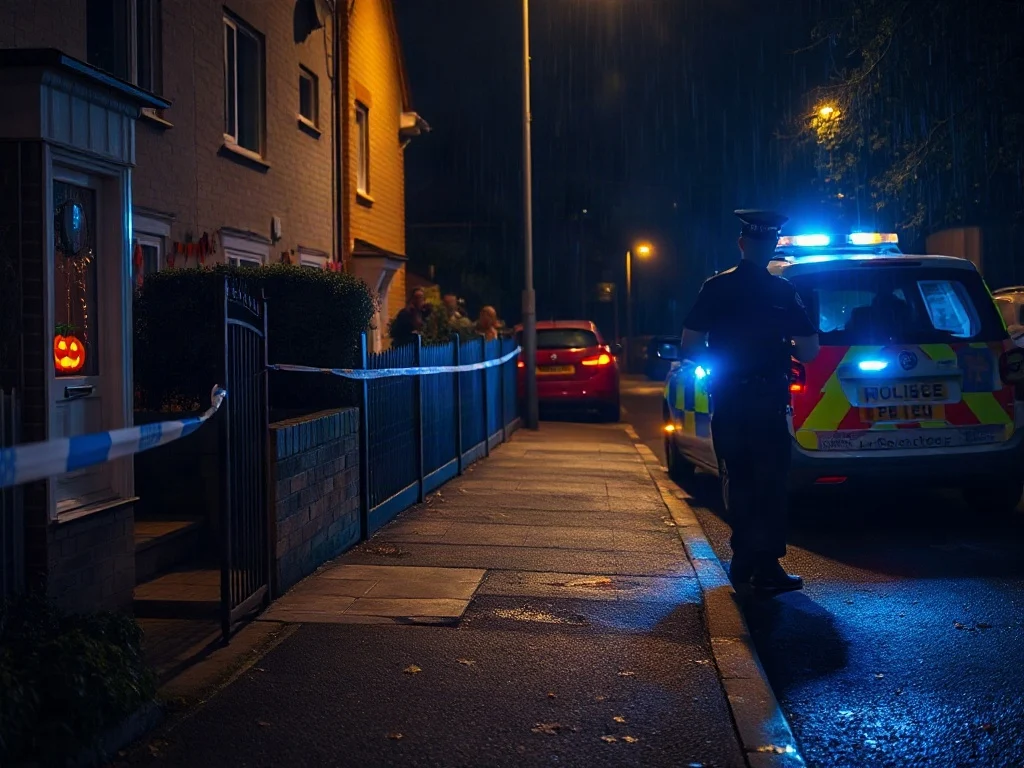
The Halloween party stabbing in Chandler’s Ford, in which five teenagers were stabbed, is already being read as another knife crime headline. The reported facts are narrower and more specific than that. Hampshire Police believes an unknown group gained entry to a party at a private address. That detail shifts attention from the familiar story of teenagers fighting each other to the mechanics of how a private gathering became an open target. This analysis separates what is known from what is not, and it examines the structural conditions that make incidents of this kind possible.
The article relies only on the information police have publicly attached to the case. Where details are missing, such as the identities of the attackers, their motive, the weapons used or the condition of the victims, they are treated as unknown rather than filled in with speculation.
What is known about the Chandler’s Ford incident
Chandler’s Ford is a suburban town in the Borough of Eastleigh, in Hampshire. It is not a place that features regularly in national crime coverage. According to the reporting, five teenagers were stabbed at a Halloween party held at a residential address. Hampshire Police believes an unknown group entered the party. The word “believes” matters, because it marks this as a working hypothesis rather than an established finding.
Two things follow from that wording. First, the police do not currently describe the incident as a dispute between guests, which would be a very different investigative problem. Second, “unknown group” suggests the suspects were not identified as attendees. That points investigators toward the arrival route, the timing, and any footage or messages that show how the group learned of the party.
What remains unconfirmed
- Whether the victims were targeted individually or attacked indiscriminately.
- Whether the attackers had a prior connection to anyone at the party.
- What the weapons were and whether they were brought to the address.
- How the party was publicised, if at all, beyond its invited guests.
Until police release further information, any account of motive is conjecture. Readers should be wary of early social media narratives, which frequently attach gang, rivalry or revenge explanations to incidents before investigators have established anything.
Why a Halloween party is a distinctive risk setting
Halloween is a night when masks, costumes and unfamiliar faces are normal. That undermines the most basic informal safeguard at any house party: hosts recognising who belongs there. A person in face paint or a mask draws less scrutiny than the same person would on an ordinary Saturday.
Costume also complicates the aftermath. Witnesses may struggle to describe attackers who were disguised, and CCTV or doorbell footage may capture masks rather than faces. Disguise gives offenders a degree of anonymity that is rarely available in other settings.
Halloween is also associated with heavy teenage movement after dark. Large numbers of young people travel between homes in groups, and police and local authorities routinely treat the period as one of elevated demand. This does not make violence likely. It means that the normal gap between informal social events and formal supervision is wider than usual.
How uninvited groups gain entry to house parties
The detail that an unknown group entered the party is the part of this case with the broadest lessons. Entry to private parties usually succeeds through a small number of routes.
Open invitations and social media spread
A party shared in group chats or on social media can travel far beyond the intended guest list within hours. Each forwarded message enlarges the audience, and the host has no control over who sees it. When an address is attached, the party becomes a known location for anyone who wants to find it.
Weak physical control at the door
A domestic property has none of the controls a licensed venue has. There is no trained door staff, no search policy and no formal capacity limit. A front door that stays open for arrivals and departures lets a determined group walk in, and a host who is a teenager or a parent working alone cannot realistically turn a group away.
Social pressure against refusing entry
Hosts often admit people they do not know because refusing feels confrontational. Offenders understand this. A group presenting itself as friends of a friend will frequently be waved through.
These conditions fit the logic of routine activity theory, which holds that crime requires a motivated offender, a suitable target and the absence of a capable guardian. A crowded teenage party can supply the second element in quantity while lacking the third.
Knife crime and teenagers: the wider context
Knife crime has been a sustained public concern in England and Wales for years. Official figures are published by the Office for National Statistics and the Home Office, and readers who want current numbers should consult those releases directly rather than rely on secondhand totals.
It is important to be precise about what a single incident can show. Five victims in one event is unusual and it will attract attention, but one event does not establish a trend. Analysts typically warn against drawing conclusions from clusters, since high-casualty incidents are statistically rare and heavily reported. Conversely, rarity does not make the underlying risk imaginary. The more useful question is what circumstances allow a single armed group to injure multiple people in a short time.
The legal framework
Carrying a blade in public without good reason is an offence under the Criminal Justice Act 1988, and the Prevention of Crime Act 1953 covers offensive weapons. Wounding with intent is prosecuted under the Offences against the Person Act 1861. Which charges apply in this case depends entirely on evidence not yet public, and nobody should be presumed guilty of anything on the basis of early reports.
The policing and investigative challenge
Identifying an unknown group is slow, evidence-dependent work. Investigators typically draw on several sources:
- Digital footage from doorbell cameras, neighbouring homes, vehicles and nearby CCTV.
- Witness accounts from partygoers, who may be frightened, intoxicated or reluctant to speak.
- Phone and social media records that reveal how the group learned of the address.
- Forensic material recovered from the scene and from victims.
Witness cooperation is often the weakest link in cases involving young people. Teenagers fear retaliation, social exclusion or trouble over underage drinking. Police appeals therefore tend to stress that information can be passed on anonymously, for example through Crimestoppers. Whether tactics such as stop and search would have prevented this kind of event is a contested question. A private party gives police no advance trigger for such powers, and the evidence for their deterrent effect remains disputed.
Medical response and the first minutes
When several people are injured at once, the demand on emergency services is sharply different from a single-casualty call. Paramedics must triage patients, and the most serious cases may be transferred to a major trauma centre. In stabbing injuries, survival often depends on controlling severe bleeding before an ambulance arrives. Basic first aid, in particular firm direct pressure on wounds, is the single most useful skill a bystander can have. Many young people have never been taught it. Organisations such as the NHS publish guidance on emergency response, and schools and youth groups could teach it far more widely.
Practical lessons for hosts, parents and schools
None of the following makes a person responsible for a crime committed by others. They are risk-reduction measures consistent with situational crime prevention.
For hosts and parents
- Keep the guest list closed and avoid posting the address in any shared space.
- Nominate one or two sober adults or trusted older people to manage the door.
- Agree in advance that no one is admitted without being named by a known guest.
- Brief guests on what to do if uninvited people arrive: do not confront them, move to a safe room and call 999.
For schools and youth services
- Teach bleeding control and emergency calling as practical skills, not abstract health topics.
- Address the pressure not to “snitch”, which suppresses early warnings.
- Share seasonal safety messaging before Halloween and other high-activity nights rather than after incidents.
Common mistakes
The most frequent errors are treating a party as private and therefore safe, posting location details publicly, and attempting to confront intruders. Confrontation is the point at which many weapon injuries occur.
Frequently asked questions
What happened at the Chandler’s Ford Halloween party?
Five teenagers were stabbed at a Halloween party at an address in Chandler’s Ford. Hampshire Police believes an unknown group gained entry to the party.
Do police know who carried out the stabbings?
Based on the available reporting, the group has been described as unknown. Further information would need to come from official police statements.
How can people report information about the incident?
Anyone with information should contact Hampshire police directly, or pass information anonymously through Crimestoppers. Emergencies should always go to 999.
How can hosts stop uninvited people entering a house party?
Keep the invitation private, control the door with trusted people, never publish the address, and have a plan to call emergency services rather than confront intruders.
What this case will ultimately test
The most important feature of this incident is not the number of victims but the route of entry. If the investigation confirms that an unknown group walked into a private party and attacked those inside, the case exposes a gap that no existing policy closes: homes hosting dozens of teenagers have no security infrastructure, yet they can attract the same threats as public venues.
Three developments are worth watching. The first is whether police identify the group and what the evidence says about motive, since a targeted attack and a random one lead to very different conclusions. The second is how the case is charged and reported, and whether early speculation survives contact with the evidence. The third is whether local schools, councils and police use the aftermath to push practical measures, such as bleeding-control training and party safety guidance, rather than limiting their response to statements of concern.
A reasoned prediction, not a certainty: the public discussion will gravitate toward blades and sentencing, because those are visible levers. The less visible question is how young people find, share and defend social spaces in an era when an invitation can reach strangers within minutes. Until that question gets as much attention as the weapon, the next gatecrashed party will carry the same risk.
Frequently Asked Questions
Does the police statement mean the attackers were not guests at the party?
Not necessarily. Hampshire Police say they believe an unknown group gained entry, which is a working hypothesis rather than a confirmed finding. It suggests the suspects were not identified as attendees, but investigators have not publicly ruled anything in or out, so the picture may change as evidence emerges.
Why does Halloween make a house party harder to secure?
Masks, costumes and face paint make unfamiliar faces normal, so hosts cannot easily tell who belongs. This weakens the basic safeguard of recognising guests. Disguises can also make it harder for witnesses to describe attackers and for CCTV or doorbell cameras to capture identifiable faces.
Is it known why the teenagers were attacked?
No. Police have not publicly established a motive, the weapons used, or whether the victims were targeted individually or attacked at random. It is also unknown whether the attackers had any prior link to people at the party. Any explanation offered at this stage is conjecture.
How can a private party become a target for uninvited people?
Invitations shared in group chats or on social media can spread well beyond the intended guest list, especially if an address is included. A home also lacks door staff, searches or capacity limits, so once the location is known, controlling who enters is very difficult.
Should readers trust early social media explanations of the incident?
They should be cautious. Early posts often attribute incidents to gangs, rivalries or revenge before investigators have established any facts. Such claims can be wrong and unfair to those involved, so it is safer to rely on information that police have publicly released.
Does this incident show that Halloween is generally a violent night?
No. The article stresses that Halloween's context does not make violence likely. It simply widens the gap between informal social events and formal supervision, as many teenagers move around after dark in groups, which is why police and local authorities treat the period as one of elevated demand.