
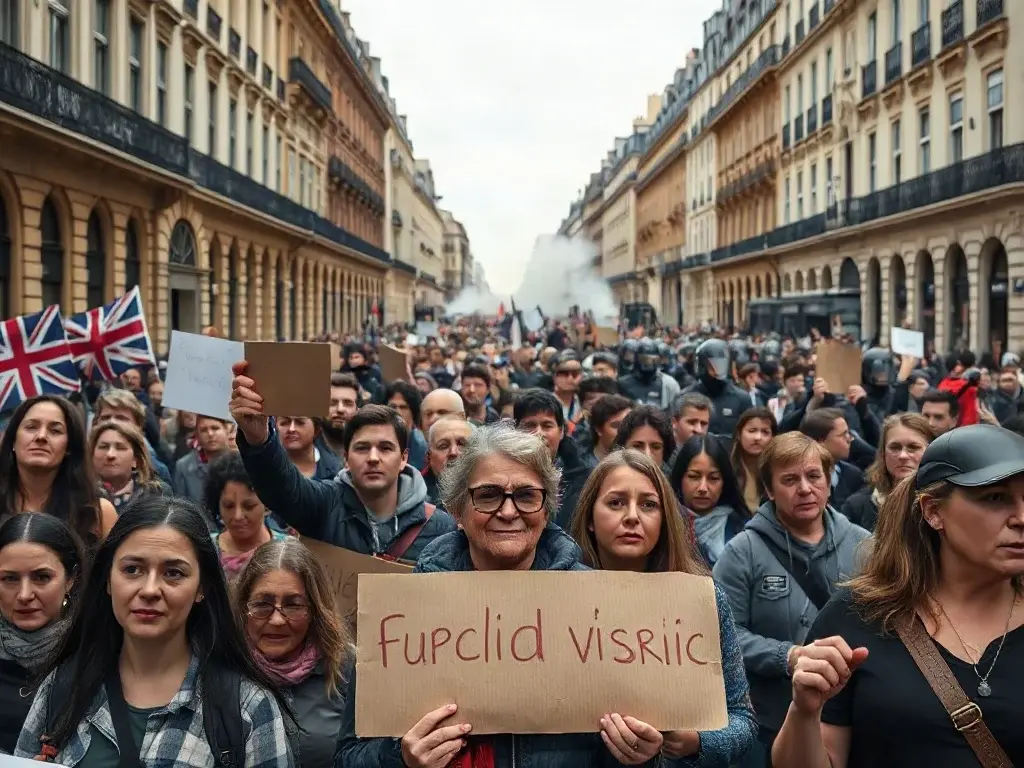
The protests in Paris and across France are best read as a warning about economic strain and eroding trust in institutions, not as an isolated street event. According to the reported figures, more than 320,000 people took part in demonstrations nationwide against the rising cost of living and poor public services. Some protesters clashed with police, and the unrest is being described as part of a wider wave across Europe. This analysis separates what is established from what is interpretation, and asks why this grievance keeps returning to French streets.
What the Reported Numbers Do and Do Not Tell Us
The core facts are simple. More than 320,000 people demonstrated in Paris and elsewhere in France. Their stated grievances were the cost of living and the state of public services. Some demonstrators clashed with police.
Treat the headline figure with caution. Crowd counts in France are routinely contested, and organizers, police and independent analysts often report very different totals for the same march. A figure of 320,000 is large by any measure, but it is a snapshot, not proof of sustained momentum. The more important signal is the breadth: demonstrations spread across the country rather than concentrating in the capital, which suggests a grievance felt well beyond the usual protest constituencies.
The report also does not tell us who organized the marches, how many of the clashes were planned, or how many arrests followed. Any analysis that claims to know those details from this report alone is speculating.
Cost of Living Protests in France: The Economic Mechanism
The cost of living protests in France reflect a gap between prices and perceived purchasing power. The cost of living is not the same as headline inflation. Inflation measures how quickly prices change. Households feel the cumulative level of prices for essentials such as housing, energy, food and transport against their wages. Even when the inflation rate falls, prices do not return to earlier levels, so a household can feel poorer long after official figures improve.
Why averages mislead
National statistics from INSEE, the French national statistics institute, and Eurostat describe the average experience. Protest movements are driven by the distribution of that experience. Lower-income households spend a larger share of income on necessities, so they absorb price increases more painfully. Commuters in areas with weak public transport, and renters in expensive cities, face further pressure that no national average captures.
The political economy of resentment
Economic stress becomes protest when people judge it to be unfair rather than merely unfortunate. Visible corporate profits, perceived tax burdens and the sense that policy favors some groups all convert hardship into grievance. That is why cost-of-living movements usually demand fairness and state action rather than a specific technical fix.
The Public Services Crisis in France
The second grievance, poor public services, is what makes this more than a price protest. The public services crisis in France is a structural concern that sits on top of the economic one. France maintains one of the more extensive welfare states in the world, and citizens pay for it through high taxes and social contributions. The political bargain is that high contributions buy reliable public services. When people believe the service level has slipped, the bargain feels broken.
Sectors that frequently feature in this debate include health care, education, transport and local administration. The report names poor public services in general terms, so it would be wrong to attribute the protests to one specific sector. Still, the combination is politically potent. A household squeezed by prices is far less able to absorb the cost of private substitutes, such as paid childcare, private medical appointments or a second car, when public provision weakens.
The two grievances reinforce each other: higher prices reduce private resilience at the moment public provision is perceived to be weakening.
That interaction is the central analytical point. Governments tend to treat inflation and service quality as separate policy files. Citizens experience them as one problem.
Why Protests Are Spreading Across Europe
The headline links the French marches to protests elsewhere in Europe. The report summary does not detail them, so the following is interpretation rather than reporting.
Several shared conditions make parallel unrest plausible. Countries in the European Union have faced overlapping pressure from energy and food prices and from tight public budgets. Many also operate under fiscal rules that push governments toward spending restraint, which critics describe as austerity. When prices rise while budgets tighten, the same political argument surfaces in several capitals at once.
Two cautions apply. First, simultaneous protests do not mean coordinated or identical movements. Demands, organizers and political leanings differ by country. Second, a shared theme does not guarantee shared impact. Protest has a long tradition in France and often translates into political pressure more readily than in some neighboring states.
France’s Protest Tradition and the Question of Impact
France has a strong culture of street politics. Large mobilizations are a normal instrument of political bargaining, frequently organized by a trade union coalition or through a general strike call. The most relevant recent precedent for a cost-of-living grievance is the yellow vests movement, which began in 2018 over fuel costs and grew into a broader challenge to government economic policy under President Emmanuel Macron.
That precedent offers two lessons. A narrow price grievance can quickly become a general expression of distrust. And a government can concede on the trigger issue without resolving the underlying frustration. Whether the latest marches follow that path depends on whether they remain episodic or settle into a durable movement with identifiable leadership. One day of large turnout is not yet a movement.
Clashes With Police: Reading the Violence Carefully
Reports of clashes dominate coverage because they are visual and dramatic. Analytically, they are the least informative element. In large French demonstrations, a minority of participants often seek confrontation, and policing tactics, including the use of tear gas, shape how events escalate. The report says only that some protesters clashed with police. It does not support conclusions about who initiated violence or how widespread it was.
The practical risk is political framing. If coverage and official response center on disorder, the underlying economic and service complaints get less attention. If authorities respond only to the grievance and ignore the violence, they invite criticism on public order. Both failure modes are common. The right to protest is protected as part of freedom of assembly, and the credibility of a movement often depends on keeping its message distinct from the small minority engaged in violence.
Practical Implications for Businesses, Travelers and Observers
For people who need to act on this news rather than merely read it, a few measured steps are sensible.
- Travelers and event organizers: check official transport and municipal notices before moving through central Paris on protest days. Demonstrations commonly disrupt routes and services.
- Employers: plan for strike-related absences and delivery delays rather than assuming normal operations.
- Analysts and investors: watch for government concessions, since fiscal responses to protest affect the budget outlook.
- Citizens following the story: compare crowd estimates from several sources rather than relying on one number.
A common mistake is to read a single day of large turnout as a forecast. Turnout trends over successive mobilizations are a far better indicator than any individual figure.
Policy Options and Their Trade-Offs
The government’s options are constrained. Targeted support for low-income households can ease immediate pressure but strains public finances. Broad price measures are costly and can blunt market signals. Increased investment in public services answers the second grievance but competes with deficit reduction. Each option satisfies one constituency while risking criticism from another, and a response perceived as inadequate can sustain the protests.
The legislative arena matters too. Any significant budgetary response must pass through the National Assembly, where political fragmentation can make decisive action difficult. That institutional friction often pushes political conflict from parliament back onto the street.
FAQ: Protests in France and Europe
Why are people protesting in France over the cost of living?
Demonstrators cite rising living costs and poor public services. Prices for essentials have outpaced many households’ sense of financial security, and perceived declines in public provision leave them less able to cope.
How many people took part in the protests?
The report states that more than 320,000 people demonstrated across France. As with most large protests, totals vary by source, so treat the figure as an estimate.
Why are protests spreading across Europe?
Many European countries face similar pressures from high prices and constrained public budgets. The shared themes make parallel protests plausible, though they are not necessarily coordinated.
Were the protests violent?
According to the report, some protesters clashed with police. The reported violence involved some demonstrators, not the whole crowd.
The Real Test Is What Comes After the March
The most important insight is that two grievances, prices and public services, are fusing into one question about whether the state still delivers value for what it asks of citizens. Large crowds show the question is widely felt. They do not show how it will be answered.
Watch three indicators over the coming weeks: whether turnout holds or fades in subsequent mobilizations, whether the government offers a concrete response on household costs or service funding, and whether protests in other European countries converge on shared demands. A reasonable prediction, clearly labeled as such, is that unrest will persist wherever price pressure and budget constraints coincide, regardless of national protest traditions.
The unanswered question is whether governments can rebuild confidence in public services quickly enough to matter. If they cannot, the next demonstration is unlikely to be the last, and the size of the crowd will matter less than how long it keeps coming back.