
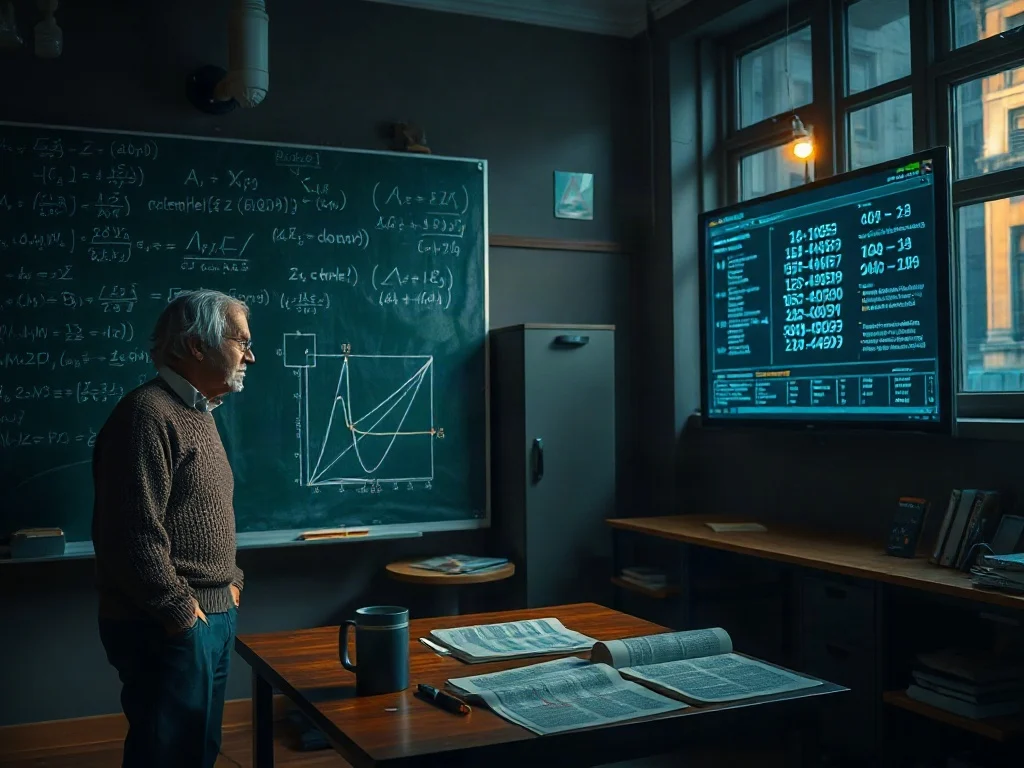
Two rival claims of a Riemann Hypothesis proof landed within hours of each other on Friday, and the mathematics community is now scrambling to work out whether either one holds. Levent Alpöge, a mathematician at Anthropic, said he solved the most famous open problem in mathematics with the help of AI. Alessandro Masullo, a postdoctoral researcher at Stanford University, then said he had solved it too, without AI. This analysis separates what has been reported from what has been established, and argues that the human-versus-machine framing obscures the real question: what counts as a verified proof?
What Is the Riemann Hypothesis and Why Does It Matter?
The Riemann Hypothesis was posed by Bernhard Riemann in 1859. It concerns the Riemann zeta function and asserts that all of its non-trivial zeros lie on a single vertical line in the complex plane, the line where the real part equals one half. That sounds abstract, but the zeros encode information about the prime numbers. The prime number theorem describes roughly how primes thin out as numbers grow. The Riemann Hypothesis, if true, would tightly bound the error in that description.
Business Insider summarized this as a predicted distribution for how often primes appear among other numbers. That is a fair shorthand, though the precise statement is about the location of zeros. Cornell’s Steven Strogatz called it the “White Whale” of mathematics. Many results in number theory are currently stated conditionally, in the form “assuming the Riemann Hypothesis, then…”. A confirmed proof would convert a large body of conditional work into unconditional theorems. A disproof would be just as consequential, though far more disruptive.
A Millennium Prize Problem
The hypothesis is one of the Millennium Prize Problems named by the Clay Mathematics Institute, each carrying a $1 million award. Business Insider notes that the Navier-Stokes problem sits in the same category and that OpenAI has said it solved it. Both statements are claims by the companies involved, and neither amounts to confirmation. The Clay Institute’s own rules, published on its official website, have historically required publication in a qualifying peer-reviewed outlet and a waiting period before any award is considered. A social media announcement or a preprint does not meet that bar.
Two Claims, One Afternoon
The Anthropic Claim
According to the report, Alpöge described working for weeks with Claude, Anthropic’s AI model, to reach his result. His paper is described as considerably longer than Masullo’s. That detail matters. A long, AI-assisted argument is harder for human referees to audit, and the length of a manuscript is no evidence of correctness. The central question is whether each step can be independently checked, not who or what generated it.
The Human-Only Claim
Masullo said he had worked on the problem for 12 years and was roughly a year from releasing his work when Alpöge’s announcement appeared. Advised to publish immediately, he posted a version he acknowledged may contain errors because it was rushed. That admission is notable. Serious claimants to major conjectures rarely volunteer the possibility of error in the first sentence, and it is a mark of honesty, not of weakness. It also means his paper should be treated as a draft that needs scrutiny.
His framing was pointed. He said the work is meant for mathematicians discouraged by the pace of the current climate: “we are still here.” The sentiment is understandable. As a scientific argument, it is irrelevant. A proof is valid or it is not, regardless of its author’s motive or toolset.
Neither paper had been formally verified by Friday afternoon, according to Business Insider. Everything beyond that point is expectation, not fact.
Why Neither Claim Is Yet a Proof
The history of the Riemann Hypothesis is a history of failed announcements. Credible-looking attempts have appeared repeatedly over the decades and collapsed under inspection. The base rate for a claimed solution to a problem this old is low, and that holds whether the claimant is a postdoctoral researcher, a senior professor, or a research lab.
The reaction from established mathematicians is telling. Strogatz wrote, “The plot thickens!” Caltech’s Sergei Gukov told Business Insider, “Now it’s getting more complicated,” and called the claim a “HUGE deal,” speaking of the problem in the past tense. Gukov’s enthusiasm reflects how significant the claim would be if confirmed. It is not a verdict on correctness. Reading it as one would be a mistake.
Two Different Verification Problems
The two papers pose distinct challenges for reviewers:
- The longer AI-assisted paper raises an audit problem. Large language models can produce fluent, plausible reasoning that contains subtle errors, and a weeks-long human-AI collaboration may leave gaps that neither party noticed.
- The shorter human-authored paper raises a rigor problem. By its author’s own account it was rushed, and concise proofs of famously hard problems often hide their difficulty in a single unjustified step.
Brevity and length are both poor proxies for truth. Only line-by-line checking settles the matter.
The Wrong Frame: Human Versus AI
The media narrative treats this as a contest, and the mathematicians involved have helped it along. That framing is analytically weak for three reasons.
First, it conflates provenance with validity. Mathematics has an unusually objective standard: a mathematical proof either follows from accepted axioms or it does not. Who wrote it is secondary.
Second, the dichotomy is false. Alpöge is a human mathematician who used a tool, and mathematicians already rely on computation in many forms. The field has a long record of automated theorem proving and computer-assisted proofs. What is new is the use of a large language model as a research collaborator at the frontier of the field.
Third, the framing invites motivated reasoning. If reviewers approach one paper hoping it fails because AI wrote it, or the other hoping it fails because a lone human beat a laboratory, their scrutiny will be compromised. The credibility of mathematics as a discipline depends on adjudicating both with the same standards.
How the Claims Will Actually Be Tested
Expect a sequence of increasingly demanding checks rather than a single dramatic ruling. The likely process looks like this:
- Informal expert reading. Specialists in analytic number theory scan both papers for the core idea and look for obvious breaks. Many failed claims die at this stage within days.
- Targeted scrutiny of key lemmas. Reviewers isolate the steps where the argument claims to do something previously considered out of reach.
- AI-assisted checking. As Business Insider reports, mathematicians are now using AI as well as their own judgment. This is useful for finding inconsistencies, though a model verifying a model’s output is not independent confirmation.
- Formalization. The strongest test is encoding the argument in a proof assistant such as Lean (see the Lean project site), where a machine checks each logical step. Formalizing a research-level proof can take a long time, and the gap between a paper and a formal proof is often where hidden assumptions surface.
- Formal peer review. Journal refereeing remains the gatekeeper for prize eligibility and for the field’s consensus.
What Is at Stake Beyond the Prize
The $1 million award is the least important consequence. The larger stakes are institutional.
If the AI-assisted proof is correct, it would be the most dramatic demonstration to date that AI can contribute to frontier mathematical research. It would reshape how departments, funders, and journals think about authorship and credit. Questions the field has barely begun to address would become urgent. Who is the author of a result produced in collaboration with a model? How should journals disclose AI involvement? Does the prize apply to a result generated this way?
If it is wrong, the damage runs the other way. Companies have, per Business Insider, spent months announcing high-profile solutions to long-standing problems. A failed claim on the field’s best-known problem would deepen skepticism about every such announcement, including those that may be sound. Conversely, if the human-only paper is right, it would show that decades-long individual effort still competes, though one result cannot settle a broader question about the trajectory of the field.
There is also a third outcome that the race framing ignores: both papers may contain errors but still carry useful ideas. Mathematical progress frequently comes from flawed attempts that introduce a workable technique.
Practical Guidance for Readers Following the Story
- Discount announcements, weight verification. Treat statements on social media and in press coverage as claims. The relevant signals are detailed expert reports and formal checks.
- Watch who engages. Analytic number theorists who find, or fail to find, a gap carry more weight than commentators from adjacent fields.
- Look for specificity. Credible critiques point to particular steps. Vague praise and vague dismissal are both low-information.
- Separate disclosure from quality. AI involvement should be disclosed, but it neither validates nor invalidates the mathematics.
Frequently Asked Questions
Has the Riemann Hypothesis actually been proven?
No. As of the reporting, neither paper had been formally verified. Both are claims awaiting expert scrutiny.
Did AI solve the Riemann Hypothesis?
Anthropic mathematician Levent Alpöge says he solved it by working with Claude for weeks. That is his claim, and it has not been confirmed by independent verification.
Who is Alessandro Masullo?
He is a postdoctoral researcher at Stanford who says he spent 12 years on the problem and reached a solution without AI. He has acknowledged that his rushed paper may contain errors.
What does solving a Millennium Prize Problem earn?
A $1 million award from the Clay Mathematics Institute, subject to the institute’s rules on publication and review, which a preprint alone does not satisfy.
The Verdict Will Come From the Mathematics, Not the Race
The most important insight is that this episode has stress-tested mathematics’ verification culture more than its creative capacity. The field now faces a flood of long, sophisticated arguments produced faster than humans can read them, and the old process of informal trust followed by slow refereeing may not scale. Formalization in systems like Lean looks increasingly like the only credible answer, and it may become the expected companion to any major claim.
Watch three things next: whether specialists identify a concrete gap in either paper, whether anyone begins formalizing the key arguments, and whether the Clay Institute or major journals publish guidance on AI-assisted submissions. A reasonable prediction, and it is only a prediction, is that history’s base rate favors skepticism toward both claims for now. The unanswered question is more interesting: if a proof is eventually verified, and the only entity that can fully follow it is a machine, what will it mean to say that mathematicians understand it?
SEO DATA
Primary Focus Keyphrase: Riemann Hypothesis proof
Related Keyphrase 2: AI solves Riemann Hypothesis
Related Keyphrase 3: Alessandro Masullo Riemann Hypothesis without AI
Related Keyphrase 4: what is the Riemann Hypothesis
Related Keyphrase 5: Millennium Prize Problems
Primary Keyphrase Synonyms: proof of the Riemann Hypothesis, solution to the Riemann Hypothesis, Riemann Hypothesis claim, resolution of the Riemann Hypothesis, Riemann conjecture proof
SEO Title: Riemann Hypothesis Proof Claims: AI vs. Human Mathematician
Meta Description: Two rival Riemann Hypothesis proof claims, one AI-assisted and one human-only, are under scrutiny. Here is what is known and what remains unverified.
URL Slug: riemann-hypothesis-proof-ai-vs-human
Image Filename: riemann-hypothesis-proof-ai-vs-human-mathematician.jpg
Image ALT Text: Mathematician at a chalkboard of zeta function equations beside a glowing AI interface on a screen
Image Title: Riemann Hypothesis proof claims: human versus AI
Image Caption: Two competing claims of a Riemann Hypothesis proof are now being scrutinized by mathematicians.
Search Intent: Mixed intent (informational and news/current event)
Frequently Asked Questions
Does a preprint or social media announcement qualify for the Millennium Prize?
No. According to the Clay Mathematics Institute's rules, a solution has historically needed publication in a qualifying peer-reviewed outlet, followed by a waiting period before any award is considered. A preprint, a blog post or a social media announcement does not meet that standard, so neither claim is eligible yet.
Why does the length of an AI-assisted proof matter to reviewers?
A long argument produced with AI help is harder for human referees to audit step by step. Length is not evidence of correctness. What matters is whether every step can be independently checked, regardless of whether a person or a model generated it.
How would a proof of the Riemann Hypothesis change other mathematics?
Many number theory results are currently stated conditionally, as 'assuming the Riemann Hypothesis, then...'. A confirmed proof would turn that body of conditional work into unconditional theorems. It would also tightly bound the error in the prime number theorem's description of how primes are distributed.
Does Masullo's admission that his paper may contain errors mean it is probably wrong?
Not necessarily. He said he rushed the posting after Alpöge's announcement, so the paper should be treated as a draft needing scrutiny. The admission signals honesty rather than weakness, but it does not prove or disprove anything. Only independent verification of each step can settle its validity.
Why should readers be skeptical of both claims right now?
The Riemann Hypothesis has a long history of credible-looking attempts that collapsed under inspection. Neither paper had been formally verified by Friday afternoon, so everything beyond the announcements is expectation. Company or author statements, including OpenAI's claim about Navier-Stokes, are not confirmation.
Is the human-versus-machine framing the right way to judge these claims?
According to the analysis, no. A proof is valid or invalid regardless of its author's motives or tools. Masullo's 'we are still here' sentiment is understandable but irrelevant scientifically. The real question is what counts as a verified proof and whether the logic survives independent checking.