
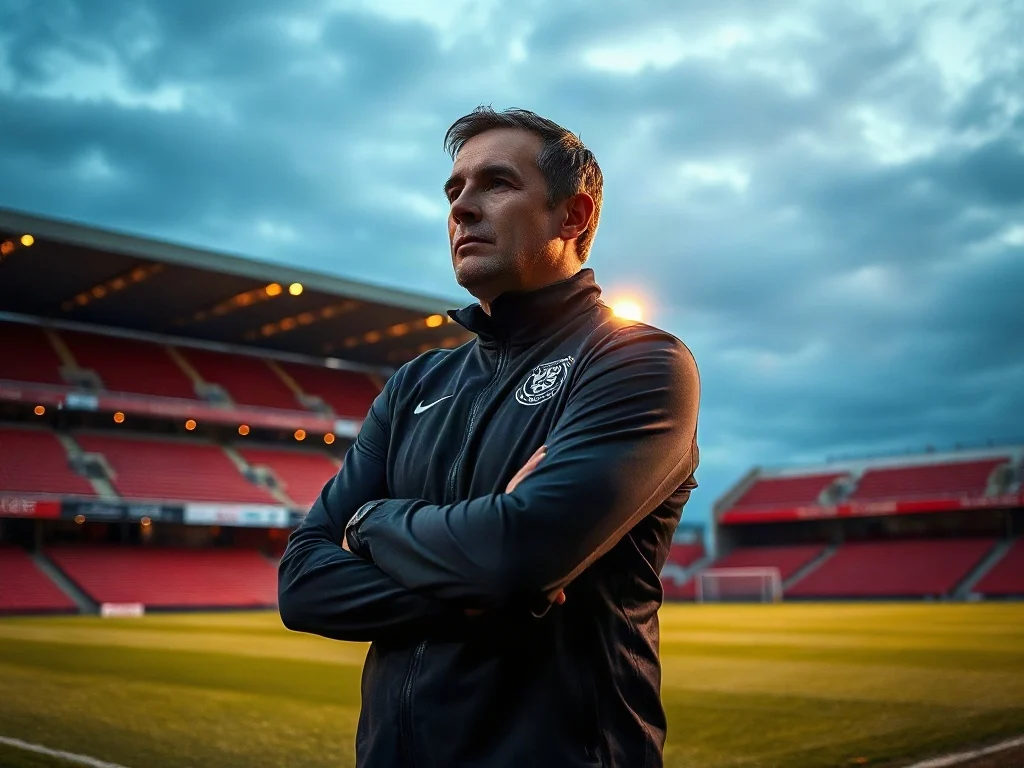
The story of Pochettino at Manchester United is as much about process as personnel. Reporting on how the club identified Mauricio Pochettino as its new head coach, and on what happened during the week Michael Carrick was left waiting, shows how a club of this size makes its biggest sporting decision. This analysis separates what the original reporting establishes from what can reasonably be inferred, and explains what the move means for Manchester United.
One caveat applies throughout. The source piece is a short report on the sequence of events. Contract terms, the exact timeline and the precise message given to Carrick are not independently verified here, so this article does not assert them.
What the Reporting Tells Us About the Manchester United Head Coach Appointment
The headline makes two claims. First, Pochettino became a serious candidate through an identifiable process rather than a sudden approach. Second, Carrick, a former United midfielder and a natural candidate, spent a notable period waiting for clarity while that process ran.
Both claims matter because they describe how the club behaves under pressure. A Manchester United head coach appointment involves the ownership group, the executive and sporting leadership, the candidate’s representatives and, often, a candidate’s current employer. When several of these run in parallel, the people left waiting are usually those the club regards as credible fallback or continuity options.
Head coach versus manager
The title “head coach” is deliberate. In modern English football the role is often narrower than the traditional manager model associated with Sir Alex Ferguson. Recruitment, contracts and long-term strategy increasingly sit with a director of football or a technical director, while the head coach is responsible for the first team, tactics and the daily training environment. Any coach who accepts the job accepts that division of labour.
Why Pochettino Fits the Profile Manchester United Appears to Want
Pochettino’s record explains why he would surface in any shortlist. He began his coaching career at Espanyol and then moved to Southampton, before joining Tottenham Hotspur in 2014. At Tottenham he built a young, high-intensity side that challenged for the title and reached the 2019 UEFA Champions League final, where it lost to Liverpool.
He later managed Paris Saint-Germain, where he handled a dressing room of global stars, and Chelsea, where he left after a single season. His most recent post before United was with the United States men’s national team, ahead of the 2026 FIFA World Cup.
The case in his favour
- Premier League familiarity: he knows the Premier League calendar, its scrutiny and its tactical demands, so adaptation time should be short.
- Player development: his Tottenham years are widely associated with raising the level of young and mid-career players.
- Intensity and pressing: his teams are associated with aggressive pressing, a style related to gegenpressing, which gives a clear tactical identity to build around.
- Experience with high-profile squads: managing PSG and Chelsea means the pressures of a major-club dressing room are familiar to him.
The case against
His Chelsea tenure produced a sixth-place league finish and a one-year exit, which critics cite as evidence that his methods work best with a long runway and a coherent squad. Whether United can offer that stability is the central question. Supporters of the appointment answer that his Tottenham project took years to mature and that he was never given similar time at Stamford Bridge.
The Carrick Dimension: What It Means to Be Left Waiting
Carrick is not an incidental figure. He made more than 460 appearances as a United player between 2006 and 2018 and has since moved into management. He took charge on a caretaker basis in November 2021 after Ole Gunnar Solskjær left, and later managed Middlesbrough. His standing among supporters and former colleagues is high.
That is why the phrase “what Carrick was told” matters. In a managerial search, communication to an internal or sentimental candidate is a test of the club’s culture. If the message was vague, it reflects a process that stayed open until the last moment. If it was clear, it suggests the club knew its direction earlier than the public assumed. The original report is the place to read the specific detail. The wider lesson is that sequencing is a governance issue, not a courtesy.
A club that keeps a respected former player waiting while it pursues someone else is not simply being cautious. It is deciding how much loyalty it owes to its own history.
How Manchester United’s Structure Shapes Every Managerial Search
Appointments at United now run through a different power structure than in the Ferguson era. Since Sir Jim Ratcliffe and Ineos acquired a minority stake and took responsibility for football operations, the sporting side has been reorganised, while the Glazer family remains a major shareholder. The club has also gone through several head coaches since Ferguson retired in 2013, including Erik ten Hag and Ruben Amorim.
Frequent turnover creates a recurring dilemma: appoint a coach who suits a specific system, or one who can adapt to the squad. The table below sets out the trade-offs. It is an analytical framework, not a description of any internal documents.
| Candidate type | Typical advantage | Typical risk |
|---|---|---|
| Club legend or internal figure | Fan goodwill, cultural fit | Limited top-level experience |
| System-driven coach | Clear tactical identity | Squad mismatch if recruitment lags |
| Experienced Premier League coach | Fast adaptation, proven handling of pressure | Questions over long-term sustainability |
Pochettino sits mostly in the third category, with some features of the second. That is a conventional, lower-variance choice, which may be exactly what an executive group wanting stability prefers.
Practical Implications for the Club and Its Supporters
What the club should do in the first 100 days
- Define the squad model early. Pressing systems need specific athletic profiles, so recruitment and tactics must be aligned from the first window.
- Clarify responsibilities. The head coach, technical director and chief executive should have a written, shared view of who decides on transfers.
- Manage the Carrick relationship openly. Retaining a respected former player within the structure, if he wishes, protects the culture the club often says it wants to restore.
- Set measurable expectations. Qualification for European competition, goal difference and chance quality are fairer yardsticks than single results.
What supporters and analysts should monitor
- The structure of the contract and any stated multi-year plan.
- Whether the coaching staff includes figures with deep club knowledge.
- Expected goals data and pressing metrics across the first ten league matches.
- The treatment of academy players, which matters for a coach known for development.
Common mistakes in managerial transitions
The usual errors are appointing before the squad plan exists, overreacting to early results and allowing parallel lines of authority to form. Clubs that avoid them tend to give coaches a defined recruitment role and a realistic time frame. For official club announcements, readers should rely on the official Manchester United website rather than unattributed reports.
Risks, Constraints and Unanswered Questions
Several risks sit around the appointment. The first is timing relative to international commitments: because Pochettino was previously linked to a national-team role at a World Cup hosted partly in his employer’s country, the handover has to be handled by contract and diplomacy, and the details should be confirmed by official statements from U.S. Soccer and the club.
The second is the home environment. Old Trafford is a demanding stage, and past appointments have shown how quickly goodwill erodes when results lag behind expectations. The third is financial: profit and sustainability rules limit how much a new coach can reshape the squad, which makes the quality of the recruitment strategy as important as the coach himself.
Frequently Asked Questions
Why did Manchester United appoint Pochettino?
The reporting suggests the club identified him through a deliberate search. The logic visible in his record is Premier League experience, a history of developing players and a track record with high-profile squads. The club’s own explanation should be read in its official statements.
What was Michael Carrick told during the search?
The detail is set out in the original report, and it is not reproduced or paraphrased here beyond the fact that Carrick was left waiting for roughly a week while the club completed its process. Readers wanting the exact wording should consult that article.
Is Pochettino a head coach or a manager at United?
He is described as head coach, which typically means responsibility for the first team and tactics, while recruitment is shared with the sporting leadership.
Has Pochettino won trophies in the Premier League?
He has not won the Premier League title. His best league finish was second with Tottenham in 2016-17. He has won a domestic league title elsewhere, at Paris Saint-Germain.
The Real Test Begins After the Announcement
The most important insight from this episode is that the identity of the head coach matters less than the clarity of the system around him. Manchester United has changed coaches repeatedly since 2013, and each change has followed a pattern: high expectations, a tactical reset, then a squad that does not quite fit the plan. Pochettino is an experienced and credible choice, but credibility alone has not been enough in this job.
Watch three things in the coming months. First, whether summer and winter recruitment visibly matches a pressing-based identity. Second, whether Carrick, or another figure with deep club ties, is given a defined role rather than a diplomatic goodbye. Third, whether the executive group resists the pull of short-term judgement after a poor run. A reasonable prediction, and it is only that, is that this appointment will be judged on the club’s patience as much as on Pochettino’s tactics. The unanswered question is whether United can give a coach the time that its own history says it rarely does.