
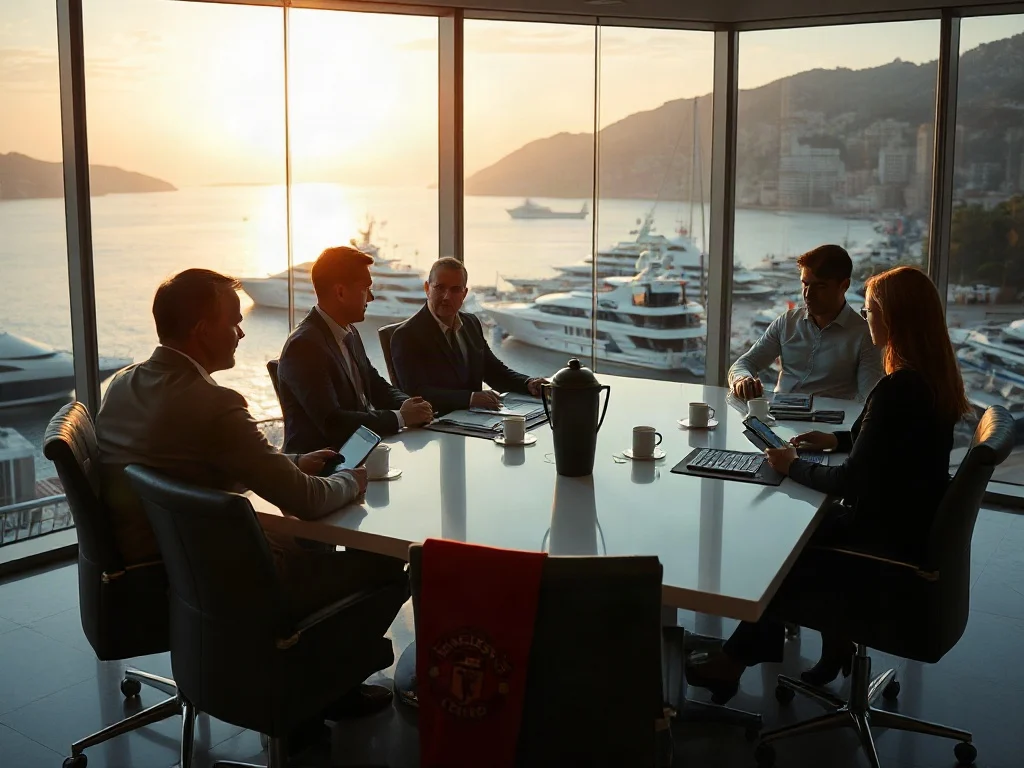
The Michael Carrick head coach question is about to be answered behind closed doors. Manchester United’s power brokers are due to meet in Monaco on Wednesday to decide whether Carrick stays in the role. The meeting matters beyond one appointment. It will show how the post-Glazer football structure at Manchester United deals with its most visible decision: who leads the team in the dugout.
This analysis separates what is publicly known from what is still speculation. The reported fact is narrow: a summit in Monaco will decide whether Carrick continues as head coach. Everything else here is context, interpretation and a reasoned look at the options.
What is happening at the Monaco summit
According to the reporting behind this story, the club’s senior decision-makers will meet in Monaco on Wednesday. Their agenda is whether Carrick, the former United midfielder, remains head coach. No outcome had been confirmed at the time of writing, and neither the format nor the exact attendees have been officially published. Readers should treat any claim about the “real” decision as unverified until the club speaks.
The location is notable. Monaco is widely reported to be the base of Sir Jim Ratcliffe, the minority owner whose company drives the club’s football operations. Holding the meeting there suggests it is a leadership-level decision rather than a routine matchday conversation at the training ground.
How Carrick came to be in the job
Carrick took charge after Ruben Amorim‘s time at the club ended, in what was widely understood as an interim arrangement. That matters. An interim spell is a live audition, but also a different task from building a squad, planning recruitment and setting a multi-year tactical identity. The summit has to decide whether the audition earned a longer contract or merely bought the club time.
Who makes the decision
Understanding the Manchester United head coach decision means understanding who holds power. The club’s structure has changed significantly since 2024.
Ratcliffe, Ineos and the football hierarchy
Sir Jim Ratcliffe and his company Ineos acquired a minority stake of roughly 27.7% in early 2024 and took responsibility for football operations. The Glazer family retained majority ownership. That split creates an unusual arrangement in which the minority owner runs sporting matters while the majority owner still holds the commercial and ultimate financial authority.
Below the owners sit the executives who shape football strategy. They include Sir Dave Brailsford in a sporting leadership role, along with chief executive Omar Berrada and technical director Jason Wilcox. The exact weight each voice carries in a head coach decision is not public. Any outsider claiming to know the internal vote is guessing.
Why the sporting director model matters
Modern clubs often rely on a sporting director structure, where recruitment, coaching and strategy are meant to be aligned rather than dominated by a single manager. Whether Carrick fits that model is a central question. A coach who works well within a defined structure may be more attractive to the current leadership than a figure demanding total control.
The case for keeping Carrick
Club knowledge and credibility
Michael Carrick won five Premier League titles and the 2008 Champions League as a player under Sir Alex Ferguson. He understands the dressing room, the expectations at Old Trafford and the pressure of the job. That familiarity is an asset when a club needs stability and a unified message. Players often respond to a coach who has lived the demands of the shirt.
A track record that is modest but real
Carrick’s coaching record is short, but it is not empty. In 2021, after Ole Gunnar Solskjaer was dismissed, he took charge as a caretaker manager for three matches, winning two and drawing one. Later he managed Middlesbrough, taking them to a play-off finish in the Championship in 2022-23. That shows he can organise a team and improve results with a limited budget. It does not prove he can win titles at the top of the Premier League.
The case against: risks the summit must weigh
The argument against is about scale, not competence. Managing United is a different job from managing a Championship club, and the club has a recent history of hiring figures who looked right on paper. Louis van Gaal, Jose Mourinho, Solskjaer and Erik ten Hag each arrived with a different philosophy. None produced sustained title challenges after Ferguson retired in 2013.
Three specific risks stand out:
- Sample size: A short run of results can flatter or punish a coach. Decisions based on a handful of matches are statistically fragile.
- Fixture and squad context: Results under an interim coach depend on injuries, the schedule and the opposition. Credit and blame are hard to separate.
- Strategic fit: The club has to decide whether Carrick’s style matches the squad it is building and the recruitment model the executives prefer.
The options on the table
The summit is not simply a yes or no vote. Clubs in this position usually weigh several routes, each with different trade-offs.
| Option | Main advantage | Main risk |
|---|---|---|
| Confirm Carrick permanently | Continuity, dressing-room trust, no disruption | Limited top-level track record |
| Extend the interim arrangement | Keeps flexibility while evidence builds | Prolongs uncertainty for players and staff |
| Appoint an external coach | Potentially higher ceiling and fresh ideas | Transition cost and a new tactical reset |
No source has confirmed which of these will be chosen. Each has a plausible logic, which is why the meeting matters.
What the decision reveals about Manchester United’s structure
The Michael Carrick Manchester United future debate is partly a test of the club’s decision-making discipline. Since the Ferguson era, United’s managerial changes have often been reactive. A deliberate, planned summit suggests the club wants a process rather than a reflex. Whether it produces a better result is another matter.
There is also a financial layer. The club operates under Champions League-dependent revenue assumptions, and European qualification affects budgets, recruitment and wages. A head coach decision is therefore also a commercial one. Appointing a new manager can mean compensation, new backroom staff and a fresh transfer strategy, all of which carry costs.
Interpretation versus fact
It is a fact that a meeting is scheduled. It is interpretation to read the Monaco location as a sign of Ratcliffe’s influence, or to assume the outcome is already decided. Responsible analysis keeps these categories apart.
What supporters and analysts should monitor
Whatever the outcome, the following indicators will show how sound the decision is:
- The wording of the announcement: A permanent appointment, a contract length and a stated objective say more than a generic statement of support.
- Backroom changes: New coaches or analysts suggest the club is building a long-term project rather than managing a stopgap.
- Transfer planning: Early recruitment signals show whether the head coach has real input.
- Performance metrics beyond results: Expected goals, pressing intensity and chance quality are more reliable than a short results streak.
Common mistakes when judging a managerial decision
Fans and commentators often over-index on narrative. The most common errors are treating a short winning run as proof of ability, assuming a famous playing career guarantees coaching success, and ignoring how much a coach depends on squad quality and recruitment. A balanced judgement needs time, data and an honest view of the resources available.
Frequently asked questions
Will Michael Carrick stay as Manchester United head coach?
That has not been confirmed. The club’s decision-makers are due to meet in Monaco on Wednesday to decide, and an official statement is the only reliable source for the outcome.
Who decides who the Manchester United manager is?
The decision sits with the club’s senior leadership, including the Ineos-led football hierarchy, with the Glazer family still holding majority ownership. The precise internal process is not public.
Has Michael Carrick managed Manchester United before?
Yes, as a caretaker in 2021 for three matches following Solskjaer’s dismissal, winning two and drawing one.
What did Carrick do at Middlesbrough?
He managed the club in the Championship and led it to a play-off finish in 2022-23, which helped establish his credentials as a coach.
The question the Monaco meeting cannot avoid
The most important insight is that the head coach is the visible face of a wider problem: United have repeatedly changed managers without changing the underlying conditions that determine results. Retaining or replacing Carrick will only matter if the club also settles on a coherent recruitment model, a defined playing identity and realistic timelines.
The thing to watch next is not the headline on Wednesday but the weeks that follow. A confirmed long-term appointment backed by clear strategy would signal a club prepared to stop lurching between ideas. A short-term fix, on the other hand, would suggest the Monaco summit postponed the real decision. A reasonable prediction, and it is only that, is that whichever route the club picks, it will be judged by whether it makes United more coherent within a single season. The unanswered question is whether the people in that room are willing to commit to a plan long enough to see it succeed.
Frequently Asked Questions
Has Manchester United officially confirmed Michael Carrick's future as head coach?
No. The only reported fact is that senior decision-makers will meet in Monaco on Wednesday to discuss whether Carrick stays. No outcome has been confirmed, and the format and exact attendees have not been published. Claims about a supposedly real decision should be treated as unverified until the club speaks.
Why is the decision being made in Monaco rather than at the club's training ground?
Monaco is widely reported to be the base of Sir Jim Ratcliffe, whose company Ineos runs football operations. Holding the meeting there suggests a leadership-level strategic decision rather than a routine conversation about matchday matters. The location itself, however, does not reveal the outcome.
Who actually has the final say on the head coach appointment?
This is not public. Ineos, with a stake of roughly 27.7%, controls football operations, while the Glazer family keeps majority ownership and ultimate financial authority. Executives such as Brailsford, Berrada and Wilcox also shape strategy, but nobody outside the club knows how much weight each voice carries.
Why does an interim spell not guarantee a permanent job?
Interim work is a live audition, but it is a different task from building a squad, planning recruitment and setting a multi-year tactical identity. The summit has to judge whether Carrick's results earned a longer contract or simply bought the club time.
How does the sporting director model affect Carrick's chances?
United's leadership wants recruitment, coaching and strategy aligned rather than dominated by one manager. A coach who works well inside a defined structure may suit that model better than one demanding total control, so how Carrick fits this approach is a central question.
Is Carrick's coaching experience enough to justify keeping him?
His record is short but real: three games as caretaker in 2021, with two wins and a draw, and a play-off finish with Middlesbrough in 2022-23 on a limited budget. It shows he can organise a team, though it does not by itself prove he can succeed long term at United.