
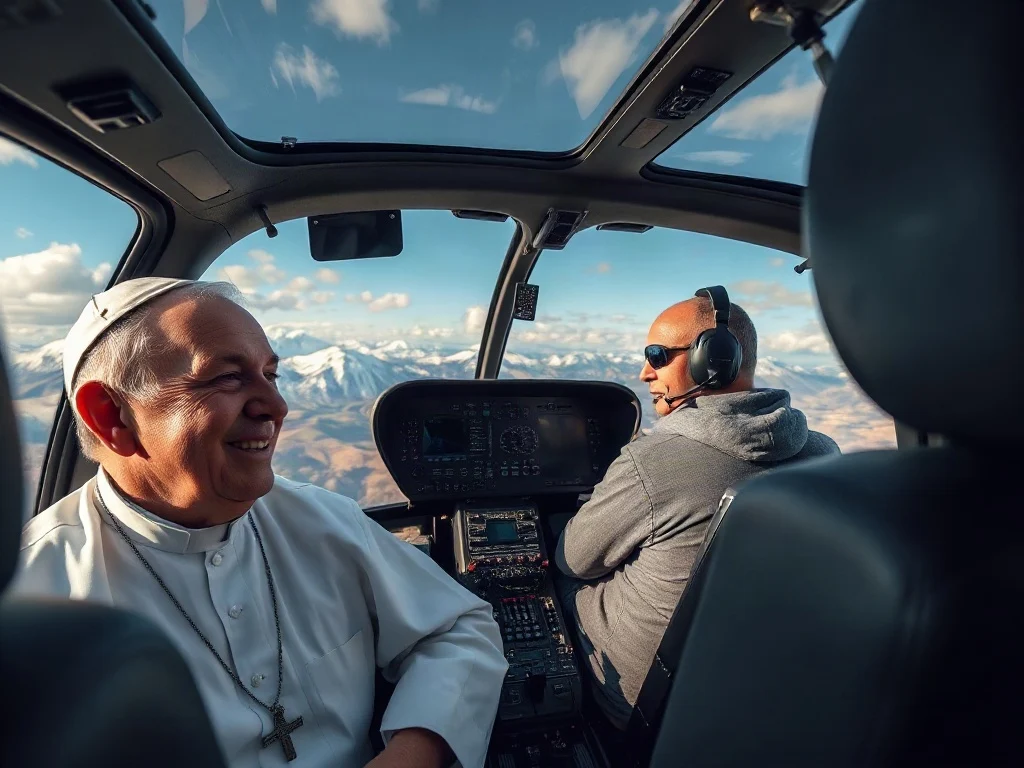
The image of the Pope Leo helicopter cockpit ride during his Peru visit is more than a curiosity. A short news report says the pontiff took to the skies before arriving in Cusco on the penultimate day of his Latin America tour. The report does not give the aircraft type, the route, the crew or the length of the flight, so this article does not guess at them. Instead, it uses the known facts to analyze the process behind such a moment: how a papal travel leg is built, why a helicopter makes sense in the Andes, and what a cockpit seat says about the pope.
What the Report Confirms, and What It Leaves Open
The report supports three points. Pope Leo XIV rode in a helicopter cockpit. The flight took place in Peru before he reached Cusco. And Cusco was the stop on the second-to-last day of a Latin American tour.
Anything beyond that is interpretation. We do not know whether the helicopter was used for logistics, scenery, security, or a mix of the three. Treat any detailed claim about the flight with caution unless it comes from the Holy See or from Peruvian authorities.
Why This Pope and This Country Make the Moment Significant
Leo XIV was born Robert Francis Prevost in Chicago and belongs to the Order of Saint Augustine. He spent many years as a missionary in Peru and served as bishop of Chiclayo before returning to Rome for senior Church roles. He was elected in May 2025, succeeding Pope Francis.
So a visit to Peru is a return to a place he knows, not only a pastoral stop. That context shapes how people read small details. A pope who knows the terrain and the people is likely to be seen as at ease in the cockpit rather than as a passenger being moved around.
Process Analysis: How a Papal Travel Leg Is Built
Papal journeys are planned over months by the Vatican together with the host country’s Church and government. The steps below describe the typical sequence of such planning. They are not a record of what happened on this trip.
Step 1: Define the pastoral purpose of each stop
Every stop needs a reason: a Mass, a meeting with a community, a shrine, or a gathering of clergy. Cusco, the historic capital of the Inca Empire, carries Indigenous, colonial and Catholic history together. The purpose of the stop then determines the time on the ground and the route.
Step 2: Choose the transport mode for each segment
Planners weigh road, rail, fixed-wing aircraft and helicopter for every segment. The factors are distance, crowd control, weather windows, runway availability and security. In mountain regions such as the Andes, a short helicopter hop can replace hours on winding roads. That is why a helicopter leg before Cusco is unsurprising on operational grounds.
Step 3: Security and aviation coordination
Papal security combines the Vatican’s own protection personnel, including the Swiss Guard and the Vatican’s police, with national forces. Flight plans are coordinated with air traffic control. Many helicopter operations in mountain terrain follow visual flight rules, which depend on cloud base and visibility. Weather is therefore a real constraint, and backup plans normally exist.
Step 4: Plan for altitude and health
Cusco sits at roughly 3,400 meters above sea level. Visitors often experience altitude sickness, and the risk is higher for older travelers. The Vatican’s medical and logistics teams would normally take this into account in the schedule and the sequence of events. Whether a given flight profile was chosen partly for altitude reasons is not stated in the report.
Step 5: Stage the public moment
The final step is how the event is shown. Photographs and video of a pope in a cockpit are not accidental by-products. Press offices and accredited media decide what to capture, and the visuals can have an outsized effect on how a trip is remembered.
Why a Helicopter Fits the Peruvian Geography
Peru’s terrain explains much of the logic. The country spans coast, highlands and Amazon basin. The capital, Lima, is on the coast, while Cusco lies in the high Andes. Around Cusco is the Sacred Valley, and the region is the gateway to Machu Picchu.
Advantages of rotary-wing transport
- Time efficiency: a short flight can replace long, winding road travel.
- Controlled environment: fewer variables than moving through crowds on the ground.
- Access: helicopters can use landing sites without a full runway.
Limitations and risks
- Weather sensitivity: mountain cloud and wind can force delays.
- Performance at altitude: thinner air reduces lift and engine power. Aviators describe this through density altitude, which limits payload and margins.
- Optics: a high-profile flight can draw criticism about cost or risk, especially from those who prefer a simpler papal style.
Reading the Cockpit Seat: Symbolism Versus Procedure
Sitting in the cockpit of a helicopter is unusual for a head of the Roman Catholic Church. Two readings compete.
- The human reading: the pope is seen as curious, approachable and comfortable among ordinary working people, here the flight crew. This fits the pastoral image of a pontiff who prefers closeness to distance.
- The institutional reading: a front seat may simply give the best view, or be where a VIP can be seated safely, and carries no deeper message.
The evidence supports neither reading strongly. The report is short and gives no statement from the Vatican explaining the choice. The sound approach is to describe the event and hold the interpretation loosely.
Comparing Papal Transport Styles
Popes since the late twentieth century have used planes, helicopters, popemobiles and, at times, ordinary vehicles. Pope Francis often stressed simplicity in vehicles and lodging. Analysts differ on how far a pope’s choices signal a style rather than respond to circumstances. The table below separates the practical drivers from the symbolic ones.
| Factor | Practical driver | Symbolic driver |
|---|---|---|
| Helicopter transfer | Time, terrain, security | Efficiency, access to remote places |
| Cockpit seating | View, crew arrangements | Closeness to ordinary workers |
| Public photos | Documentation of the trip | Humanizing the papacy |
What Professionals Can Learn From the Episode
Event planners, communications teams and travel-risk managers can take several lessons from how large trips are handled.
- Build redundancy for weather: any plan that depends on a single flight window is fragile in mountain regions.
- Plan for altitude acclimatization: schedules for senior or vulnerable travelers should limit exertion on arrival.
- Coordinate image and substance: a striking photo draws attention, but an organization should be ready to explain the practical reason behind it.
- Verify before amplifying: short wire-style reports often omit details, and secondary posts can fill gaps with speculation.
Common mistakes when covering such stories
- Presenting a guess about the aircraft or route as fact.
- Treating the cockpit visit as a policy statement.
- Ignoring local context, such as Cusco’s altitude and Peru’s importance in Leo XIV’s biography.
Frequently Asked Questions
Did Pope Leo really ride in a helicopter cockpit in Peru?
According to the news report, yes. It says the pope took to the skies and rode in the cockpit before arriving in Cusco. Specifics such as the aircraft and exact route were not included.
Why did the Pope go to Cusco?
The report says only that Cusco was a stop on the second-to-last day of his Latin America tour. The city is historically significant as a former Inca capital and a major center of Andean culture and Catholic life. For the official program, the Holy See’s site at vatican.va is the authoritative place to check.
Is Cusco a difficult place to visit for older travelers?
The high altitude can cause symptoms of altitude sickness, particularly among people who arrive quickly from sea level. Doctors typically advise gradual acclimatization, rest, hydration and limited exertion on the first day.
Do popes usually travel by helicopter?
Popes have used helicopters at various times, especially for short transfers. The choice depends on terrain, security and schedule. It is not a fixed rule of papal travel.
What the Cockpit Photo Tells Us About the Papacy Ahead
The most useful insight from the episode is that small, vivid details increasingly carry the message of a papacy. Leo XIV, a former missionary in Peru, is returning to a country he knows well, and a single photograph from a cockpit can shape perceptions as much as a long speech. The operational story behind it is a routine one: terrain, weather, altitude, security and timing decide how a pope gets from one place to another.
Three things are worth watching. First, whether the Holy See or Peruvian authorities release more detail about the flight. Second, how the final day of the tour is framed once the Cusco visit is in context. Third, whether Leo XIV develops a distinct travel style, perhaps less formal than expected, or whether this was a one-off. A reasonable prediction is that images of the trip will be used for years as shorthand for his relationship with Latin America. The open question is whether the style on show in Peru becomes a habit in his future journeys or stays tied to a country that is, for him, close to home.
Frequently Asked Questions
Do we know what type of helicopter Pope Leo XIV flew in or how long the flight lasted?
No. The short news report only confirms that he rode in a helicopter cockpit in Peru before reaching Cusco. It does not name the aircraft, route, crew or flight duration. Reliable details should only be accepted if they come from the Holy See or Peruvian authorities.
Why would a helicopter make sense for a papal trip to Cusco?
Peru's terrain mixes coast, highlands and Amazon basin, and Andean roads are slow and winding. A short helicopter hop can replace hours of road travel. Planners also weigh crowd control, weather windows, runway availability and security, which makes this a logical operational choice.
Is Cusco's altitude a concern for an older traveler like the pope?
Yes, it can be. Cusco sits at roughly 3,400 meters, and altitude sickness is more likely among older visitors. Vatican medical and logistics teams would normally adjust the schedule accordingly. However, the report does not say whether the flight was chosen partly for altitude reasons.
Why does Peru carry special meaning for Leo XIV?
Born Robert Francis Prevost in Chicago, he spent many years as a missionary in Peru and served as bishop of Chiclayo before taking senior Church roles in Rome. Visiting Peru is therefore a return to familiar ground, not just another pastoral stop on the tour.
Does weather affect helicopter flights in the Andes?
Significantly. Many helicopter operations in mountain terrain follow visual flight rules, which depend on cloud base and visibility. Poor conditions can delay or cancel a leg, so papal planners normally prepare backup plans, such as road or fixed-wing alternatives, and coordinate flight plans with air traffic control.
Is a photo of a pope in a cockpit just a spontaneous moment?
Not necessarily. Press offices and accredited media decide what to capture, and such images can strongly shape how a trip is remembered. The article treats staging the public moment as a final planning step, though it does not claim how this specific image was arranged.