
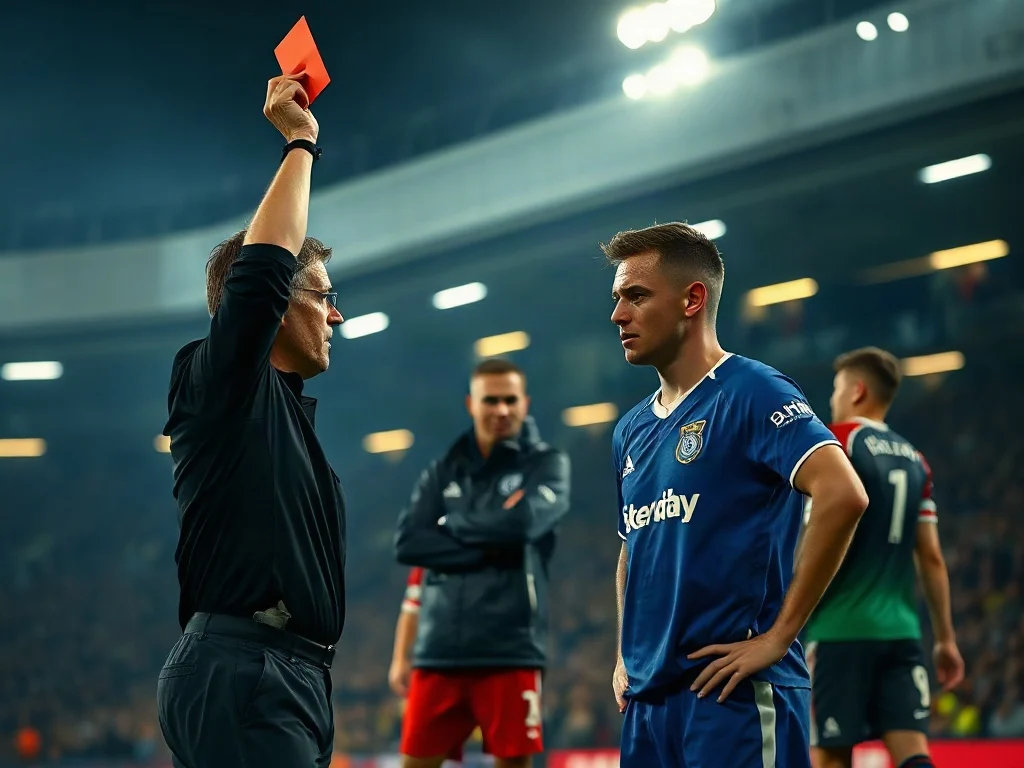
The Tarkowski red card turned a difficult Monday night for Everton into a chastening one. James Tarkowski, the club’s captain, was sent off for the first time in his Premier League career during a 4-0 defeat at Brentford. The dismissal also spoiled the evening for manager David Moyes. The obvious question is whether the decision was deserved or harsh. This article sets out what is confirmed, explains how referees judge such incidents, and looks at what the dismissal means for Everton.
What We Know About the Everton Captain’s Sent-Off Moment
The confirmed facts are limited. Tarkowski was shown a red card in Everton’s 4-0 loss at Brentford, and it was the first red of his Premier League career. The reporting frames the decision as debatable, which is why the question of whether it was harsh has attracted so much attention.
This article does not describe the exact minute, the nature of the challenge or the referee’s stated reason, because those details are not part of the information available here. Anyone assessing the decision should check the match footage and the official match report. What can be done is to explain the standards the decision should be measured against.
Why a First Red Card Matters
Tarkowski is an experienced defender who has played many Premier League matches without being sent off. A clean disciplinary record is not proof of innocence in any single incident. Still, it suggests a player who normally manages risk well, and it makes a red card less likely to be the result of a habitual pattern of reckless challenges.
It also matters because he is the captain. A captain is the player the referee talks to, the organiser of the back line and the voice that steadies a team when a game turns against it. Losing that figure mid-match has consequences beyond the numerical disadvantage.
How Red Cards Are Judged Under the Laws of the Game
Decisions on dismissals follow the Laws of the Game, which are maintained by the International Football Association Board and published on the IFAB website. Law 12 covers fouls and misconduct. A red card can be issued for several distinct offences.
| Category | What the referee must judge |
|---|---|
| Serious foul play | Excessive force or brutality, or endangering an opponent’s safety |
| Denying a goal-scoring opportunity | Whether a foul or deliberate handball stopped an obvious chance to score |
| Violent conduct | Excessive force against an opponent or anyone else away from a challenge for the ball |
| Second caution | An accumulation of two yellow cards in the same match |
| Offensive or abusive behaviour | Language or gestures that cross the threshold for a sending-off |
For a defender, the most common routes to dismissal are serious foul play and the denial of an obvious goal-scoring opportunity. They involve different tests. The first is about how dangerous the challenge was. The second is about the attacking situation: how far the goal was, which direction play was heading, how many defenders were covering and how much control the attacker had.
Why Intent Is Not the Deciding Factor
A frequent misunderstanding in debates like this one is that a player must have meant to hurt an opponent. Under the Laws, intent is not required for a challenge to be classed as serious foul play. A tackle can be mistimed, arrive late or use studs in a dangerous way, and still merit a red card even if the defender was trying to win the ball. That is why many sendings-off feel unfair to supporters while remaining consistent with the Laws as written.
The Role of VAR
The video assistant referee can review direct red card incidents, though not a second yellow. The Premier League’s match officials are provided by PGMOL. The VAR’s role is to correct a clear and obvious error, not to substitute a different opinion on a close call. That is why a debatable red card can stand: the on-field decision only has to fall within a defensible range.
Was the Tarkowski Red Card Deserved?
Without the exact details of the challenge, a definitive verdict would be speculation. A fair assessment weighs four questions that apply to almost any defender’s dismissal.
- Point of contact: Did the defender win the ball first, or make contact with the opponent’s leg or body?
- Force and speed: Was the challenge reckless, or was it a normal contest for the ball between two players moving at pace?
- Attacking situation: If the offence was a denied chance, was it truly an obvious goal-scoring opportunity, or was there cover and a realistic defensive recovery?
- Referee’s position: Did the match officials have a clear angle, and did replay evidence confirm or undermine the original call?
If the answers show clear contact with excessive force, the red card is defensible however clean the player’s record. If the contact was marginal or the situation did not meet the threshold for an obvious chance, the case for harshness is stronger. The question in the original report, whether the decision was harsh, can only be settled by applying these tests to the footage.
A sending-off can be correct under the Laws and still feel unjust to the player and the fans. The reverse is also true.
The Impact on a 4-0 Defeat
It would be too simple to blame the scoreline entirely on the red card. A 4-0 result usually reflects more than one problem. The timing of the dismissal matters. A red card early in a match can shape the whole contest, while one late in a game that is already lost mostly adds insult to injury. Because that timing is not confirmed here, it would be wrong to claim the sending-off caused the heavy defeat.
What can be said is how a red card generally affects a team. The side with ten men must either drop deeper, which invites pressure and set pieces, or hold its line and risk being stretched by runners in behind. Removing the central defender who organises the back line makes both options harder. A strong home side at Brentford’s stadium can exploit the extra space quickly.
What It Means for Moyes and Everton
For Moyes, the problem is partly practical. A dismissed player faces an automatic suspension, and for a captain and regular centre-back that means a reshuffle of the defensive unit at short notice. The length of the ban depends on the category of offence. A foul that denies a goal-scoring opportunity typically carries a shorter ban than serious foul play, but the exact sanction should be checked against the Football Association‘s published regulations.
Options for the Club
- Claim wrongful dismissal: Clubs can ask the FA to review a red card they believe was a clear mistake. These claims are not always successful, and the standard is whether the referee made an obvious error.
- Accept the ban and adjust: Move another defender into the back line and decide who wears the armband in the captain’s absence.
- Address the wider defensive picture: Treat the 4-0 scoreline as a team issue rather than a single-incident issue.
Practical Lessons for Defenders and Coaches
Whatever the verdict on this case, it highlights habits that reduce the risk of red cards at every level of the game.
- Avoid last-ditch challenges: Most dismissals for denied chances come from a defender who is already beaten. Better positioning and earlier decisions reduce them.
- Manage the angle of approach: Coming in at speed with studs showing is the typical profile of serious foul play.
- Use cover: A defender who knows a teammate is covering can delay rather than lunge.
- Prepare the squad for ten-man scenarios: Training the shape a team will use after a red card means fewer improvised mistakes in matches.
Frequently Asked Questions
Was this Tarkowski’s first Premier League red card?
Yes. According to the reporting on the match, it was the first time he had been sent off in a Premier League match.
Did the red card cause Everton’s 4-0 defeat at Brentford?
Not necessarily. A red card can contribute heavily to a heavy loss, but without confirmation of when it happened and how the game was going, it is unwise to treat it as the sole cause.
Can Everton appeal the sending-off?
Clubs can submit a claim of wrongful dismissal to the FA. It is typically successful only when the decision is judged to be a clear error.
Does a player need to intend to injure an opponent to be sent off?
No. Serious foul play is judged on force and danger, not on whether the player meant to cause harm.
The Question Everton Cannot Ignore After Brentford
The most important insight is that a red card debate can hide a bigger issue. Whether the decision was correct or harsh matters for an appeal and for a captain’s reputation. The scoreline, though, is a team result, and four goals conceded away from home is a defensive problem that a single dismissal does not fully explain.
Watch three things next. First, whether Everton lodge a wrongful dismissal claim, which would show how strongly the club believes the call was wrong. Second, how Moyes reorganises a back line without its captain, and whether the replacement pairing looks more or less secure. Third, whether Tarkowski returns with the same assertiveness or plays with extra caution after his first dismissal. The reasoned expectation is that the ban will be short-lived, but how Everton respond to a heavy defeat will say more about their season than the card itself.
Frequently Asked Questions
Can Everton appeal the Tarkowski red card if they think it was harsh?
Clubs can submit a claim of wrongful dismissal to the Football Association, which usually reviews the incident and can overturn the card and the suspension. The article does not say whether Everton will do so, so check the club's statements and the FA's decision.
Does a first red card in the Premier League make a dismissal less likely to be deserved?
No. A clean record is not proof that a single challenge was legitimate. Referees judge each incident on its own, using force, danger and the attacking situation. The record only suggests that Tarkowski normally manages risk well and is not a habitual reckless tackler.
Does a player need to intend to hurt an opponent to be sent off for serious foul play?
No. Under Law 12, intent is not required. A mistimed or late tackle, or one that uses studs dangerously, can be red-card serious foul play even when the defender was trying to win the ball. That is why some dismissals seem unfair yet still follow the Laws.
Why can a debatable red card still stand after a VAR check?
VAR only intervenes to correct a clear and obvious error, not to replace the referee's view on a close call. If the on-field decision falls within a defensible range, it stays, even when many supporters think it was harsh. VAR can review direct reds, but not second yellows.
Why does it matter that the player sent off was the captain?
A captain talks to the referee, organises the back line and steadies the team when a match turns against them. Losing him mid-game therefore costs more than the numerical disadvantage. In this case it also removed Everton's defensive leader during a 4-0 defeat.
Where can I check whether the Tarkowski red card was correct?
The article does not give the minute, the nature of the challenge or the referee's reason. To judge it, watch the match footage and read the official match report, then compare the incident with Law 12 on the IFAB website.