
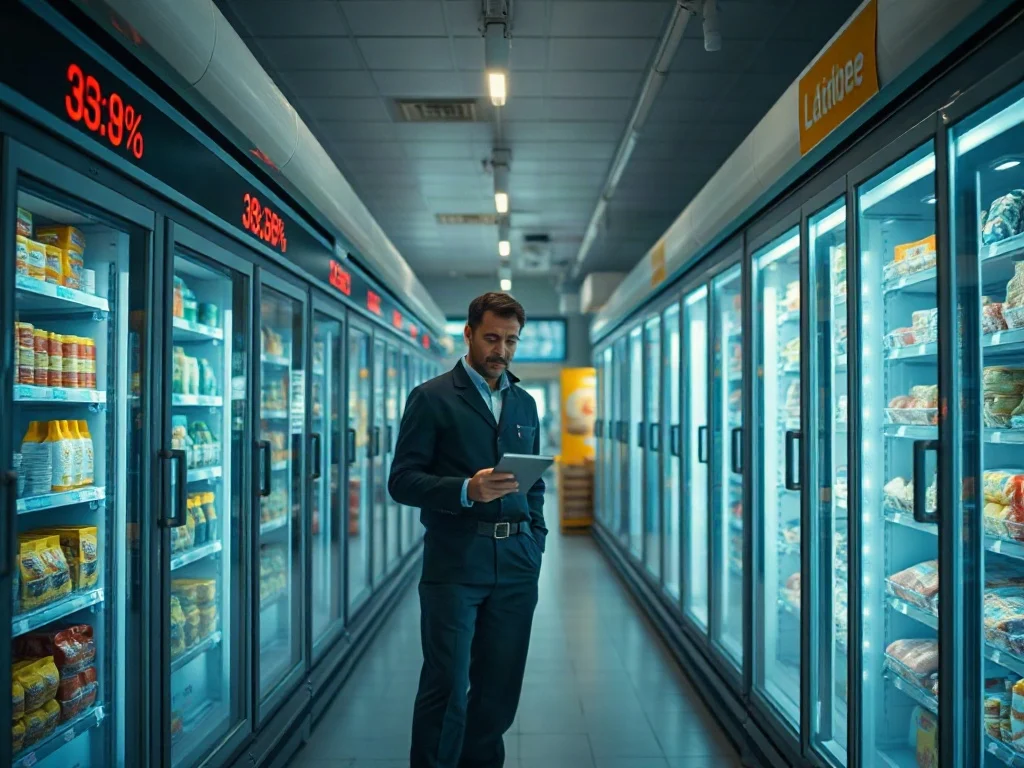
France has accused Iran of supermarket fridge hacking, a cyber-attack last month in which refrigerators and freezers in hundreds of supermarkets across the country were reportedly made to heat up. The incident is unusual because it appears to target the physical condition of food, not data, payments or websites. This analysis separates what is publicly reported from what is plausible, explains why refrigeration is a credible target, and sets out what retailers and regulators should take from the episode.
The reported core facts are brief: a cyber-attack last month, fridges and freezers in hundreds of French supermarkets heated up, and the French government blames Iran.
That is the whole verified outline. The reporting summarized here does not name the retailers, the technical method, the duration of the temperature excursions, or the volume of food lost, and this article does not invent those details. What can be examined is the logic of the attack, the attribution claim and the defensive lessons.
What Is Actually Known About the Attack
The established elements are few. A cyber-attack occurred last month. It affected refrigeration equipment in hundreds of supermarkets in France. The effect was a rise in temperature in fridges and freezers. French officials attribute the operation to Iran.
Several points remain unconfirmed in the material available:
- Whether one supplier, one software platform or many separate systems were compromised.
- Whether the heating was a deliberate setpoint change, a disabled compressor or a control failure.
- Whether food was actually spoiled or discarded, or alarms triggered a rapid response.
- What evidence underpins the attribution, and how confident officials are.
Readers should treat any claim beyond these points as interpretation until French authorities or the affected companies publish technical findings.
Why Refrigeration Is a Credible Cyber Target
A supermarket fridge looks like a simple appliance, but modern commercial refrigeration is a networked industrial control system. Compressors, evaporator fans, defrost cycles and temperature sensors are managed by controllers, often a form of programmable logic controller. These report to a central monitoring platform used by store managers, head office and maintenance contractors.
The Operational Technology Gap
This equipment belongs to operational technology (OT) rather than conventional IT. OT systems are built for uptime and longevity, not for frequent patching. Many use legacy protocols such as Modbus, which was designed without authentication. Once an attacker reaches the network segment where such controllers sit, issuing a valid command may need no exploit at all.
Remote Access as the Weak Point
Retailers commonly outsource refrigeration maintenance. Contractors need remote access to diagnose faults across hundreds of stores, which creates a concentrated attack surface: a VPN account, a remote-management portal or a vendor cloud platform. Compromising one such service could in principle affect many sites at once, which is the pattern of a supply chain attack. Whether that happened here is not public. The geographic spread, hundreds of stores, is consistent with a central point of compromise, but that is inference, not confirmation.
The Role of the Internet of Things
Sensors and gateways in the Internet of things are frequently deployed with default credentials, weak update mechanisms and cloud dependencies. Their security quality varies widely between manufacturers, and retailers rarely audit them as rigorously as payment systems.
How Could Fridges Be Made to Heat Up?
Public information does not establish the method. The plausible mechanisms are worth comparing, because each implies a different defence.
| Possible mechanism | Effect | Status in this case |
|---|---|---|
| Altered temperature setpoints in the central platform | Compressors stop cooling at the intended level | Unconfirmed |
| Commands to disable compressors or force defrost cycles | Rapid temperature rise | Unconfirmed |
| Falsified sensor readings | Controllers act on wrong data; alarms may stay silent | Unconfirmed |
| Ransomware or wiper malware on the control layer | Loss of control and monitoring | Unconfirmed |
The most worrying variant is falsified readings combined with suppressed alarms. Spoilage then goes unnoticed until stock is already unsafe. A visible failure triggers emergency procedures, whereas a silent one converts a cyber problem into a public-health problem.
The Attribution Question: How Reliable Is the Accusation?
Naming a state in connection with a cyber-attack is a political and technical act. Iran’s cyber operations have a documented history, including the destructive Shamoon malware used against Saudi Aramco in 2012. That history makes the accusation plausible in the abstract. It does not prove it in this case.
Attribution typically rests on a mix of infrastructure overlap, tooling, tactics, intelligence and sometimes classified sources. Governments rarely publish all of it. Critics argue that official attributions can be shaped by diplomatic goals, while defenders note that the public cannot be given material that would burn intelligence sources. The sensible position is to treat the claim as credible but unverified until technical evidence, ideally from independent researchers, is published. Any Iranian response should be weighed on the same basis.
The target choice also deserves scrutiny. A state wishing to signal capability without causing casualties might prefer an operation whose damage is economic and psychological, such as spoiled stock and public alarm. That is an interpretation, not a finding. The cyber-attack on a food retailer carries a different escalation profile than one on a power grid, such as the 2015 Ukrainian grid attack, and it is deniable in a way that attacks on military targets are not.
Consequences: Food Safety, Economics and Trust
Public Health
The cold chain exists to keep perishable food below temperatures at which bacteria multiply quickly. Failures create the conditions for foodborne illness. Retailers operate under HACCP principles that require monitoring of critical control points, and temperature is the clearest example. A cyber-attack that corrupts monitoring undermines the food-safety system itself, not just a piece of equipment.
Economic Impact
Even where no one is harmed, the costs are real: discarded stock, emergency technician visits, lost sales and investigation work. Because the reported incident spans hundreds of stores, costs scale with the number of sites. No figures have been published in the material summarized here, and none should be assumed.
Consumer Confidence
The reputational damage can outlast the technical fix. A shopper who learns that chilled products may have been exposed to heat will question every purchase, and retailers face the difficult task of proving a negative: that products on sale were safe.
Practical Defences for Retailers and Operators
The incident, as reported, points to defences that are well known but unevenly applied.
- Segment OT from IT. Apply network segmentation so that a compromised corporate or vendor account cannot reach refrigeration controllers.
- Harden remote access. Enforce multi-factor authentication, time-limited vendor sessions and full logging for every maintenance connection.
- Use independent temperature monitoring. Battery-powered loggers with their own cellular or local alarms cannot be silenced through the main platform. This is the single most effective safeguard against falsified readings.
- Remove default credentials and inventory every networked device in the store, including those installed by contractors.
- Rehearse manual fallback. Staff should know how to check temperatures by hand and move stock to working units.
- Contractually bind suppliers. Require vendors to disclose security practices, patch timelines and breach notification duties.
A common mistake is to treat refrigeration as facilities management rather than a cyber-risk asset. Security teams often have no visibility into it, and facilities teams have no security training. Closing that organisational gap matters more than any single tool. Guidance on ICS security is available from the U.S. Cybersecurity and Infrastructure Security Agency and from France’s ANSSI.
Regulatory and Strategic Implications
Food retail is not always classified as critical infrastructure, yet food supply plainly is. European cyber rules have expanded the range of regulated sectors in recent years, and an incident like this strengthens the argument for covering large food distributors and retailers explicitly. Operators should expect more demanding reporting obligations and audits of OT environments.
The comparison with earlier events is instructive. Stuxnet demonstrated that software can cause physical damage to industrial equipment. The Colonial Pipeline ransomware attack showed that even IT-side compromise can halt physical supply. A fridge-heating campaign, if confirmed as described, combines both lessons against a sector with thin margins and limited security staffing.
Frequently Asked Questions
Can hackers really make supermarket fridges heat up?
Yes, in principle. If an attacker gains access to the control platform or controllers, they can change setpoints or disable cooling. Whether this was the exact method used in France has not been publicly confirmed.
Has Iran been proven responsible?
No public technical proof is cited in the reporting summarized here. France has accused Iran; independent verification has not been presented.
Is food from affected supermarkets unsafe?
The available information does not say how long temperatures stayed elevated or what stock was removed. Food safety depends on those details and on retailers’ monitoring and disposal procedures.
How can supermarkets protect refrigeration systems from cyber-attacks?
Segmentation, strong remote-access controls, independent temperature alarms, device inventories and tested manual procedures are the most effective measures.
The Cold Chain as a Strategic Target
The most important insight is that the value of this attack, if the accusation holds, lies in its category rather than its sophistication. It shows that consumer-facing, low-profile OT systems can deliver visible, politically useful disruption without destroying anything. The cheapest defence, independent monitoring that does not trust the network, is also the one most often missing.
Three things deserve attention. First, whether French authorities publish technical evidence strong enough to move attribution beyond assertion. Second, whether the entry point proves to be a shared vendor platform, which would implicate refrigeration suppliers across Europe rather than one national market. Third, whether regulators respond by bringing food retail firmly inside critical-infrastructure rules. The unanswered question is whether retailers will treat a warm fridge as a cyber incident before the next one forces the issue.