
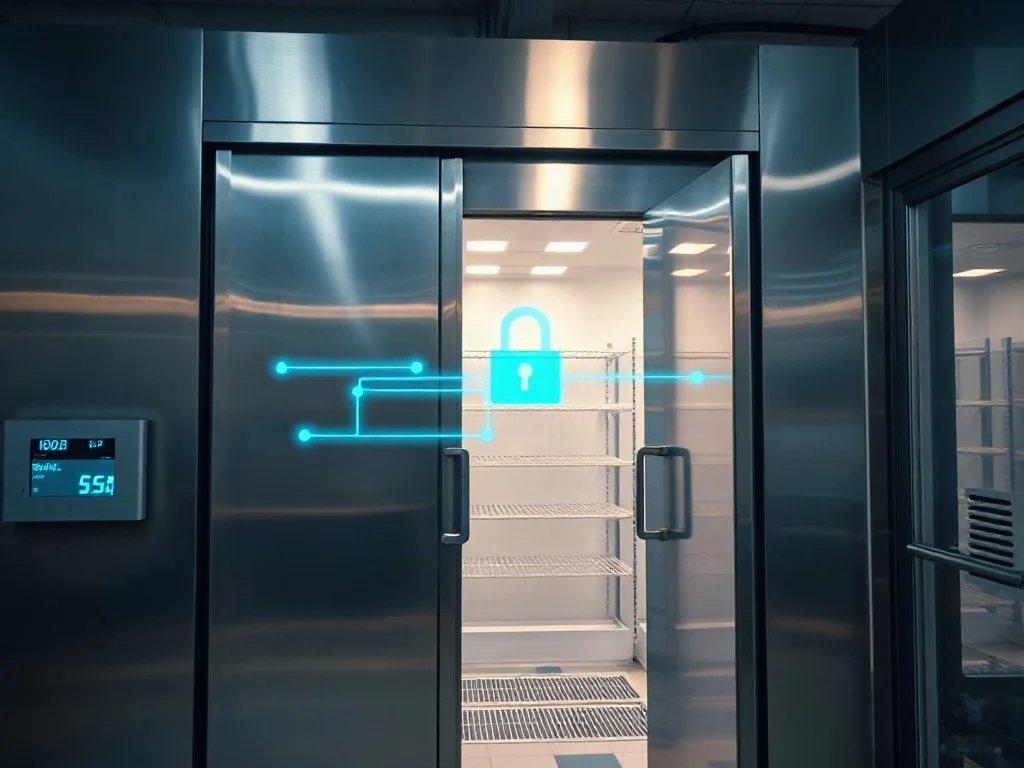
A wave of attacks on internet-connected refrigeration, reported to have affected blood laboratories and grocery stores, has made IoT security risks hard to dismiss as a niche concern. When a compromised fridge can threaten medical testing or food supply, the question is no longer whether connected devices are worth securing. The question is why so many remain unprotected. This article looks at what the fridge-hacking spree shows about the weaknesses of the Internet of Things, why basic lapses keep causing serious consequences, and what operators can do about it.
The source reporting describes escalating hacks tied to simple security failures in internet-connected devices. Public detail on individual incidents is limited, so this analysis does not attribute specific attacks to specific actors or methods. Instead, it explains the well-documented weaknesses that make this kind of attack possible and how to reduce exposure.
“Escalating hacks affecting blood labs and grocery stores show the very real risks to critical infrastructure that come from basic security lapses involving internet-connected devices.” (Summary of the news report that prompted this analysis)
Why Fridge Hacking Is a Critical Infrastructure Problem
A refrigerator seems like an odd target. Yet temperature control is the foundation of the cold chain, which keeps vaccines, blood products, reagents and perishable food usable. Many governments classify healthcare and food supply as critical infrastructure, and refrigeration quietly supports both.
What is at stake in a blood lab
Blood samples, reagents and stored components are sensitive to temperature. A fridge that drifts out of range, or that operators can no longer trust, can force a lab to discard material and delay testing. The harm does not require a dramatic breach. A modest disruption to a monitored cold-storage unit can cascade into clinical delays.
What is at stake in a grocery store
For retailers, the exposure is mostly financial and regulatory. Spoiled stock is a direct loss, and temperature failures raise food safety questions. Store chains also run many identical devices across hundreds of sites, so a single weak configuration can repeat at scale.
Why Are IoT Devices Vulnerable to Hackers?
The pattern behind most incidents is mundane. Attackers rarely need exotic exploits when devices are reachable and poorly configured. Several recurring weaknesses explain most of the exposure.
Default and shared credentials
A default password that ships on every unit and never changes is effectively a public key. Installers often leave factory credentials in place because changing them across many devices is tedious and because nobody owns the task after commissioning.
Direct internet exposure
Many controllers and monitoring gateways are reachable from the public internet because it makes remote support easy. Search engines such as Shodan index exposed devices, which lets attackers find candidates without any targeted reconnaissance. Every reachable service adds to the attack surface.
Unpatched and unpatchable firmware
Embedded devices run firmware that vendors may update rarely or never. A commercial refrigeration unit can stay in service for a decade or more, long after its manufacturer has stopped issuing fixes. Each known vulnerability stays open for the life of the device.
Legacy protocols with no built-in security
Industrial protocols such as Modbus were designed for closed networks and often lack authentication or encryption. Once bridged to an internet-facing gateway, they inherit risks they were never built to handle.
A Pattern, Not a Surprise: From Mirai to Refrigeration
Security researchers have warned about this for years. The Mirai malware appeared in 2016 and built a large botnet largely by guessing default credentials on devices such as cameras and routers. That botnet was used in the 2016 Dyn cyberattack, a denial-of-service attack that disrupted access to many well-known websites.
Since then, the stakes have shifted. Early IoT abuse mainly turned cheap gadgets into attack tools against someone else. The newer concern is attacks on the devices themselves because of what they control. The Colonial Pipeline ransomware attack in 2021 showed how disruption to business systems can halt physical operations even when the operational controls were not directly compromised. Refrigeration sits in the same gray zone between office IT and physical process control.
How Fridge Hacking Can Hurt: Scenarios and Limits
It helps to separate what is well established from what is plausible.
- Spoilage and disruption: An attacker who can change setpoints or disable alarms can cause product loss. This is the most direct risk and the one the reported incidents point toward.
- Extortion: Threatening to ruin stock is leverage similar to ransomware, though operators should verify rather than assume that any given incident follows that model.
- Pivot point: A weakly secured device on a flat network can become a foothold for reaching more valuable systems. Whether a given fridge incident involved this depends on the facts of that case.
- Botnet recruitment: Compromised devices can be conscripted into attack infrastructure, as Mirai demonstrated.
There are also limits. Many refrigeration units have independent mechanical thermostats or local alarms, so a remote compromise does not always translate into physical harm. Resilience in the physical design is a legitimate defense, and one reason risk assessments should be specific to each facility.
How to Secure IoT Devices in Critical Infrastructure
Defending connected refrigeration does not require advanced tooling. It requires discipline in basics that organizations often skip. Agencies such as the Cybersecurity and Infrastructure Security Agency (see CISA) and the UK’s National Cyber Security Centre publish guidance that supports the steps below.
- Build an inventory. You cannot protect devices you do not know exist. List every connected controller, sensor and gateway, including those installed by contractors.
- Remove direct internet exposure. Place devices behind a firewall and use a secured remote-access path rather than open ports.
- Replace default credentials. Use unique, strong passwords for each device and store them in a managed vault.
- Enforce multi-factor authentication on vendor portals and cloud dashboards that manage the devices.
- Segment the network. Keep refrigeration and other operational technology separate from corporate and guest networks, applying the principle of least privilege to every connection.
- Plan for patching and end of life. Ask vendors about update policies before purchase and schedule replacement of unsupported units.
- Keep independent safeguards. Maintain local alarms, manual temperature logs and a tested response plan for suspected tampering.
Common mistakes to avoid
- Treating the vendor or installer as fully responsible for security after handover.
- Assuming a device is safe because it is obscure or “only a fridge.”
- Monitoring temperature but not monitoring configuration changes or login attempts.
- Ignoring supply chain exposure from third-party maintenance providers with broad remote access.
Regulation Is Catching Up, Slowly
Governments have started to address the root problem of insecure products. The UK’s Product Security and Telecommunications Infrastructure Act 2022 introduced security requirements for consumer connectable products, including a ban on universal default passwords. The European Union’s Cyber Resilience Act sets cybersecurity requirements for products with digital elements, with obligations phasing in over several years.
These laws matter, but with caveats. Rules mostly apply to newly sold products, while the installed base of older commercial equipment will persist for years. Some regimes also focus on consumer devices, which leaves a gap for industrial and commercial refrigeration. In practice, operators will rely on procurement requirements and contracts rather than waiting for regulation.
Frequently Asked Questions
Can a smart fridge really be hacked?
Yes, any internet-connected device with weak credentials, exposed services or unpatched software can be compromised. Commercial refrigeration controllers carry the added risk that they manage safety-critical conditions.
Why would attackers target refrigeration?
Reasons can include disruption, extortion, access to a larger network, or opportunism because the devices are easy to find and weakly protected. The motive differs from case to case, and reported incidents should be read cautiously until investigations are complete.
What is the single most effective step to reduce IoT risk?
Removing direct internet exposure and replacing default passwords together close the most commonly exploited gaps. They are not a complete defense, but they address the lapses that this kind of attack typically depends on.
Who is responsible for IoT security in a business?
Ultimately the operator. Vendors and installers share responsibility for secure design and setup, but the organization that depends on the equipment must own inventory, access control and response planning.
The Real Lesson Behind the Fridge-Hacking Spree
The most important insight is that this is not a technology problem waiting for a breakthrough. The failures described are old and well understood: default passwords, open exposure, forgotten devices and unclear ownership. What has changed is the consequence. Connected equipment now sits inside medical and food systems, and attackers have noticed that the least glamorous devices are often the easiest ones to reach.
Three things are worth watching over the next few years. First, whether procurement standards and the new product-security laws change what operators buy, especially in commercial and industrial equipment where legal coverage is thinner. Second, whether insurers begin to demand evidence of basic device hygiene, which could move budgets faster than regulation. Third, whether healthcare and food regulators start to treat cold-storage cybersecurity as a formal compliance requirement rather than an IT afterthought.
A reasonable prediction is that incidents like these will keep appearing until ownership of device security becomes explicit in contracts and audits. The unanswered question is who pays for replacing the large installed base of insecure equipment: manufacturers, operators, or the public when something fails. Until that is settled, the humble refrigerator will remain a measure of how seriously we take the infrastructure we cannot see.
Frequently Asked Questions
Why would attackers target a refrigerator instead of a more obvious system?
Refrigerators are often poorly secured and reachable online, so they are easy targets. They also support the cold chain for blood products, vaccines and food. Disrupting temperature control can cause real operational and financial damage without a sophisticated breach, which makes weakly protected cooling equipment attractive.
Can attackers find vulnerable devices without targeting a specific organization?
Yes. Search engines such as Shodan index internet-exposed devices, so attackers can list reachable refrigeration controllers or gateways without any targeted reconnaissance. If a device is online with default credentials or an open service, it can be found and tried automatically, regardless of who owns it.
Why can't operators simply patch old refrigeration equipment?
Commercial refrigeration units can stay in service for a decade or more, often outliving vendor support. Manufacturers may release firmware updates rarely or never, so known vulnerabilities stay open for the device's life. In these cases, operators must rely on isolation, network controls and monitoring instead of patches.
Why are industrial protocols like Modbus a risk when connected to the internet?
Modbus and similar protocols were designed for closed, trusted networks and often have no authentication or encryption. When bridged to an internet-facing gateway, anyone who reaches the service may be able to read or send commands, so the protocol inherits risks it was never built to handle.
How does the Mirai botnet relate to the fridge-hacking attacks?
Mirai, which appeared in 2016, built a huge botnet mainly by guessing default credentials on cameras and routers, and was used in the Dyn attack. It shows that simple credential failures can scale into major disruption. The fridge attacks reflect the same basic weaknesses, now affecting critical services.
Does the article say who carried out the fridge attacks or how?
No. The article notes that public detail on individual incidents is limited, so it does not attribute attacks to specific actors or methods. Instead, it explains well-documented weaknesses, such as default passwords, internet exposure, unpatched firmware and legacy protocols, that make this kind of attack possible.