
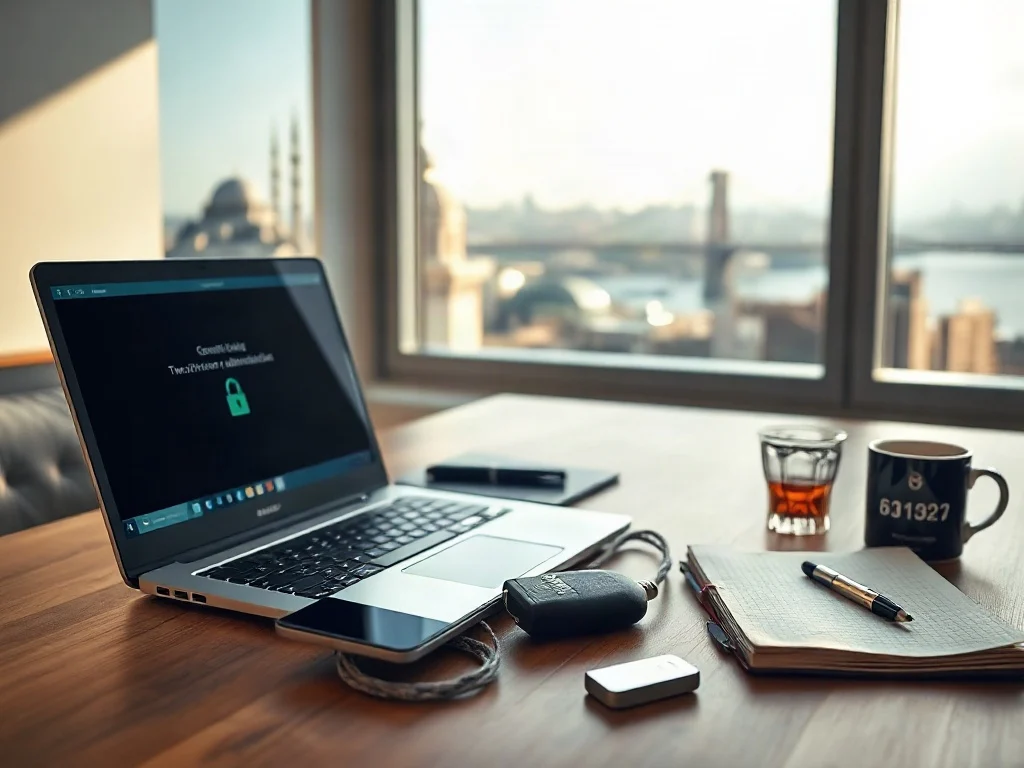
For a company trading between Istanbul, Izmir, London or Manchester, small business online security is not a technical extra. It is part of how you keep customers, suppliers and cash flow safe. Cross-border firms handle invoices in several currencies, share files across time zones and often rely on staff or freelancers working from different networks. Each of those habits creates an opening for attackers. This guide covers the basics that stop most real-world incidents: strong passwords, two-factor authentication, phishing awareness, safe cloud storage and encrypted email. It also explains how they fit together for a business operating under both UK and Turkish expectations.
Most small-company breaches do not involve sophisticated hacking. They start with a reused password, a convincing fake invoice or a shared folder that was never locked down. That is good news, because the controls that prevent these failures are inexpensive and well understood.
Why Small Turkish-UK Companies Are Attractive Targets
Attackers rarely pick victims by size. They pick them by ease. Small firms often have no dedicated IT staff, informal approval processes for payments and a mix of personal and business devices. The UK government’s Cyber Security Breaches Survey has repeatedly found that around half of UK businesses report a breach or attack in a given year, with phishing the most common type among those affected. Exact figures vary by year and business size, so check the latest edition on GOV.UK before quoting it.
A Turkish-UK business adds specific risks:
- Payment redirection fraud: a fake email claims a supplier has changed bank details. This is a form of business email compromise, and cross-border transfers are harder to reverse.
- Language and context cues: messages in Turkish or English that mention real customs, shipping or tax matters look more credible.
- Dual compliance: you may need to consider the General Data Protection Regulation as retained in UK law, overseen by the Information Commissioner’s Office, and Turkey’s personal data law (KVKK, Law No. 6698). Cross-border data transfers need legal advice specific to your situation.
Strong Passwords: The Foundation You Cannot Skip
What makes a password strong in practice
Length matters more than complexity. The UK’s National Cyber Security Centre recommends combining three random words into a long passphrase instead of forcing symbol-heavy rules that people work around. A passphrase such as three unrelated words is far harder to guess than a short string with a swapped-in number. Because it is easier to remember, staff are less likely to write it down or reuse it.
Why reuse is the real danger
When a third-party site is breached, attackers try the stolen credentials elsewhere in a technique known as credential stuffing. If one employee uses the same password for a supplier portal and your email, the weakest site decides your security. You can check whether an address has appeared in known breaches using Have I Been Pwned.
Use a password manager
A password manager generates and stores unique credentials for every account, so nobody has to memorise them. For small teams, choose one with shared vaults, an administrator role and the ability to remove a leaver’s access quickly. Protect the manager itself with a long master passphrase and multi-factor authentication.
Two-Factor Authentication for Small Business Accounts
Two-factor authentication for small business accounts adds a second proof of identity beyond the password. It is a subset of multi-factor authentication. If a password leaks, the attacker still cannot log in without the second factor.
Choosing the right second factor
| Method | Strength | Main weakness |
|---|---|---|
| SMS code | Better than nothing | Vulnerable to SIM swap fraud and interception |
| Authenticator app (time-based one-time password) | Good for most small firms | Codes can be phished in real time |
| Hardware security key (WebAuthn/FIDO2) | Strongest; resists phishing | Cost and the need for spare keys |
Prioritise the accounts that would hurt most if lost: business email, online banking, your domain registrar, cloud storage and accounting software. Enable recovery codes and store them offline, because a lost phone should not lock you out of the company.
Phishing Awareness: How to Protect Your Business from Phishing
Many owners ask how to protect a business from phishing. Technology helps, but the most reliable control is a team that pauses before acting. Phishing is a form of social engineering, so it exploits urgency, authority and routine rather than software flaws.
Warning signs worth teaching
- Unexpected urgency, such as an overdue payment or a suspended account.
- A sender name that looks right but a domain that is slightly off.
- Requests to change bank details, gift card purchases or secrecy instructions from a supposed director.
- Links that reveal a different address when you hover over them.
- Attachments you did not expect, especially archives or macro-enabled documents, which are a common route for ransomware.
Process beats vigilance
Rules that do not depend on spotting a clever fake work best. Require a phone call to a known number before any bank detail change. Require a second person to approve payments above an agreed threshold. Encourage staff to report suspicious messages without fear of blame, because fast reporting limits the damage.
Technical email protections
Ask whoever manages your domain to configure SPF, DKIM and DMARC. These make it harder for criminals to send mail that impersonates your domain to your customers and suppliers. They do not stop every phishing attempt aimed at your staff, so training still matters.
How to Secure Cloud Storage for Small Business
People often search for how to secure cloud storage for a small business after discovering a folder shared with “anyone with the link”. Cloud computing can be safer than an office server, but only when it is configured with care. Our guide to choosing safe cloud storage for your business goes deeper into providers, and the essentials are below.
Configuration checklist
- Apply least privilege. Give each person access only to the folders they need.
- Audit sharing links. Review public and external links monthly, and set expiry dates.
- Enforce two-factor authentication for every user, including the administrator.
- Keep independent backups. A synced folder is not a backup, because deleted or encrypted files sync too. Follow a sound backup routine with at least one copy kept offline or immutable.
- Check data location. Know where your provider stores data, since this affects UK and Turkish data protection obligations.
- Remove leavers promptly. Revoke access on the last working day.
Provider-side versus client-side encryption
Most providers encrypt data in transit and at rest, but they usually hold the keys. For highly sensitive files such as contracts, payroll or customer identity documents, consider client-side encryption so that only you can decrypt them. The trade-off is that a lost key can mean permanently lost data.
Encrypted Email for Business and Secure Connections
Standard email is often compared to a postcard: it may be protected between servers by Transport Layer Security, but it is generally readable by providers and can be exposed if any hop is unprotected. Encrypted email for business becomes important when you send contracts, financial statements or personal data between Turkey and the UK.
Options compared
- End-to-end encryption services: only sender and recipient can read the message. These are simple to adopt but work best when the other party uses the same service or a password-protected portal.
- PGP and S/MIME: mature standards with strong protection, but key management can be demanding for non-technical teams.
- Encrypted attachments: a pragmatic fallback, provided you share the password through a different channel.
Our article on how encrypted email works for small teams explains setup in detail. Encryption does not stop phishing, though. A perfectly encrypted message from an impostor is still fraud.
Where a VPN fits
A virtual private network protects traffic on untrusted networks such as hotel or airport Wi-Fi, which matters for staff travelling between Turkey and the UK. It does not secure your accounts or stop malware, and a poor VPN provider can see your traffic. Read our guide to choosing a VPN for your business before buying.
Putting It Together: A Practical 30-Day Plan
- Week 1: Deploy a password manager, then change passwords on email, banking and domain accounts.
- Week 2: Enable two-factor authentication everywhere it is offered, prioritising email and finance.
- Week 3: Run a short phishing briefing, and write down a payment verification rule.
- Week 4: Audit cloud sharing, set up backups, and decide how sensitive documents will be encrypted.
Consider working towards the UK’s Cyber Essentials scheme, a government-backed certification that also reassures UK customers. The NCSC’s Small Business Guide is a free, authoritative companion to this article.
Common mistakes to avoid
- Relying on SMS codes for the most critical accounts.
- Sharing one login among several staff.
- Treating cloud sync as a backup.
- Training staff once and never repeating it.
- Ignoring offboarding, so former contractors retain access.
Frequently Asked Questions
What is the most important first step in small business online security?
Secure your email account with a unique passphrase and two-factor authentication. Email is the key to password resets for almost every other service.
Is two-factor authentication really necessary for a very small company?
Yes. Attackers automate attacks and do not check company size. Two-factor authentication blocks most account takeovers that rely on stolen passwords.
Do I need to follow both UK and Turkish data protection rules?
If you handle personal data of people in both countries or transfer it across borders, you may have obligations under both regimes. Seek advice from a qualified data protection adviser and consult the ICO guidance.
Is a VPN enough to protect my business?
No. A VPN protects traffic on untrusted networks, but it does not replace strong authentication, phishing training, backups or encryption.
The Next Frontier: Passkeys, AI Fraud and the Human Layer
The most important insight is that small business online security is mostly about removing easy mistakes, not buying advanced tools. Strong, unique credentials and a second factor close the most common doors, and a verification habit for payments closes the most expensive one.
What to watch next is the shift towards passkeys, which replace passwords with phishing-resistant cryptographic credentials, and the rise of AI-generated messages that remove the spelling errors and awkward translations staff were once taught to spot. It is a reasonable prediction, not a certainty, that this will push small firms away from “spot the fake” training and towards process-based controls and hardware-backed login. The unanswered question for Turkish-UK businesses is how quickly data protection rules, banking safeguards and customer expectations will converge across both markets. The firms that build these habits now will be better prepared whichever way that goes.
Frequently Asked Questions
Why is a three-word passphrase better than a short complex password?
Length makes a password harder to guess, while forced symbols and numbers push people toward predictable tricks. Three unrelated words are also easier to remember, so staff are less likely to write them down or reuse them across accounts. The NCSC recommends this approach for that reason.
How can one employee's reused password put the whole company at risk?
If a third-party site is breached, attackers try the stolen login details on other services, which is called credential stuffing. When someone uses the same password for a supplier portal and company email, the weaker site decides your security. Unique passwords stored in a password manager prevent this chain reaction.
Is SMS two-factor authentication still worth using?
Yes, it is better than having no second factor, but it is the weakest option. Attackers can intercept codes or carry out SIM swap fraud. If possible, move important accounts to an authenticator app, or to hardware security keys for the most sensitive ones, such as banking and email administration.
What features should a small team look for in a password manager?
Choose one with shared vaults, an administrator role and the ability to revoke a leaver's access quickly. These matter for small firms using freelancers or staff on different networks. Protect the manager itself with a long master passphrase and multi-factor authentication, since it holds every other credential.
Why is payment redirection fraud especially risky for Turkish-UK firms?
Fake emails claiming a supplier has changed bank details are a form of business email compromise. Cross-border transfers are harder to reverse, and messages mentioning real customs, shipping or tax matters in Turkish or English look more credible. Verify any bank change through a separate, known contact method before paying.
Do I need to follow both UK and Turkish data protection rules?
Possibly. A business operating in both countries may need to consider UK GDPR, overseen by the Information Commissioner's Office, and Turkey's personal data law, KVKK (Law No. 6698). Cross-border data transfers raise specific questions, so take legal advice tailored to your situation.