
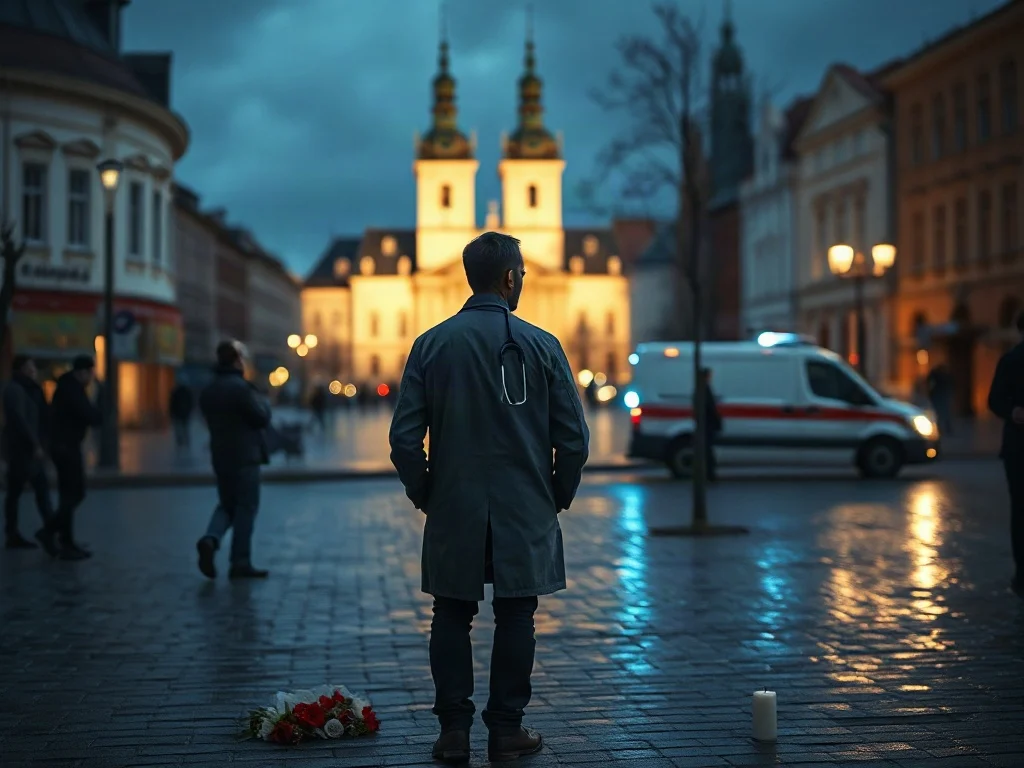
The Krakow shooting suspect was treated by a doctor who later said, “I treat all these people like they are victims.” The sentence is short, and it raises one of the oldest questions in medical ethics: what does a clinician owe a patient who is also the suspected author of the harm around them? According to the reporting, two doctors were eating near the city’s Main Market Square when a gunman began firing at random. They were not on shift and had no protective equipment. They were ordinary diners who became responders. This analysis does not retell the attack, since the published details are limited. It examines what the doctor’s statement means, why it is professionally defensible, and where it deserves scrutiny.
What the Reporting Establishes, and What It Does Not
Only a few facts are firmly on the record. The shooting took place in or near the historic center of Kraków. The gunman fired at random. Two doctors were nearby, and one of them treated the suspect and has spoken publicly about it. The headline and standfirst do not say how many people were hurt, what injuries the suspect had, or what the motive was. This article does not guess at any of that.
That caution matters in a story like this. Early accounts of shootings are often revised, and a doctor’s recollection is one witness perspective, not a forensic record. Readers should treat the quoted statement as an account of professional attitude, not as evidence about the attack. Official updates from Polish prosecutors and police remain the authoritative source for the facts of the case.
Why the Doctor’s Statement Matters
The sentence “I treat all these people like they are victims” can be read in two ways, and the difference is worth noting.
The Charitable Reading: Clinical Neutrality
The doctor may simply be describing clinical neutrality. A patient with a life-threatening injury receives care because of the injury, not because of who the patient is. This is the working norm of emergency medicine. The Hippocratic Oath tradition and the World Medical Association’s Declaration of Geneva both commit physicians to caring for patients without discriminating on the basis of status or character. The Declaration’s official text says that considerations of age, disease, creed, nationality, politics or social standing must not come between a doctor’s duty and the patient.
The Critical Reading: A Loaded Word
The word “victims” is where the statement becomes contested. If it means “everyone here is a human being in need of care,” few would object. If it implies that the suspect and the people he shot occupy the same moral position, many would find it uncomfortable. The better interpretation, and probably the intended one, is that the doctor is separating the clinical role from the judicial role. The doctor’s job is to keep a person alive. A court’s job is to establish guilt. Mixing the two would be dangerous in both directions.
A doctor who withholds care from a suspect has not delivered justice. The doctor has simply appointed himself judge, jury and executioner without evidence or process.
The Ethics of Treating a Suspected Perpetrator
Three principles sit behind this situation. They do not always point the same way.
- Beneficence: the duty to act for the patient’s benefit, as set out in the principle of beneficence.
- Non-maleficence: the duty to avoid harm, traditionally summarized as primum non nocere.
- Justice: fair allocation of limited resources, which becomes decisive when several casualties compete for the same hands.
The weak point in the standard defense is the third principle. Treating a suspect is uncontroversial when resources are adequate. It becomes harder when a single doctor with no equipment faces several injured people. In that situation, the rules of triage apply. Triage ranks patients by clinical urgency and survivability, not by blamelessness. A consistent triage framework is ethically cleaner than any moral ranking, because moral ranking at a chaotic scene would be unreliable, unaccountable and open to abuse. That is the strongest argument for the doctor’s position. It is not softness. It is a protocol that protects the integrity of the whole system.
Duty to Act When Off Duty
The detail that two doctors were simply having a meal changes the analysis. Off-duty clinicians are not always legally bound to respond, but the position varies by country. Good Samaritan laws in many jurisdictions protect responders from liability. Poland, like many European countries, has legal provisions concerning the failure to help a person in immediate danger of death. The precise scope and conditions should be checked against the statute and legal commentary, not inferred from a news summary.
Law aside, the practical reality is stark. In the first minutes after a shooting, survival often depends on whoever is physically present. Professional ambulance crews cannot enter a scene until it is judged safe. This gap, before official help arrives, is where bystander first aid decides outcomes. In this case, the gap was filled by two people whose training happened to be relevant.
The Hidden Cost: Psychological Burden on Responders
The public conversation tends to stop at the quotable line. The longer story is what happens to the clinician afterwards. Treating a person suspected of mass harm, possibly while treating those he injured, creates a recognized risk of secondary traumatic stress. It can also contribute to moral injury, the distress that comes from acting in ways that conflict with one’s own moral expectations, even when the action was professionally correct. The research on first responders and post-traumatic stress disorder is substantial. How well it applies to any single doctor in this case is something no outside observer can know.
The point is analytical, not sentimental. A healthcare system that depends on clinicians treating anyone, whatever the circumstances, must also provide structured debriefing, confidential counseling and time away from work. Praising a doctor’s composure while offering no support afterwards is a policy failure.
Where the Public Debate Often Goes Wrong
Reaction to stories like this usually splits into two predictable camps. One celebrates the doctor’s professionalism. The other recoils at any perceived sympathy for a gunman. Both camps often miss the structural point.
Treating a Suspect Serves the Justice System
A suspect who dies at the scene cannot be questioned, tried or held accountable. Survivors and victims’ families lose the chance of a verdict and a public record. Saving the suspect’s life is therefore also, indirectly, a service to victims.
Medical Confidentiality Has Limits but Still Applies
Once a suspect becomes a patient, medical confidentiality becomes relevant. Doctors may be asked to speak about what they saw. There is a legitimate line between describing one’s general approach and disclosing clinical details about a named patient. Privacy rules such as the General Data Protection Regulation treat health data as a special category. Readers should note how much clinical detail the doctor does not give, because that restraint may be deliberate.
Media Framing Shapes the Aftermath
Headlines that foreground a single quote can distort the underlying ethic. Standards of journalism ethics call for context: what was asked, what was left out, and whether the quote represents the speaker’s full view. A one-line statement, however striking, is not a position paper.
Practical Lessons for Responders and Institutions
The case points to some concrete, non-generic priorities.
- Scene safety comes first. A responder who becomes a casualty helps no one. Off-duty clinicians should assess whether the threat has ended before approaching.
- Bleeding control is the highest-yield skill. Programs such as Stop the Bleed teach laypeople to use direct pressure and a tourniquet to control severe hemorrhage, which is a leading cause of preventable death in mass-casualty incidents.
- Hospitals need written policy for suspect patients. This should cover security, police access, documentation and communication, so that individual clinicians are not improvising under pressure.
- Staff support must be automatic. Debriefing and counseling should be offered by default, not on request, to everyone who treated casualties, including those who treated the suspect.
- Public communication should be designated. Hospitals should decide who speaks on the record and to what extent, so that a clinician’s personal reflection is not mistaken for institutional policy.
The common mistake is to treat the ethical question as settled in principle and ignore implementation. Principle is easy. A trauma bay with several critical patients, a security presence and a hostile public is where the principle is tested.
Frequently Asked Questions
Do doctors have to treat a suspected shooter?
Professional ethics, including the Declaration of Geneva, hold that doctors should care for patients without discrimination. Legal obligations vary by country and by whether the doctor is on duty. In emergency settings, treatment is generally given according to clinical need, regardless of suspected guilt.
Why do doctors treat people who have hurt others?
The clinical role is separate from the judicial one. Doctors treat injury, not guilt. Keeping those roles apart protects patients from arbitrary judgment and preserves the possibility of a trial.
What does the doctor in the Krakow case actually say?
Based on the available headline and summary, the doctor said that he treats all these people as victims. The reporting available here does not detail the injuries, the sequence of events or the doctor’s full reasoning.
Can off-duty medical staff be held liable for helping at a scene?
Many countries have Good Samaritan protections, but the details differ. In Poland, anyone concerned about liability should consult the relevant statutes or a qualified lawyer.
The Question the Quote Leaves Open
The most important insight from the Krakow case is not that a doctor was compassionate. It is that a society’s values show most clearly in how it treats the person it has the strongest reason to despise. A medical system that keeps its rules when the patient is a suspected gunman shows that those rules are principles, not conveniences.
What to watch next is less dramatic than the shooting itself. First, the legal process: whether the suspect’s treatment leads to a trial that gives victims and families an official account. Second, the institutional response: whether Polish hospitals and emergency services use the case to improve protocols, training and mental health support for responders. Third, the tone of the public debate: whether the doctor’s words are treated as an invitation to think or as a provocation.
A reasonable prediction is that the quote will be quoted more often than it is examined. The unanswered question is whether a society can hold two ideas together: that the suspect must be fully accountable, and that the doctor was right to save his life. If it cannot, the pressure will fall on the clinicians who have to act before the argument is settled.
Frequently Asked Questions
Does the doctor's statement mean the suspect and the people he shot are morally equal?
Not necessarily. The article argues the more likely meaning is that the doctor separates the clinical role from the judicial one. His task is to keep a person alive, while a court decides guilt. The word 'victims' is loaded, but it probably expresses care for every patient, not moral equivalence.
Is a doctor really obliged to treat someone suspected of causing the harm?
Generally yes. The Hippocratic tradition and the World Medical Association's Declaration of Geneva commit physicians to care without discrimination based on status, character, politics or social standing. A patient receives treatment because of the injury, not identity. Withholding care would turn the doctor into judge and executioner without evidence or due process.
What happens if a single doctor must choose between the suspect and other wounded people?
Triage rules apply. Patients are ranked by clinical urgency and survivability, not by blame or innocence. The article says this is ethically cleaner than any moral ranking, because judging who deserves help at a chaotic scene would be unreliable. Justice, as fair allocation of limited resources, becomes the decisive principle.
Can the doctor's account be treated as evidence about the attack?
No. The article stresses that a doctor's recollection is one witness perspective, not a forensic record. It shows professional attitude rather than established facts. Early accounts of shootings are often revised, so readers should rely on Polish prosecutors and police for authoritative details about the case.
What facts about the Krakow shooting are actually confirmed in the reporting?
Very few. The shooting happened in or near Kraków's historic center, the gunman fired at random, and two off-duty doctors nearby helped, one of whom treated the suspect and spoke publicly. The number of injured, the suspect's injuries and the motive are not stated, so the article does not speculate.
Why were the doctors able to help with no equipment or shift duty?
They were ordinary diners eating near the Main Market Square, not on shift and without protective gear. They became responders by circumstance. This is why the article notes that resources were limited, which makes the ethical question of whom to treat first more difficult than in a hospital.