
Hagia Sophia and the Blue Mosque are often treated as interchangeable Sultanahmet landmarks, but that framing misses the architectural and operational reality. They are not simply two famous buildings facing each other across a square; they represent two distinct civilizational programs, two different acoustics of worship, and two competing models of heritage management. This analysis is unique because it compares them not as postcards, but as living structures whose meaning depends on structural logic, religious function, access policy, and visitor behavior.
For readers who know the basics: Hagia Sophia was completed in 537 as a Byzantine cathedral, later converted into a mosque, then a museum, and now again functions as a mosque with controlled tourist access. The Blue Mosque, completed in 1616, is an imperial Ottoman mosque designed for continuous worship and public visitation. Their proximity makes comparison convenient, but their interiors, circulation patterns, and symbolic registers diverge sharply.
Architectural Systems: Monumental Innovation vs. Classical Refinement
Hagia Sophia is the more radical building. Justinian’s engineers solved a structural problem that still matters in architectural history: how to suspend a massive central dome over a vast interior without collapsing the visual openness of the nave. The result is not just large; it is conceptually unstable in the best sense. Semi-domes, pendentives, and buttressing create a visual tension that later Ottoman builders studied closely.
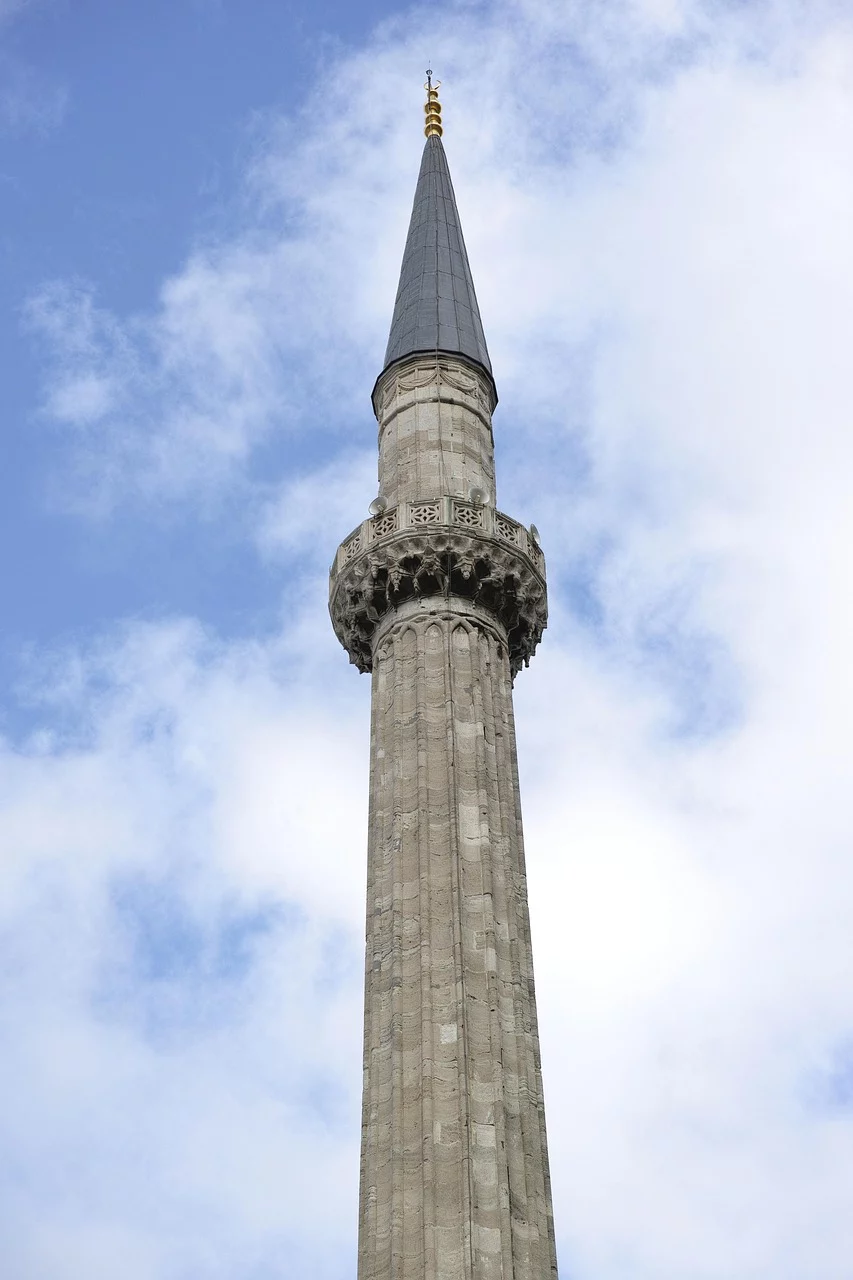
The Blue Mosque is more disciplined. Its domed hierarchy is derived from Hagia Sophia, but it resolves the composition into a more symmetrical and legible Ottoman scheme. The central dome, cascading half-domes, and six minarets create a balanced exterior silhouette. Where Hagia Sophia feels like an architectural argument, the Blue Mosque feels like an architectural answer.
What advanced observers should notice
- Load distribution: Hagia Sophia’s dome is a triumph of spatial compression and structural adaptation; the Blue Mosque uses a later, more confident Ottoman synthesis.
- Visual hierarchy: Hagia Sophia emphasizes mass and transformation; the Blue Mosque emphasizes symmetry and ritual clarity.
- Material reading: Marble, brick, and surviving mosaics in Hagia Sophia reveal layered interventions; İznik tilework in the Blue Mosque creates a more controlled decorative field.
UNESCO’s recognition of the Historic Areas of Istanbul reflects this layered architectural history, but the site value is not merely chronological. It is comparative: one structure demonstrates continuity through conversion, the other demonstrates confidence through design consistency.
Religious Function: Living Mosque vs. Layered Sacred Palimpsest
Both buildings are active mosques, but the visitor experience is not comparable in atmosphere. Hagia Sophia is a palimpsest: Christian and Islamic elements remain in visual tension. The Deësis mosaic, imperial portraits, calligraphy roundels, mihrab, and minbar do not merge into a single style. They coexist under conditions of institutional negotiation. That makes the interior intellectually dense, but also harder to read quickly.
The Blue Mosque is more coherent as a worship space. Its design channels attention toward the prayer axis, while the tiled surfaces and filtered light produce a quieter devotional environment. The building is not less historic because it is active; in some ways, its continued liturgical use preserves the mosque as a functional Ottoman artifact rather than a frozen monument.
Edge cases that matter
- Prayer closures: The Blue Mosque’s access depends on prayer timing, with Friday midday often the least flexible window.
- Tourist routing: Hagia Sophia generally channels foreign visitors through a paid upper-gallery route, which changes how the building is perceived spatially.
- Interpretive friction: Hagia Sophia’s dual identity can produce a more fragmented visitor experience than the Blue Mosque’s more stable mosque function.
In practical terms, this means the Blue Mosque is operationally easier when open, but Hagia Sophia is analytically richer once you accept the constraints of access. For serious travelers, that trade-off is not incidental; it defines the quality of the visit.
Visitor Strategy: Timing, Circulation, and Opportunity Cost
Most tourists underestimate the time cost of transitions in Sultanahmet. Security lines, prayer closures, shoe removal, and route restrictions are not minor inconveniences; they are the system. A disciplined schedule turns the square from a bottleneck into an efficient two-site circuit. A careless schedule turns it into a waiting room.
Based on current travel patterns, Hagia Sophia typically requires 45 to 75 minutes, while the Blue Mosque can be covered in 30 to 60 minutes if prayer windows are favorable. That time estimate assumes deliberate viewing rather than photo-taking alone. If you are doing both in one morning, the optimal strategy is to begin with whichever site is open, then pivot immediately to the other.
Advanced planning tips
- Check prayer times on the day of visit, not the week before; seasonal shifts are enough to invalidate older itineraries.
- Arrive early to minimize queue friction, especially if you want Hagia Sophia’s gallery route without compression.
- Use the Blue Mosque as the variable component and Hagia Sophia as the fixed one in your schedule.
- Wear slip-on shoes and carry a light scarf; this reduces latency at both entrances.
For travelers with limited time or budget, the Blue Mosque’s free entry is strategically valuable. But
Frequently Asked Questions
Why are Hagia Sophia and the Blue Mosque often compared, even though they serve different purposes?
They sit across from each other in Sultanahmet and both shape Istanbul’s skyline, so visitors often lump them together. But the comparison is deeper than location: Hagia Sophia reflects centuries of conversion and layered identity, while the Blue Mosque was designed from the start as a coherent imperial Ottoman mosque. Their similarity is visual; their meaning is not.
In what sense is the Blue Mosque considered a response to Hagia Sophia?
The Blue Mosque borrows the idea of a dominant central dome and monumental presence, but reorganizes it into a more symmetrical and controlled Ottoman composition. In that sense, it can be read as an architectural answer to Hagia Sophia’s structural daring: less experimental, more refined, and more clearly aligned with mosque worship.
Does Hagia Sophia still function as a mosque, and how does that affect visiting it?
Yes, Hagia Sophia is again an active mosque, which means access is more regulated than in its museum era. Visitors are typically routed through controlled areas, often with limited visibility of some spaces. That active status makes the experience less like touring a preserved monument and more like entering a contested, living religious site.
Why does the interior experience feel so different in the two buildings?
Hagia Sophia feels layered and visually tense because Christian mosaics, Islamic calligraphy, and later additions coexist without fully blending. The Blue Mosque feels more unified: its tilework, dome hierarchy, and prayer axis create a calm devotional atmosphere. One space invites interpretation and comparison; the other prioritizes ritual clarity and spatial order.
Which mosque is better to visit if I care more about architecture than history?
If you want architectural innovation, Hagia Sophia is usually more striking because its dome system and spatial engineering changed architectural history. If you prefer a more legible, harmonious composition, the Blue Mosque is the better example of Ottoman classical balance. In practice, many visitors benefit from seeing both, since they represent different design ambitions.
Why is the Blue Mosque sometimes easier to read as a mosque than Hagia Sophia?
Because the Blue Mosque was designed as a purpose-built imperial mosque, its layout naturally directs attention toward prayer, symmetry, and light. Hagia Sophia, by contrast, carries multiple historical layers that compete for attention. That makes it intellectually rich, but also less immediately legible as a single-function worship space.