
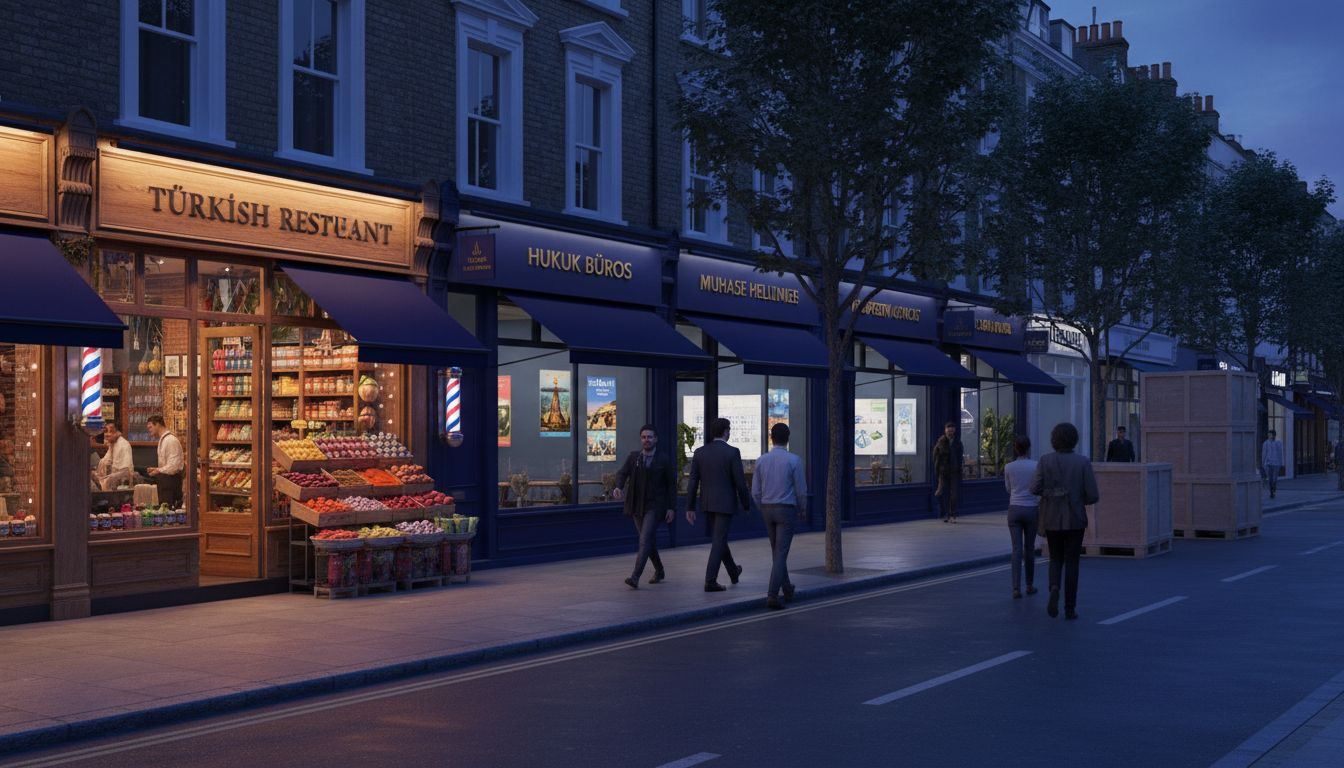
Walk along many British high streets today and the change is easy to feel, even if it is not always loudly discussed. The old image of the high street as a row of chain shops is fading. In its place, a more service-led local economy is emerging, built around cafés, takeaways, barbers, beauty salons, repairs, care services, professional advice, convenience retail and community-facing businesses. In this quieter transformation, diaspora entrepreneurs are playing a bigger role than many people realise.
For Turkish business owners in the UK, and for communities looking for trusted local services, this shift matters. It creates practical openings for founders who understand everyday neighbourhood needs and can build businesses around relationships, flexibility and cultural knowledge. Recent data, policy changes and finance trends all point in the same direction: Britain’s local streets are being reshaped not by a return to old retail, but by a broader mix of useful services, and diaspora entrepreneurs are helping lead that change.
The high street is no longer mainly about shops
One of the clearest official statements on this shift came from the House of Lords Built Environment Committee in November 2024. Its conclusion was direct: “the dominance of retail on high streets is something of the past.” That matters because it confirms what many local business owners already see on the ground. The high street is becoming a mixed-use civic and commercial space, not simply a retail strip.
The Office for National Statistics reinforced this with hard numbers in March 2026. Between 2015 and 2024, employment on central high streets in Great Britain moved away from retail. Retail employment fell by 19%, while accommodation and food services rose by 18%. This is not a small adjustment. It is a structural change in what local streets are for and which kinds of businesses are most likely to thrive there.
The wider picture also supports this new model. ONS mapping shows central high streets now include banks, post offices, cafés, restaurants, pubs, bars, fast-food takeaways and shops, with more than half of land use being residential. In most regions, retail addresses account for only around a third of central high-street addresses. That means local streets are increasingly about living, meeting, eating, solving practical problems and accessing services close to home.
Why diaspora entrepreneurs fit the new local economy
This changing high street suits many diaspora-led businesses especially well. Sectors such as food, beauty, logistics, care, tailoring, convenience retail, repairs and specialist services do not always require the large footprints or huge inventories associated with traditional retail. Instead, they depend on local trust, repeat custom, responsiveness and a strong understanding of what people need every day.
That is one reason diaspora entrepreneurs are so visible in neighbourhood economies. Many founders build businesses that are practical first: a place to eat, a barber who understands customer preferences, an accountant who can explain systems clearly, a grocery shop with familiar products, or a repair service that people can rely on quickly. These businesses often succeed because they meet overlooked needs in a way bigger operators cannot.
For the Turkish community in the UK, this is already familiar. Turkish restaurants, cafés, food stores, travel services, legal advisers, tradespeople, beauty specialists and import-export businesses often do far more than offer a commercial transaction. They become trusted local anchors. In a high street economy that increasingly rewards service, convenience and community connection, that kind of business model is not marginal. It is central.
Local services are now part of neighbourhood infrastructure
Another important official finding is that around one fifth of people in Great Britain now live on or around a high street. In London, the figure rises to 45.4%, according to the ONS. This changes how we should think about local businesses. They are not only amenities for shoppers. They are part of the infrastructure of daily life for millions of residents.
When people live close to high streets, they need businesses that fit real routines: breakfast on the way to work, last-minute groceries, childcare support, mobile phone repairs, takeaway meals, elder care, tailoring, parcel services, haircuts and social spaces. In that environment, a successful business is often one that is embedded in the rhythms of the neighbourhood rather than one that relies on destination shopping.
This is where diaspora entrepreneurs often make a deep contribution. They do not just fill empty units. They create places that support everyday life. A local bakery, a small restaurant, a beauty salon or a service office can add safety, footfall, familiarity and practical value to a street. Quietly, these businesses help make an area feel lived in and usable, not just commercially occupied.
Ambition is strong, even when scale remains difficult
Recent finance data shows that ethnic-minority-led businesses in the UK are among the most growth-oriented in the country. The British Business Bank reported in March 2026 that 71% of Ethnic Minority-led firms aim to become significantly larger, compared with 40% of White-led firms. It also found that 52% are willing to use finance to grow, compared with 35% of White-led firms.
That is a striking signal. It challenges the outdated idea that diaspora businesses are only small by choice or limited to survival entrepreneurship. In reality, many are ambitious and ready to expand. They want larger premises, more staff, new locations, broader product lines and stronger digital operations. They are not simply maintaining livelihoods. Many are actively trying to build scalable enterprises.
Yet ambition does not always translate into established scale. NatWest said in April 2026 that people from ethnic minority backgrounds are twice as likely to have entrepreneurial ambitions as white entrepreneurs, but significantly less likely to be running established firms. Its cited figures show entrepreneurial ambition at 23% among ethnic minority individuals versus 7% among white entrepreneurs, while established-firm rates stand at 43% versus 67%. So the drive is there, but the pathway remains uneven.
The finance picture is improving, but barriers still matter
There are reasons for cautious optimism. The SME environment has recently improved, which matters for diaspora founders operating local services. The British Business Bank reported that 314,000 start-ups were created in 2025, up 1% year on year, while gross SME bank lending rose 9% to £68 billion in 2025. That suggests a business environment that, while still difficult, is more supportive than many feared.
Publicly backed finance is also reaching diverse founders at meaningful scale. The British Business Bank says 20% of its Start Up Loans in 2024/25 went to founders from Black, Asian or other Ethnic Minority backgrounds. Its Impact Report 2025 also noted that “around one in every 200 UK businesses received a flow of finance supported by the Bank in 2024/25.” For founders who have historically found mainstream finance hard to access, that level of support can make a real difference.
Still, barriers remain significant. Lloyds has noted that Black-owned businesses in the UK generate approximately one third of the average turnover, which highlights how unequal the growth landscape still is. NatWest has responded with partnerships such as Foundervine and Bae HQ as it expands its Accelerator community to 50,000 in 2026. These efforts matter because diaspora entrepreneurs do not only need motivation. They need routes into finance, mentoring, networks and procurement that can turn strong local businesses into durable growth stories.
Empty units are becoming new entry points
One of the most practical recent changes is the introduction of High Street Rental Auction powers across England in December 2024. These powers allow councils to auction leases on persistently vacant commercial properties. Westminster said in 2026 that it was among the first authorities to adopt them, showing that this is not just a policy idea on paper but a live tool being used in town centres.
This matters directly for migrant and diaspora entrepreneurs because the eligible uses are broad. Local authority guidance makes clear that these spaces can support retail, hospitality, business services and community uses. In other words, the kinds of businesses that many diaspora founders are already good at building, from cafés and convenience stores to advice services and specialist customer-facing operations, fit the intended model.
For new founders, this could become an important opportunity pipeline. Access to premises has long been one of the biggest practical barriers to getting onto a visible local street. If councils actively refill long-empty units with local businesses and community tenants, the result could be more diverse ownership and a better match between vacant space and neighbourhood need. For communities with strong entrepreneurial energy, including Turkish founders across the UK, these openings are worth watching closely.
The market is still tough, which makes these successes more notable
None of this means the high street has become easy. Competition remains intense, and the broader market is still unforgiving. PwC reported that across Great Britain in the first half of 2024, 38 chain outlets closed per day while 25 opened, producing a net decline of 12 per day. Convenience stores, coffee shops and value retailers were among the growth areas, but the overall picture remained difficult.
PwC’s fuller tally for 2024 was also sobering: 12,804 chain shops and outlets exited the market, equivalent to 35 closures a day. Closures were concentrated on high streets, even though the rate of decline began to slow. This context is important because it shows that success in local services is not happening because conditions are universally favourable. It is happening despite pressure.
That makes the resilience of flexible, locally embedded entrepreneurs more impressive. Businesses that survive and grow in this environment usually do so by understanding their customer base closely, adapting quickly and controlling costs carefully. Diaspora entrepreneurs often bring exactly that discipline. Many build step by step, stay close to community demand and diversify naturally, for example by combining food with delivery, retail with services, or a physical shop with social media and local advertising.
Much of the renewal is happening outside London
There is also a strong regional story here. Britain’s high-street recovery is increasingly happening outside London, which matters for diaspora business communities spread across the country. The British Business Bank said 84% of the businesses it newly supported in 2024/25 were based outside London, compared with 82% of the UK business population. That suggests support and momentum are not only concentrated in the capital.
Startup activity in 2025 was also geographically broad-based. NatWest and Beauhurst reported that 426,000 new businesses were registered with Companies House in the first half of 2025, with ten UK regions seeing higher startup activity. This is encouraging for founders in Birmingham, Manchester, Leeds, Leicester, Glasgow and many other towns and cities where diaspora communities are already deeply involved in local commerce.
For Turkish businesses in particular, this wider spread matters. Opportunity is not limited to a few famous areas of London. Many regional high streets are changing in similar ways, with demand for food, family services, beauty, care, property-related support, logistics and trusted local professionals. The future of the British high street is likely to be built in many places at once, often by small businesses rooted in their own communities.
Why these contributions are still underestimated
Even when the contribution is visible on the ground, it is often underestimated in public debate. COMPAS at the University of Oxford argued in January 2025 that “The many contributions that migrants and diaspora have made through their entrepreneurship still remain unseen.” That sentence captures an important contradiction. People can walk past these businesses every day and still miss the scale of what they are doing economically and socially.
COMPAS also highlighted concrete examples of diaspora founders solving practical problems across borders and within UK communities. These included UK-based Jamaican diasporan Nathaniel Peat, Moldova-UK founder Victoria Dunford and Sri Lankan-UK founder Harsha Rathnayake. Rathnayake’s waste-management company Junk Hunters was described as being on track for over £1 million annual turnover. Dunford’s work included recycling hospital equipment from the UK to Moldova and delivering more than 1,200 wheelchairs.
These examples remind us that diaspora entrepreneurship is not only about opening a shop or restaurant, though those businesses matter greatly. It is also about spotting service gaps, building trust, linking communities and turning overlooked needs into viable ventures. On Britain’s local streets, that same logic appears in smaller but equally meaningful ways every day. A founder sees what is missing, creates a service around it and strengthens the neighbourhood in the process.
Put together, the evidence is clear: Britain’s high street is no longer mainly about shops, and that shift is creating space for a wider range of local-service businesses. Official data shows retail employment declining while accommodation, food and other service uses grow. Policy is adapting, finance support is widening and vacant units are increasingly being seen as opportunities rather than just symbols of decline.
In that changing landscape, diaspora entrepreneurs are quietly transforming Britain’s local services and streets. They are doing it through ambition, practicality and close community ties. For Turkish business owners and for anyone interested in the future of local Britain, this is not a side story. It is one of the most important stories on the high street today.