
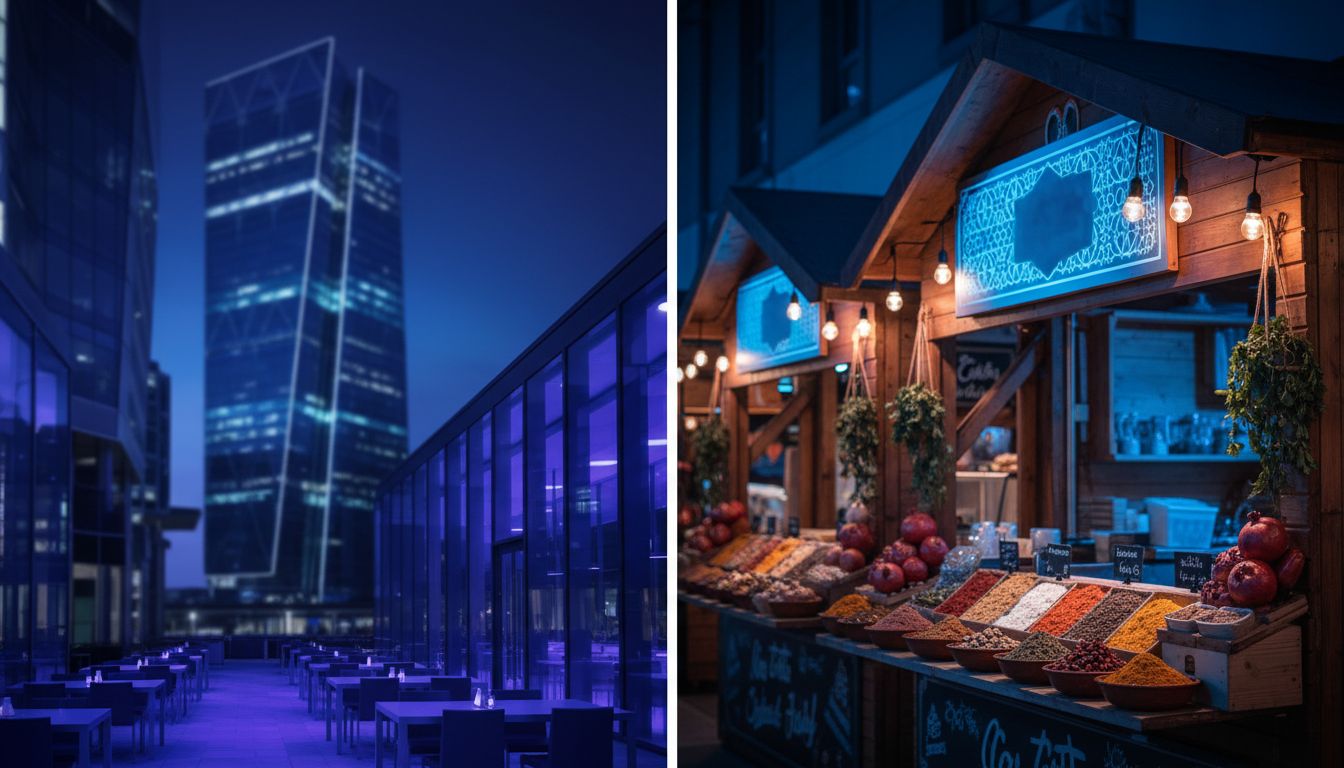
London’s hospitality map is shifting again, and two places are helping tell the story in a particularly interesting way for the Turkish community and anyone following regional food trends: Canary Wharf and Harrow. On one side, Canary Wharf is investing heavily in becoming a full seven-day leisure destination. On the other, Harrow is openly describing itself as a food hub and putting practical support behind that ambition. Taken together, these moves suggest renewed interest in Anatolian hospitality across both premium destination settings and everyday local high streets.
What makes this moment notable is that the story is no longer only about kebab shops or quick-service familiarity. The latest openings and official local initiatives point to something broader: regional storytelling, stronger design and drinks programmes, quality-led operations, and a more confident place for Turkish and Eastern Mediterranean concepts within London’s mainstream hospitality economy. For business owners, diners, and community members alike, that is a meaningful development.
Canary Wharf is building a bigger hospitality stage
A major signal came in October 2024, when Imbiba agreed a deal with Canary Wharf Group for a 65,000 sq ft hospitality and leisure destination at 12 Bank Street. The scheme is set to include a 78-bedroom House of Gods hotel, an Amazing Grace music venue, a rooftop bar overlooking Eden Dock, and an events space operated by Camm & Hooper. This is not a small restaurant opening or a one-off food unit; it is a large-format commitment to making the district a place people visit for experiences, stays, nightlife, and social occasions.
The commercial backdrop helps explain why this matters. Canary Wharf Group said visitors were up 7.5% year to date in 2024 compared with 2023, after the estate welcomed 67.2 million visitors in 2023. It also reported 97% occupancy across retail, leisure, and hospitality. Those numbers point to confidence from both operators and landlords, and they show that the Wharf’s customer base is no longer being viewed only through the lens of weekday office workers.
Executives have also been explicit about the direction of travel. Stuart Fyfe of Canary Wharf Group said the estate is being curated into a “thriving seven-day destination” spanning retail, leisure, hospitality, and competitive socialising. Imbiba partner and property director Kieran Sherlock added that “Canary Wharf is becoming a world-class destination for hospitality and leisure.” For Turkish and Anatolian operators, this matters because it creates room for concepts that can sit comfortably in a premium, experience-led environment.
Why that matters for Anatolian hospitality
For years, Turkish food in London has often been associated with neighbourhood dining, family-run grills, and strong local trade. Those strengths remain important, but what is changing is the type of stage on which Anatolian-inspired concepts are appearing. If Canary Wharf is now a place for hotels, rooftop bars, music venues, and destination dining, then a Turkish-led opening there carries a different kind of signal: it says the cuisine is being absorbed into higher-spend, higher-visibility hospitality circuits.
This is especially relevant because district-making and food curation often go hand in hand. Once a location is positioned as a seven-day destination, operators are expected to offer identity, story, and a reason to travel. Anatolian hospitality is well suited to that. It can bring regional breads, charcoal cooking, meze culture, generous hosting, wine exploration, sweets, and a strong sense of occasion. That gives it a broader appeal than a single-format grill concept.
In practical terms, this means Turkish businesses and entrepreneurs can look at emerging opportunities differently. A district like Canary Wharf is not simply asking whether a cuisine is popular; it is asking whether a concept can contribute to placemaking, dwell time, and destination value. The latest developments suggest the answer for well-executed Anatolian offers is increasingly yes.
Nora shows a more premium, region-led Turkish direction
That shift became clearer in July 2025, when Restaurant reported that brothers Ozgur and Sidar Akyuz would launch Nora in Canary Wharf. The concept was described as being inspired by Istanbul’s culinary diversity, drawing from street-food carts, mangal grill houses, and fine dining influences. That framing is important because it presents Turkish food not as a narrow category, but as a layered urban cuisine with depth, contrast, and regional sophistication.
The reported menu details reinforced that premium positioning. Nora’s offer was set to include daily in-house baked sesame and caraway pide, grilled bazlama, künefe with orange blossom, and walnut baklava with pistachio and fig leaf cream. These are the kinds of dishes that move the conversation beyond generic mixed grills and into a more distinctive Anatolian and Istanbul-inspired dining experience. They also show how breads, desserts, and finishing details can become part of the brand story.
The drinks list was also designed to foreground terroir and regional flavour, with wines from Turkey and surrounding areas. That is a notable step for Turkish hospitality in London, because beverage programmes often determine whether a concept is seen as truly destination-worthy. The fact that Nora is backed by operators who already run four Café Beam locations in Crouch End, Muswell Hill, Notting Hill, and Highbury adds even more weight. This is not a first experiment; it is an established London operator bringing a Turkish-led proposition into a prime commercial setting.
Canary Wharf’s dining mix has been preparing the ground
Nora did not appear in isolation. In March 2024, Restaurant reported that Canary Wharf’s broadened dining mix included Hawksmoor, Dishoom, Fish Game, and Blacklock, with Hovarda, Kricket, and Roe also listed as forthcoming at the time. The significance here is not simply that big names were arriving, but that the Wharf was clearly widening its food identity beyond the old office-lunch stereotype.
Des Gunewardena captured that mood when he said, “This is why a number of leading restaurateurs have chosen to open here post-Covid.” In other words, experienced operators were reading changing customer behaviour and seeing long-term potential. When that kind of confidence spreads, it often benefits cuisines that were previously underrepresented in premium business districts.
There was already evidence that East Mediterranean flavours could work in the area. Gallio, from DOMA Hospitality, first opened in Canary Wharf before later expanding to Fitzrovia, and in 2025 the company said that “Gallio has already proven itself in Canary Wharf.” Even earlier, its 2021 opening featured combinations such as spiced lamb with labneh, rose harissa, guindilla peppers, fresh mint, and za’atar-led toppings. While not Turkish in a strict sense, that East Mediterranean palate helped show that diners in the Wharf were receptive to flavour profiles adjacent to Anatolian hospitality well before Nora arrived.
Harrow is making the food-hub case official
While Canary Wharf represents premium destination investment, Harrow tells a different but equally important story. In its recently published Food Business Toolkit, Harrow Council states: “At the heart of the economy is Harrow’s unique food offer where you can eat your way around the world without leaving the borough.” That is a strong statement from a local authority. It shows food is not being treated as a side note to the economy, but as part of the borough’s identity and appeal.
The same document goes further, describing the borough’s mix of global cuisines as “This vibrant hub of quality food” extending into restaurants, cafés, bars, and nightlife. That language matters because it gives official backing to the idea of Harrow as a food hub, not just a place where good places to eat happen to exist. For food entrepreneurs, recognition like this can shape confidence, perception, and future investment.
Just as importantly, the toolkit is practical. It includes guidance on product development, logistics, premises, local assets, and customer questionnaires. That suggests Harrow is not only celebrating its food identity but trying to help more businesses open, improve, and scale. For Turkish operators, that kind of ecosystem support can be just as valuable as line-grabbing openings in central London.
Harrow’s Turkish market looks broad, visible, and competitive
Harrow’s positioning as a food hub becomes even more convincing when you look at the activity on the ground. A 2025 guide described Market Place Harrow as a two-floor indoor street-food hall with seating for up to 300, around 8 to 10 vendors, and a bar, calling it a community favourite since opening in 2021. Spaces like this create visibility for multicultural dining and help train local customers to explore a wider mix of cuisines.
The borough is also showing that Turkish dining there is not marginal. In November 2025, Melissa Restaurant in Harrow Town Centre was named Best Turkish Restaurant in North West London at the Turkish Restaurant and Takeaway Awards, or TURTA 2025. That is a meaningful benchmark because Harrow Online reported that judging was based on quality, consistency, and customer feedback, with hundreds of nominations coming from diners across the UK. This points to a sector with real competition and standards, not just casual local recognition.
Recent food-business data strengthens the case further. Harrow Online reported in March 2026 that more than 30 food businesses in the borough received the top Food Standards Agency rating of 5 in February 2026. High hygiene ratings do not tell the whole story, but they do support an image of professional, quality-focused trading conditions. For a borough building a reputation around food, these details matter.
What this means for UK Turkish businesses and diners
Together, Canary Wharf and Harrow show two sides of the same trend. Canary Wharf suggests that Anatolian hospitality in London is gaining visibility in premium, destination-led environments shaped by leisure investment and mainstream hospitality brands. Harrow shows that borough-level ecosystems, public support, and strong local demand can sustain a wider base of food businesses, including award-winning Turkish operators. One is about prestige and visibility; the other is about community infrastructure and everyday resilience.
For business owners, this creates useful lessons. A successful Turkish concept in today’s market may need more than familiar dishes. It may need a clearer regional identity, stronger drinks thinking, better storytelling, and a format suited to its location, whether that is a market hall, high street, neighbourhood restaurant, or destination district. Operators who can combine authenticity with modern hospitality standards are likely to be best placed.
For diners, the upside is exciting. It means more opportunities to encounter Turkish and Anatolian food in different settings: from local family favourites and community-centred businesses to premium restaurants that showcase breadmaking, desserts, wine, and regional nuance. That range is healthy for the sector because it reflects the real diversity of Turkish food culture rather than reducing it to a handful of expected dishes.
The bigger takeaway is that renewed interest in Anatolian hospitality is not coming from one opening alone. It is being reinforced by investment patterns, local-government strategy, operator confidence, and customer appetite. When a place like Canary Wharf adds hotels, rooftop bars, music venues, and chef-led concepts, and a borough like Harrow formally brands itself as a vibrant food hub, it becomes easier to see Turkish hospitality as part of London’s future growth story.
For the UK Turkish community, this is encouraging not only as a business trend but as a cultural one. It means the warmth, generosity, regional variety, and craftsmanship associated with Anatolian hospitality are reaching wider audiences in new ways. Whether through a high-profile launch in Wood Wharf or a trusted award-winning restaurant in Harrow, the message is similar: Turkish food and hospitality are moving from niche visibility toward networked, confident growth.