
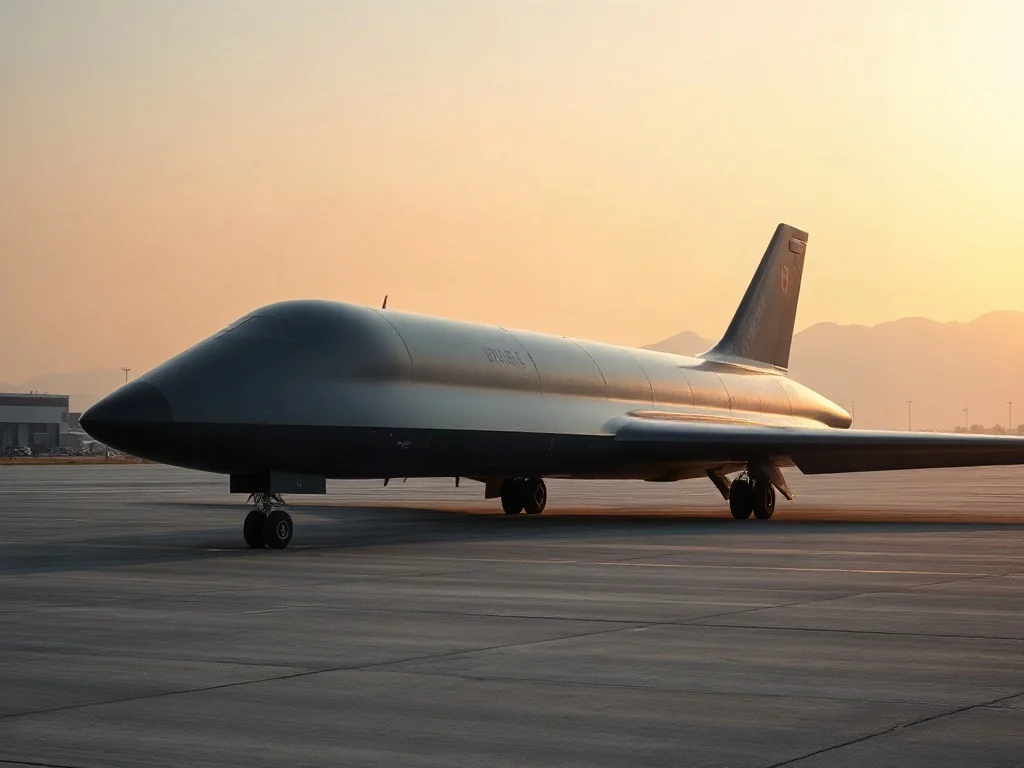
China’s reusable spaceplane program has drawn growing attention from defense analysts, space researchers, and policymakers since the Pentagon released a full-resolution image of the vehicle this week. The Chinese spaceplane represents one of the most closely watched military and aerospace developments of the decade, yet many of its capabilities remain unclear. Because the program is classified, most of what the public knows comes from official imagery, indirect observation, and cautious interpretation by independent experts. This article examines what is confirmed, what is inferred, and why the vehicle matters for the broader competition in space.
Background: What Is a Spaceplane?
A spaceplane is a crewed or uncrewed vehicle that takes off and lands like an aircraft while being capable of operating in or passing through outer space. Unlike conventional rockets, which are typically expended after a single flight or recovered through specialized methods, spaceplanes are designed for runway landings and potential reuse. The concept has existed since the early days of spaceflight, with programs such as the Space Shuttle operated by NASA and the X-37 operated by the United States Space Force being the most prominent examples.
Reusable space vehicles promise lower costs per launch, greater operational flexibility, and the ability to return payloads to Earth. They also raise distinct engineering challenges, including thermal protection during reentry, the management of hypersonic airflow, and the need for precise guidance during unpowered descent. For military planners, a reusable vehicle that can remain in orbit for extended periods introduces additional questions about surveillance, deployment of payloads, and strategic ambiguity.
The Pentagon Image and What It Reveals
The release of a full-resolution image by the United States Department of Defense is itself a notable development. Official government imagery of foreign military systems is typically released to support public messaging, to signal technological awareness, or to draw attention to specific capabilities. Analysts generally caution that imagery alone rarely reveals performance parameters such as payload capacity, orbital altitude, maneuverability, or mission duration.
Visual inspection can still provide useful indicators. Observers often examine the vehicle’s wing geometry, control surfaces, the placement of any visible propulsion components, and the structure of thermal protection materials. These features can suggest the intended flight regime, whether the vehicle is designed for hypersonic speeds, and how it might be launched. However, interpretation requires care, since design features can be misread or deliberately misleading.
Distinguishing Confirmed Facts from Analysis
Readers should separate three categories of information. The first is confirmed: the existence of a program, the publication of imagery, and the official acknowledgment of certain test activities. The second is reasonable inference, such as the likely use of reusable thermal protection and runway-based recovery. The third is speculation, including specific claims about weapons payloads, orbital bombardment potential, or operational deployment timelines, which should be treated cautiously unless supported by official or verifiable evidence.
Potential Capabilities and Strategic Implications
Experts have discussed several possible roles for a Chinese spaceplane. One is responsive space access, meaning the ability to place satellites into orbit on short notice and with flexible launch windows. Another is on-orbit inspection and servicing, which could allow the vehicle to examine or repair other satellites. A third, more controversial possibility is the deployment or retrieval of payloads that serve military purposes, including reconnaissance or the testing of advanced technologies.
Each capability carries different implications. Responsive launch could strengthen satellite constellations and reduce dependence on fixed launch infrastructure. Inspection and servicing capabilities are dual-use, since the same maneuvers that assist maintenance could also be used to approach or disable another nation’s assets. This ambiguity is a central concern in discussions of space warfare and the stability of orbital environments.
Competing Interpretations
Some analysts argue that the program primarily reflects China’s ambition to match or exceed American reusable space technology, pointing to the long history of comparable projects in the United States. Others emphasize the strategic signaling aspect, suggesting the vehicle is designed to demonstrate capabilities that complicate the planning of adversaries. A third group cautions against overinterpreting limited data, noting that many early reusable prototypes have had mixed results and that technical objectives may be narrower than public speculation implies.
Technical Challenges and Limitations
Developing a functional spaceplane is technically demanding. The vehicle must withstand extreme heat during reentry, which requires advanced thermal protection systems and careful management of structural loads. It must also maintain control through the transition from the vacuum of space to the dense atmosphere, a phase where aerodynamic forces change rapidly. Reusability adds further requirements, since materials must endure repeated thermal cycling without significant degradation.
Engine design, guidance accuracy, and the reliability of landing systems are equally important. A vehicle that flies successfully once may still be far from operational, because reliability across many missions is what determines practical value. Independent researchers have repeatedly noted that the gap between a successful test flight and a repeatable service capability can span years and substantial investment.
Risks and Edge Cases
- Thermal failure during reentry, which can destroy the vehicle and its payload.
- Guidance errors that could lead to off-target landings or loss of control.
- Operational limits, such as restricted orbital inclinations or constrained mission durations.
- Verification difficulty, since foreign observers have limited means to confirm stated performance.
Regulatory, Ethical and Security Considerations
The spaceplane raises questions under international space law, including the Outer Space Treaty, which prohibits the placement of nuclear weapons and other weapons of mass destruction in orbit but does not comprehensively address conventional military activity in space. This gap has led to ongoing debate about transparency measures, norms of responsible behavior, and the need for clearer rules governing inspection and proximity operations.
Security implications extend beyond the vehicle itself. A reusable system capable of rapid launches could alter the calculations of crisis stability, since adversaries may be uncertain about its purpose. Transparency is limited, and classified programs make it difficult for other states to assess intentions accurately. Economists and policy researchers also note that competition in reusable launch could affect commercial markets and the cost structure of global satellite services.
Practical Takeaways for Readers and Analysts
For readers trying to evaluate reports about the spaceplane, several practices are useful. Consult primary sources, such as official government releases and peer-reviewed analysis, before accepting claims. Distinguish between statements about the existence of a program and statements about its capabilities. Be cautious with headlines that describe specific weapons or mission profiles without supporting evidence. Track follow-up reporting, since initial assessments are often revised as more information becomes available.
Professionals in aerospace, defense, and policy fields should monitor flight test indicators, orbital tracking data from public observers, and changes in official statements. Comparing the program with other reusable vehicles can clarify realistic timelines and performance expectations.
Future Developments to Watch
Over the next few years, the most informative signals will likely come from observable flight activity, the deployment of new satellite systems, and any shifts in international discussion about space norms. If the spaceplane conducts repeated landings or regular orbital missions, its operational importance will become clearer. If activity remains sporadic, analysts may conclude that the program is still in a demonstration phase.
A reasoned prediction is that reusable spaceplanes will become a standard feature of the strategic landscape, but their precise roles will remain contested for some time. The open question is whether transparency and norms of restraint can develop quickly enough to keep pace with technical capability. That question, more than any single image, will determine how the world interprets the vehicle’s purpose and whether its arrival reduces or intensifies competition in orbit.
Frequently Asked Questions
Has China officially confirmed the purpose of its reusable spaceplane?
No. The program is classified, and China has not publicly disclosed its mission, payload capacity, or operational role. Most information comes from official imagery and independent observation, so claims about weapons or specific missions should be treated as analysis or speculation unless backed by verifiable evidence.
Why would the Pentagon release a detailed image of a foreign military system?
Governments release such imagery to shape public messaging, signal technological awareness, or highlight particular capabilities. However, images rarely reveal performance details like orbital altitude, maneuverability, or mission duration, so the release is more about attention and signaling than about disclosing hard technical data.
Can the design of a spaceplane reveal how it will be used?
Partially. Wing geometry, control surfaces, propulsion placement, and thermal protection materials can suggest the intended flight regime, such as hypersonic speeds or runway recovery. Yet design features can be misread or intentionally misleading, so experts treat these clues as indicators rather than conclusive proof of purpose.
Why are reusable spaceplanes considered harder to build than conventional rockets?
They must survive reentry heating, manage hypersonic airflow, and perform precise unpowered descent to a runway landing. Designing thermal protection that can be reused across many flights, while keeping the vehicle light enough to reach orbit, adds engineering difficulty that disposable rockets largely avoid.
What is the difference between responsive space access and orbital bombardment?
Responsive space access means launching satellites on short notice with flexible windows, which is largely a logistics advantage. Orbital bombardment involves placing weapons in orbit to strike targets on Earth, a far more controversial capability. Analysts frequently discuss the first as plausible, while the second remains unconfirmed for this vehicle.