
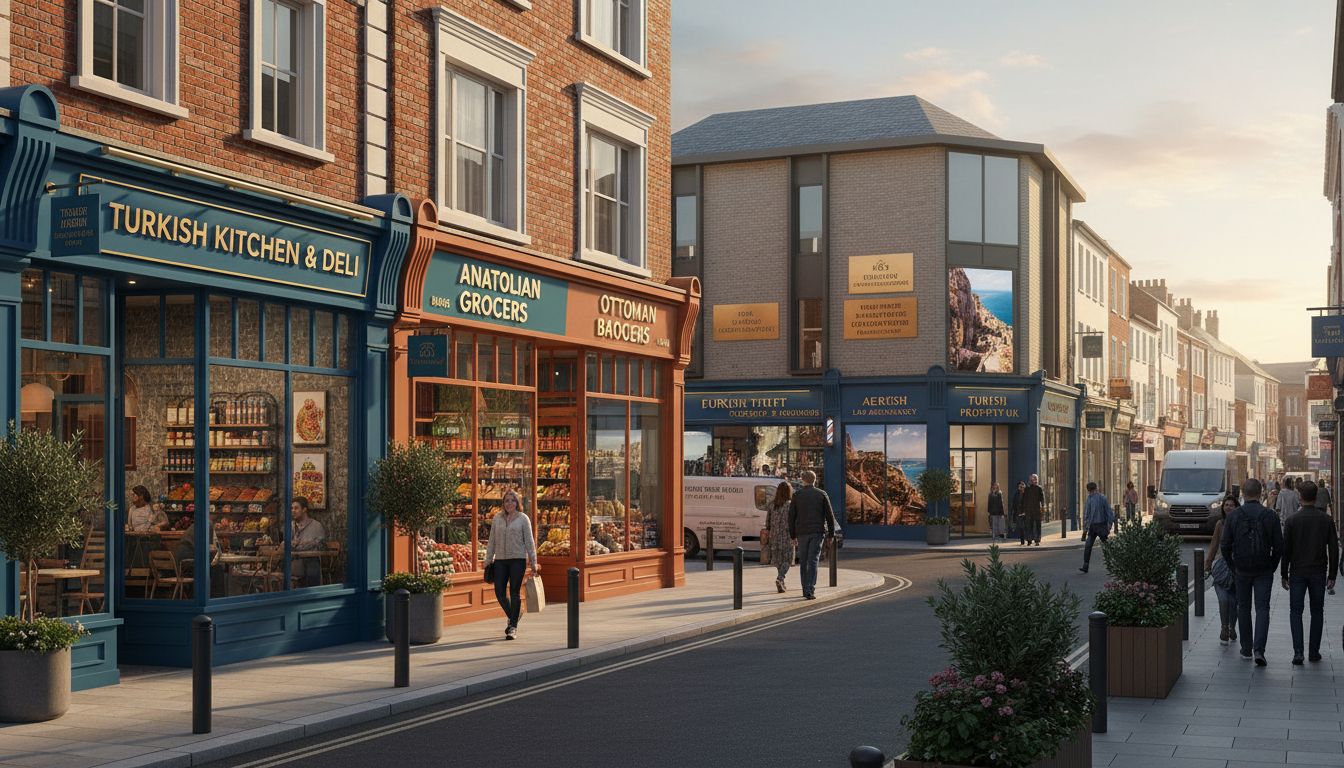
Across Anatolia, local high streets are not fading in a simple, one-direction story of decline. Instead, many entrepreneurs are adjusting to a more demanding environment where planning decisions, infrastructure upgrades, finance programmes, and changing consumer habits all play a bigger role in who succeeds and where businesses choose to trade.
For Turkish business owners in the UK and readers following opportunities in Türkiye, this shift matters. It shows that the future of the Anatolian entrepreneurs pivot is less about abandoning traditional shopping streets and more about repositioning within a tighter but better-structured market, where location quality, service mix, digital readiness, and municipal strategy increasingly shape results.
The business shift beyond the biggest cities
The movement of business energy into Türkiye’s secondary cities is not new, but it is becoming more visible and more strategic. The World Bank’s urbanization review found that the country’s secondary cities, often referred to as the “Anatolian Tigers”, captured a larger share of newly established firms and urban population growth than Istanbul, Ankara, and Izmir. That is an important clue for anyone watching local high streets, because it suggests commercial gravity has been spreading across a wider urban map for some time.
What is changing now is the logic behind that growth. The World Bank argues that the next phase depends on stronger spatial planning, transport investment, and city-scale financing. Its summary is especially clear: “These developments make planning, connecting, and financing important policy principles” for Türkiye’s next-generation urban agenda.
In practical terms, that means entrepreneurs in places such as Bursa, Konya, Gaziantep, Kayseri, Eskişehir, and other regional centres are operating in a business climate shaped not only by customer demand, but also by road access, public transport, street design, licensing systems, and public investment priorities. The high street is no longer just a row of shops; it is part of a broader urban strategy.
Why the macroeconomy still matters on the local parade
Türkiye’s wider economic backdrop in 2025 and 2026 is improving enough to matter for small business confidence. The OECD projects GDP growth of 3.6% in 2025 and 3.4% in 2026, with improved financial conditions expected to support private consumption and investment in 2026 and 2027. For local traders, that does not remove the pressure, but it does create a more workable environment than the most turbulent recent years.
Inflation, however, remains central to the story. Official CBRT and TURKSTAT data show annual CPI falling from 42.12% in January 2025 to 30.89% in December 2025, and standing at 30.87% in March 2026. That decline signals less extreme volatility than in 2024, but it is still a punishing level for businesses trying to price menus, stock shelves, negotiate wages, and commit to longer leases.
For high-street operators, the key point is that easing inflation does not feel like normality. It simply means the shocks are somewhat less violent. Entrepreneurs still need tighter planning, more frequent repricing, and a sharper eye on margins, especially in local centres where customers remain price-sensitive and operating costs continue to climb.
Rents and services costs are reshaping business models
One of the clearest pressures on traditional shopping streets is the cost structure of service-led businesses. A CBRT analytical note said consumer inflation ended 2025 at 30.9%, but goods inflation was 25% while services inflation was much higher at 44%. That matters because many businesses on Anatolian high streets are concentrated in food, personal care, hospitality, repairs, cafés, and everyday services rather than tradable goods.
Rent is an even sharper issue. In Governor Fatih Karahan’s briefing on 14 August 2025, the central bank said the annual rent inflation rate was 63.6%, even if recent trends had moderated. For many independent operators, that helps explain why staying on a traditional main street is becoming a strategic decision rather than an automatic one.
As a result, business owners are pivoting in several ways. Some are moving into smaller but better-positioned units. Some are redesigning their offer toward higher-margin services or more premium food concepts. Others are combining in-store trade with delivery, online booking, social media selling, and appointment-based custom to make expensive street frontage work harder. This is one of the clearest ways the Anatolian entrepreneurs pivot is showing up in real life.
Finance is opening new options for regional founders
There is also a more positive side to the story: access to entrepreneurship and growth finance is expanding. OECD’s 2026 SME and entrepreneurship financing profile for Türkiye says investments reached a record TRY 33.9 billion in 2023, up 392.12% year on year. It links that jump to legal and policy changes as well as programmes such as BİGG Funds and the BİGG+ Venture Capital Investment Fund.
That matters because it creates more room for regional founders to move from survival thinking to scale thinking. A business that once focused only on paying next month’s bills may now be able to consider a second branch, a production upgrade, a digital platform, or a more efficient format in a stronger location. Even when venture-style funding is not directly available to every shopkeeper, the broader financing ecosystem can still improve confidence and spill over into supplier networks, service businesses, and local employment.
The widening of the SME definition also plays a role. Türkiye raised the annual turnover or balance-sheet threshold for SME classification from TRY 500 million to TRY 1 billion. That can expand eligibility for public programmes, finance, and advisory support for growing local firms that might previously have been too large for some schemes but too constrained for conventional expansion finance.
Development finance is influencing the high street indirectly
International development finance is now arriving at a scale large enough to influence local business streets, even when the money is not going directly into retail units. The EBRD said it invested a record €2.7 billion in Türkiye in 2025 across 54 projects, with 91% going to the private sector. These investments covered SME finance, infrastructure, reconstruction, decarbonisation, digitalisation, and human capital.
That broader investment picture supports the idea that street-level renewal increasingly depends on place-based improvements. Better infrastructure, stronger business lending, digital tools, and workforce development all shape how commercial districts perform. As EBRD Managing Director Elisabetta Falcetti put it, “our work in Türkiye reflected both the scale of the country’s investment needs and its long-term potential.”
For entrepreneurs, the indirect effects can be just as important as direct grants. A renewed transport corridor, upgraded utilities, stronger local bank lending, or a better-skilled workforce can change the viability of a shopping street over time. This is why high-street recovery in Anatolia is increasingly tied to the wider investment climate, not just to retail demand in isolation.
Digital transformation is becoming part of the street-trade formula
Another important shift is that support is increasingly aimed at modernisation rather than simple expansion of floor space. In 2025, the EBRD provided €25 million to DenizBank for on-lending to Turkish manufacturing SMEs investing in digital transformation through the Türkiye Digital Transformation Financing Facility, with KOSGEB support for implementation. While this example is centred on manufacturing SMEs, the message is wider: competitiveness now depends on upgrading operations.
DenizBank’s Executive Vice President Engin Eskiduman captured the logic well, saying: “we have long prioritised SMEs’ access to finance due to their critical role in Türkiye’s sustainable economic growth.” For local businesses on Anatolian high streets, that often means using software, digital payments, online marketing, booking systems, customer databases, and smarter stock control to protect margins in an expensive environment.
Women-led and youth-led firms are also becoming a more visible part of this new enterprise mix. In 2025, the EBRD and Akbank announced a package including up to US$70 million for women-led SMEs, US$50 million for youth-led SMEs, and US$10 million for SME digital transformation investments. That is significant for local streets, because it can diversify who opens businesses and what kinds of services, retail concepts, and community-oriented ventures emerge in regional centres.
Planning is now shaping which streets win
One of the strongest signals from recent policy and market evidence is that not every high street will benefit equally. Planning is becoming more explicit, and municipalities are increasingly trying to guide commercial change rather than simply letting market churn decide outcomes. Istanbul’s Kadıköy Central Strategy Document is a useful example, proposing spatial interventions and governance tools to preserve historic street identities, improve accessibility, use more transparent licensing, and rebalance food and service uses.
Although Kadıköy is not Anatolia in the narrow geographic sense, the approach matters nationally because it shows how Turkish municipalities are framing commercial-street management. Instead of seeing retail only as private-sector activity, local authorities are treating streets as shared civic assets that need balancing between heritage, mobility, tourism, everyday commerce, and liveability.
This planning-led mindset aligns closely with OECD guidance on city-centre regeneration, which argues that mixed-use urban planning, accessibility upgrades, and targeted investment can raise footfall and revitalise city centres. For Anatolian entrepreneurs, this means business success increasingly depends on understanding local plans, licensing trends, public works, and district identity, not just passing trade.
Historic centres are being repositioned as mixed-use corridors
Historic-centre planning in Anatolia is also being reframed in a more integrated way. A 2025 peer-reviewed study on Bursa argues that landscape planning for historical city centres should link religious sites, shopping streets, traditional food venues, caravanserais, covered bazaars, and recreational areas in one coherent corridor. This is more than an urban design idea; it is a business model for place-making.
For local entrepreneurs, that approach creates opportunities in sectors that work well together: food and drink, crafts, gifts, boutique hospitality, guided experiences, personal services, and culturally rooted retail. It also helps explain why some businesses are not leaving central areas at all, but repositioning within heritage districts that can attract both residents and visitors.
In this sense, high-street change is not only about surviving inflation. It is also about curating a more coherent urban experience. Streets that combine culture, convenience, tourism, and daily life are more likely to hold attention and spending than corridors filled with repetitive uses and weak public space. That is a major part of how local high streets are being reshaped across Anatolia.
Selective growth is replacing blanket expansion
Recent retail evidence from Istanbul helps illustrate a pattern now influencing the wider market. Cushman & Wakefield’s İstanbul High Streets 2025 reported that weekday footfall on İstiklal Street rose 13% to around 240,000 visitors, while weekend footfall rose 27% to 427,000. Yet the same report said retail activity was shifting toward efficiency and selectivity over expansion-driven growth.
That distinction is crucial. More footfall does not automatically mean every operator should open more branches or take larger risks. Market advisers such as ACROSS similarly describe 2025 in Türkiye as a year of selective growth rather than aggressive rollout. Demand is supported by tourism and destination projects, but operators are choosing openings more carefully, while urban renewal and limited supply have affected transaction activity on streets such as Bağdat Street.
CBRE Turkey’s retail outlook reinforces the point, saying prime high street assets, shopping centres, and retail parks are likely to outperform. In other words, the investment narrative now favours stronger streets and mixed-use districts, not every retail corridor equally. Entrepreneurs are responding by choosing resilient locations, right-sized formats, and concepts that can perform even when the wider market remains uneven.
Construction, access, and regeneration are now business variables
Another reason businesses are pivoting is that the physical condition of streets is changing more often. Cushman & Wakefield noted a 34% increase in ongoing urban regeneration activity affecting İstiklal Street dynamics in 2025. That may sound like a local detail, but it reflects a broader reality: construction, renewal, access works, and redesign projects can materially affect trade patterns.
For an entrepreneur, regeneration can bring both disruption and opportunity. Building works may reduce visibility or complicate access in the short term, but improved public realm, better connections, and upgraded buildings can strengthen a district over the medium term. Businesses that survive and adapt may emerge in a more valuable location than before.
This is why today’s successful operator often thinks like both a retailer and a local urban analyst. Decisions about leases, refurbishments, delivery models, opening hours, and staffing increasingly depend on reading the trajectory of the street itself. In many Anatolian centres, the question is not simply whether a high street is busy today, but whether it is being planned, connected, and financed for a stronger tomorrow.
The strongest evidence-based reading of the market is that entrepreneurs across Anatolia are not simply turning away from local high streets. They are repositioning within a harsher but more structured ecosystem. Lower, though still high, inflation, targeted SME finance, selective investor demand, urban regeneration, and municipal planning are all pushing businesses toward smarter formats rather than blanket expansion.
For Turkish business owners in the UK, investors watching regional opportunities, and anyone interested in Türkiye’s local economies, the lesson is clear. The future belongs less to the biggest footprint and more to the best fit: digitally capable, service-aware, well-located, and aligned with the new logic of place-based investment. That is the real story behind how local high streets are being reshaped today.