
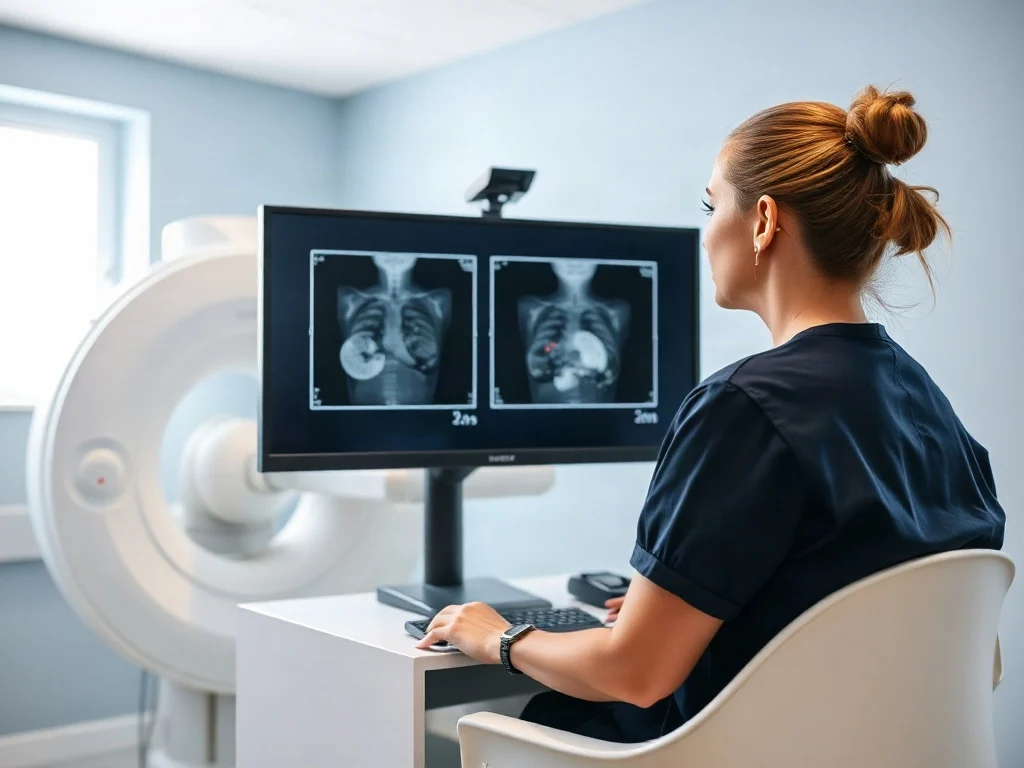
The NHS has launched what is being described as the world’s largest AI breast cancer screening trial. It tests whether artificial intelligence can help clinicians read mammograms efficiently without missing cancers. Coverage reports that the study, known as EDITH, involves around 700,000 women. It arrives as screening services face rising demand and a shortage of specialist imaging staff. This analysis explains how such a trial works, what earlier evidence shows, and which questions remain open.
Why the NHS Is Testing AI in Breast Screening
Breast cancer is the most common cancer in the UK, with more than 50,000 new diagnoses a year, according to Cancer Research UK statistics. The NHS breast screening programme in England invites women roughly between the ages of 50 and 71 for a mammogram every three years. You can read the official guidance on the NHS breast screening page.
Each image is traditionally examined by two trained readers, a process known as double reading. It is a strong safeguard, but it is labour-intensive. Workforce reports from the National Health Service and professional bodies have repeatedly highlighted shortages in radiology. If AI can safely take on part of the reading burden, breast cancer screening could become faster and more resilient.
How Does AI Read Mammograms?
Most tools rely on deep learning. Algorithms are trained on large archives of mammography images with known outcomes. They learn to flag suspicious patterns and often produce a risk score for each case. The idea builds on older computer-aided diagnosis systems, which delivered mixed results. Modern artificial intelligence is considered considerably more capable.
Three Possible Roles for AI
- Second reader: AI replaces one of the two human readers, with a human arbitrating disagreements.
- Triage: low-risk scans receive lighter review, while high-risk scans get extra attention.
- Safety net: AI flags cases a human reader might have overlooked.
Which of these models performs best in routine NHS practice is exactly what a large trial can establish.
What Evidence Already Exists?
The strongest prior signal comes from Sweden’s MASAI randomised controlled trial. Its interim results, published in The Lancet Oncology in 2023, reported cancer detection rates comparable to or higher than standard double reading. Screen-reading workload fell by roughly 44 percent. These are encouraging findings, but they came from one country, one set of equipment and a specific AI product. Whether they transfer to the more diverse UK screening population is uncertain, and that gap is why a larger NHS study matters.
The Risks the AI Breast Cancer Screening Trial Must Test
- False positives and overdiagnosis: More sensitive detection can increase false positives and overdiagnosis, causing anxiety and unnecessary treatment.
- Automation bias: Clinicians may defer too readily to the machine, a well-documented automation bias.
- Fairness: Algorithmic bias could mean weaker performance for certain ethnic groups, ages or breast densities if training data were unrepresentative.
- Regulation: Software used in diagnosis must meet standards set by the Medicines and Healthcare products Regulatory Agency, and any national rollout would draw on advice from the UK National Screening Committee.
Practical Implications for Screening Services
If results are positive, the benefit is not only speed. Shorter reading times could free clinicians for complex cases, assessment clinics and breast cancer early detection technology more broadly. Services and policymakers should monitor several metrics rather than a single headline figure:
- Cancer detection rate and sensitivity and specificity
- Recall rate for further tests
- Interval cancers, meaning those that appear between screening rounds
- Performance across demographic subgroups and scanner types
- Cost, IT integration and real reduction in radiologist workload
A common mistake is to treat time saved as proof of benefit. A faster system that quietly lowers detection quality would be a failure, however efficient it appears.
Frequently Asked Questions
Will AI replace radiologists in breast screening?
Not on current evidence. Trials like this test AI as a supporting reader or triage tool, with humans retaining oversight and final decisions.
Is AI safe for mammogram screening?
Early research is promising, but safety in routine NHS practice is what the trial is designed to assess. Regulators and screening experts will weigh the results.
Do women need to do anything differently?
No. Women should keep attending invitations to screening. Participation in the trial is managed through screening services, not through individual action.
The Real Test Comes After the Trial
The most important insight is that detection numbers alone will not settle this debate. The decisive evidence will be whether AI-assisted screening reduces interval cancers and advanced-stage diagnoses over several years, without harming women through unnecessary recalls. Watch for interim safety findings, subgroup performance data and any assessment from national screening advisers. The open question is whether AI becomes a quiet second reader in every NHS clinic or remains a tool that works well only in carefully controlled settings. The answer will shape cancer screening well beyond the UK.
Frequently Asked Questions
Will AI replace radiologists in reading my mammogram?
Not according to the models being tested. In the most discussed approach, AI acts as one of the two readers, while a human still arbitrates disagreements. Other models use AI for triage or as a safety net. Clinicians remain responsible for the final decisions about recall and diagnosis.
Why is a new NHS trial needed if Sweden's MASAI trial already showed good results?
MASAI came from one country, using one set of equipment and one specific AI product. The UK screening population is more diverse, and scanners and workflows differ. A large NHS trial can show whether those results hold in routine practice and which AI role performs best.
Could AI make screening less accurate or cause more false alarms?
It is a real risk. More sensitive detection can raise false positives and overdiagnosis, leading to anxiety and unnecessary treatment. Clinicians may also over-trust the machine. That is why the trial tracks recall rates and interval cancers rather than judging success on speed alone.
Might the AI work less well for some groups of women?
Possibly. If the training data were not representative, performance could be weaker for certain ethnic groups, ages or breast densities. Researchers and services are therefore advised to check results across demographic subgroups and scanner types before any wider rollout is considered.
Does saving reading time prove that AI screening is better?
No. Time saved is only one benefit and can be misleading if detection quality quietly drops. Evaluation should also look at cancer detection rate, sensitivity and specificity, recall rate, interval cancers, costs, IT integration and the real reduction in radiologist workload.
What would have to happen before AI is used across the NHS screening programme?
The software must meet standards set by the Medicines and Healthcare products Regulatory Agency. Any national rollout would also draw on advice from the UK National Screening Committee, informed by trial evidence on safety, accuracy, fairness and cost-effectiveness.