
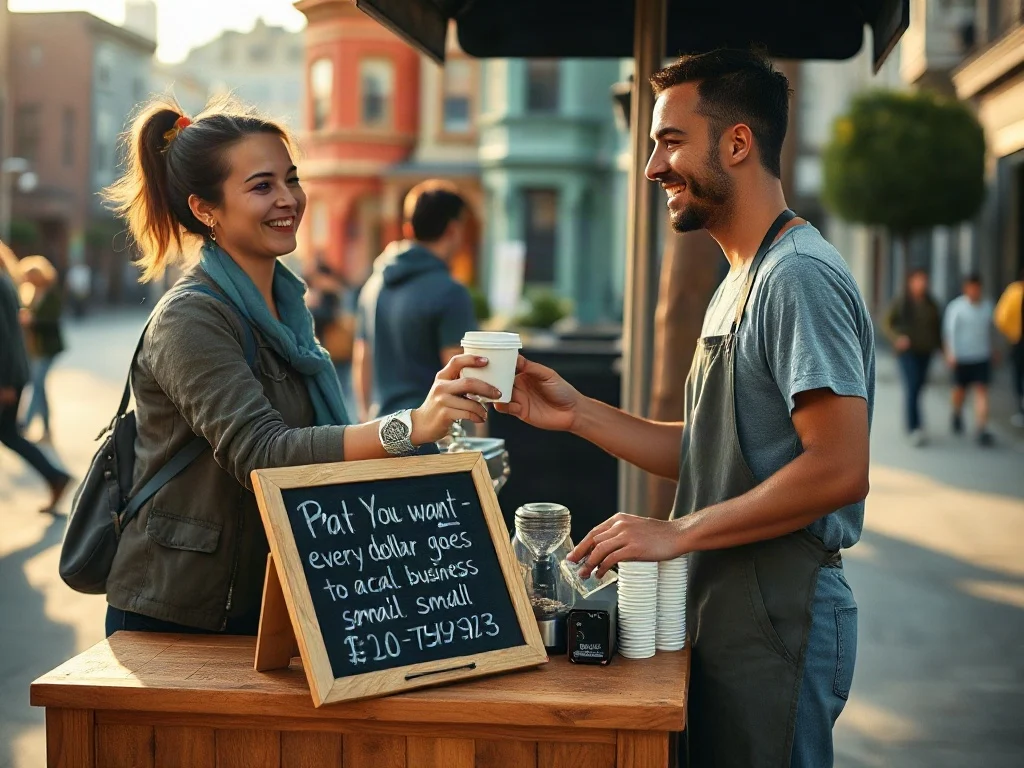
The pay what you want model sounds like a business school thought experiment rather than a growth tactic. Yet Brandon Sardi, founder of San Francisco-based Poorboy Coffee, is using it as a marketing channel. His pop-up series, “Who Gives a Hand,” lets customers take a drink for free or pay any amount. Every dollar goes to another local small business. The first event raised $957 in three hours, and the second raised about $500 before Sardi topped it up. This analysis looks at what those two data points show, what they cannot show, and whether the approach holds up as a repeatable strategy.
How the Pay What You Want Model Works in Practice
Under pay what you want pricing, the buyer sets the price, often with no minimum. Poorboy’s version adds a twist. The money never reaches Poorboy. It follows a pay-it-forward logic: customers fund a third party, and Poorboy absorbs the costs of ingredients, transport, staff time and a full working day.
That structure changes the economics. A customer who pays nothing costs Poorboy a cup of coffee. A customer who pays $50 is not paying Poorboy at all. The transaction becomes a donation vehicle, and the coffee works as the invitation.
Background: from wine-bar pop-ups to private catering
Poorboy began with hundreds of pop-up events at wine bars. Sardi found the model hard to justify. His team spent hours preparing, hauling equipment and setting up, hoping enough people would buy a $5 drink. The company then moved into private catering, where clients pay in advance and revenue is predictable. Sardi says the economics improved, but he missed the public-facing side of the business.
This is a common pattern in food and beverage startups. Pre-paid, contracted work is more profitable than speculative foot traffic, but it hides the brand from casual customers. Who Gives a Hand tries to restore that visibility without returning to the old cost structure.
What the Two Pop-Ups Actually Showed
Event one: generosity without a crowd
Sardi expected free drinks and social media promotion to draw a line. None formed. The event was slow, much like his earlier pop-ups. But nearly everyone who came contributed, some paying more than a normal drink price and one or more giving as much as $50. Over three hours, the event collected $957, more than double the roughly $450 in sales Sardi says a typical pop-up generated. The money went to AK Meats, a family-run San Francisco business.
Two details matter here. First, Sardi set up a live tracker showing the running total. Second, the turnout was modest, so the high total came from the amount per person rather than the number of people.
Event two: the free-rider reality
The second event drew roughly as many people, but more took drinks without paying. Sardi called this fully within the spirit of the model and suspects some customers did not understand the concept. The event collected about $500. His staff declined payment for their time, and Sardi added $500 of his own money so that $1,000 could again be passed on.
The gap between the two events is the most useful part of the story. With only two events, no one can say which result is typical. The swing, from $957 to about $500 with similar foot traffic, shows how volatile voluntary pricing is. It also shows that the free-rider problem is real, even when the beneficiary is a sympathetic small business.
Why Customers Pay: The Behavioral Economics
Voluntary payment is not irrational. Behavioral economics offers several explanations, though the article does not test which one applies at Poorboy.
- Social proof: A live tracker makes other people’s giving visible. Social proof can nudge hesitant customers toward contributing, and Sardi believes the tracker helped.
- Reciprocity: A free, well-made drink creates a felt obligation. Reciprocity is a well-documented social norm, though its strength varies by person and setting.
- Anchoring: Visible large gifts, such as a $50 contribution, can act as an anchor that raises what others consider reasonable. This is a plausible mechanism, not something the pop-up data proves.
- Third-party framing: Customers are not paying a company. They are helping a neighbor.
The third point has research support. A 2010 study in Science by Ayelet Gneezy and colleagues found that pairing pay-what-you-want pricing with a charitable component could increase revenue compared with fixed pricing in a field setting. That study concerned a different product and context, so it supports the mechanism rather than predicting Poorboy’s results.
The Wider Record of Pay-What-You-Want Experiments
Voluntary pricing has a mixed track record. In 2007, Radiohead released In Rainbows as a download where fans chose the price, and it became the best-known example. The reception was strong, but the band had a large existing audience, which a local coffee startup does not.
In food service, Panera Bread ran its Panera Cares pay-what-you-can cafés, which depended heavily on customer goodwill. The company later closed them. That illustrates a structural limit: a permanent business that depends on voluntary payment must absorb the costs of non-payers every day. Poorboy avoids this by running occasional events and treating them as marketing spend rather than revenue.
Is It Marketing or Charity? Both, With Limits
Sardi is candid that the series is partly promotional: “It’s a way for us to be creative as far as marketing goes,” he told Business Insider. That places it in the territory of cause marketing and guerrilla marketing: a low-budget, attention-seeking tactic that associates a brand with a positive act.
The case in favor
- Positive association: Sardi wants people to hear about Poorboy “in a good light,” which builds brand awareness through goodwill.
- Shareable content: Handing over a check to a family business produces a story people can pass along, which supports word of mouth.
- Founder motivation: Sardi started Poorboy with about $500 and understands the difficulty of bootstrapping. For him, seeing a recipient’s reaction is “kind of priceless.”
The case for caution
- Unmeasured returns: The article reports no data on repeat customers, new catering inquiries or follower growth. The marketing benefit is asserted, not demonstrated.
- Real costs: Ingredients, transport, staff time and a full day of work are expenses. In the second event, the owner covered a $500 shortfall in addition to those costs.
- Unclear incentives: If customers learn that the business benefits from publicity, some may discount the generosity. This is a risk to consider, not a documented outcome.
Practical Lessons for Small Business Owners
For other operators considering the pay what you want model as a promotional tactic, the Poorboy example suggests several practical rules. They are interpretations of a small case, not proven best practices.
- Budget the event as marketing, not revenue. Decide in advance how much you can lose. Sardi’s second event shows that a gap may need to be filled out of pocket.
- Explain the concept at the point of sale. Sardi suspects some customers misunderstood the model. A clear sign and a verbal explanation reduce confusion without removing the free option.
- Use visible progress. A live total gave Sardi a way to encourage giving. Transparency also builds trust that the money reaches the stated recipient.
- Choose the beneficiary deliberately. A named, local, family-run recipient gives customers a concrete reason to give. Generic charity framing is likely weaker.
- Track outcomes. Record new followers, catering inquiries and repeat visits tied to each event. Without this, you cannot tell whether the model is marketing or just goodwill.
- Plan for volatility. Two events produced very different totals. Treat any single result as noise.
Risks and Edge Cases
Three risks deserve attention. The first is norm erosion: if customers expect free coffee from a brand, they may be less willing to pay full price at later events. The second is location dependence. The first event ran at a former Poorboy pop-up site, where the brand may have had existing recognition, and a new city such as New York would test whether the model travels. The third is scale. A three-hour event with a few dozen participants is manageable, but a larger crowd multiplies costs while leaving the average contribution uncertain.
There is also an ethical point. Because the recipient receives the funds with no strings attached, the arrangement is straightforward. But a business that gains publicity from a donation should be open about its role, which Sardi has been, by describing the series as marketing.
What Comes Next for Pay-It-Forward Pop-Ups
Sardi plans more events, including one in New York City. That will be the first real test of whether the approach generalizes. Reasonable expectations, which remain predictions rather than facts, are that totals will vary widely, that recognition in new markets will be lower, and that results will depend on local partnerships and social media reach.
Broader market conditions may also favor experiments like this. Small food businesses face pressure on margins, and cheap, high-trust marketing is attractive. Voluntary pricing is unlikely to replace fixed menu prices, but as a limited, well-framed promotion it can work alongside them.
FAQ: Pay What You Want Pricing and Pop-Ups
Does pay what you want pricing work for coffee shops?
As a permanent model, it is risky because the business absorbs the costs of non-paying customers. As an occasional promotion, it can work. Poorboy’s first event brought in more than double a typical pop-up’s sales, but the second brought in about half that, so results are inconsistent.
What is the Who Gives a Hand pop-up series?
It is a Poorboy Coffee initiative where customers take a drink for free or contribute any amount. All money collected is passed to another local small business. The first recipient was AK Meats.
Does Poorboy Coffee keep the money?
No. According to the report, every dollar goes to the featured business, and Poorboy covers the event costs. Sardi’s staff also declined pay for their time at the second event.
How much did the pop-ups raise?
The first collected $957 in three hours. The second collected about $500, and Sardi added $500 of his own money to pass along $1,000.
Why do customers pay more than the usual price?
Possible explanations include social proof, reciprocity and the desire to support a local business. The article does not test these, so they remain hypotheses.
The Real Test: Whether Goodwill Converts Into Customers
The most important insight from Poorboy’s experiment is that the generosity itself is not in question. People gave, sometimes lavishly. The open question is whether that goodwill converts into the paying relationships Poorboy needs, such as catering clients and repeat buyers. Sardi has not reported figures on this, and the two events are too few to draw conclusions.
Watch the New York pop-up closely. If contributions remain strong in a market where Poorboy is unknown, the model has real drawing power. If totals drop and Sardi must fill the gap again, the series is closer to philanthropy with a marketing halo. Either result is useful, but only if Poorboy measures what follows the event rather than just the amount collected on the day.
Frequently Asked Questions
Does Poorboy Coffee earn any revenue from the pay what you want pop-ups?
No. Every dollar collected goes to another local small business, such as AK Meats at the first event. Poorboy absorbs the costs of ingredients, transport, staff time and a full working day. Its return is brand visibility and community goodwill rather than direct sales income.
Why did the second pop-up raise about half as much as the first one?
Foot traffic was similar, but more people took drinks without paying. Sardi suspects some customers did not understand the concept. With only two events, it is impossible to say which result is typical, so the gap mainly shows how volatile voluntary pricing can be.
Can two pop-ups prove that this model is a repeatable marketing strategy?
No. Two data points show potential and risk, but they cannot establish an average outcome. The swing from $957 to roughly $500, plus Sardi topping up the second event with his own $500, suggests results vary widely and that more events would be needed to judge reliability.
Why did customers pay more than a normal drink price at the first event?
The article does not test the cause, but behavioral economics offers explanations. A live tracker may have created social proof, a free drink may have triggered reciprocity, and large gifts like $50 may have acted as anchors. Sardi believes the tracker helped, though this remains unproven.
How is Poorboy's version different from standard pay what you want pricing?
In standard pay what you want, the buyer sets the price and the seller keeps the money. Poorboy uses a pay-it-forward twist: customers fund a third-party small business instead. The transaction becomes a donation vehicle, and the coffee works as the invitation to participate.
Why did Poorboy move away from regular pop-ups toward private catering in the first place?
Regular wine-bar pop-ups required hours of preparation, hauling and setup, with no guarantee enough people would buy a $5 drink. Private catering offered prepaid, predictable revenue and better economics, but it hid the brand from casual customers, which Who Gives a Hand tries to fix.