
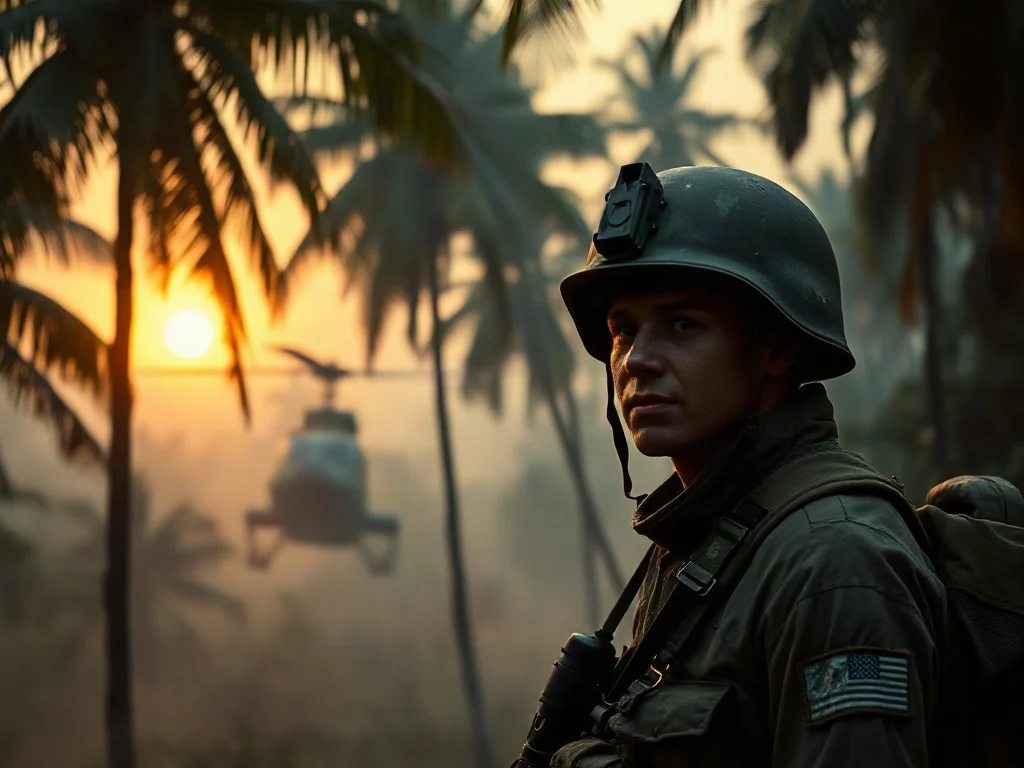
Any list of the best Vietnam War movies is also an argument about how America remembers a lost conflict. The Vietnam War produced one of the most morally contested bodies of work in cinema. It spans features and documentaries, and its tone runs from hallucinatory epic to procedural combat drama to forensic nonfiction. A ranking of twenty titles, such as the one a recent entertainment feature has published, sets the stage. The more useful exercise is to ask what criteria should govern such a list, which films survive scrutiny, and where the genre’s blind spots lie. This article does that.
Why the best Vietnam War movies are hard to rank
Ranking war films usually mixes three separate questions: artistic achievement, historical reliability, and cultural influence. A film can excel on one and fail on another. Hollywood’s Vietnam cycle makes the problem sharper, because most of its landmark works were made by or about American participants, often a decade or more after the fighting. They are acts of memory and revision as much as depictions of events.
The genre also has a structural tension. Anti-war intent does not guarantee anti-war effect. Directors have long complained that audiences read combat spectacle as thrilling regardless of the message. Any serious ranking has to weigh what a film intends against what it actually does on screen.
The canon: features that defined Vietnam War cinema
Apocalypse Now: the hallucinatory benchmark
Apocalypse Now (1979), directed by Francis Ford Coppola, transposes Joseph Conrad’s Heart of Darkness to the river war in Southeast Asia. It remains the usual first choice on lists of the greatest Vietnam War films, and the reasons are stylistic. It treats the war as a collapse of rationality, not as a battlefield with a front line. Its weakness is political vagueness. It is a masterpiece of atmosphere and a thin account of why the war was fought or lost. The film was shot in the Philippines amid a famously troubled production, and Coppola later released expanded cuts, so which version you rank matters.
Platoon and Full Metal Jacket: two incompatible realisms
Platoon (1986) comes from Oliver Stone, who served in Vietnam and built the film on that experience. It is a moral allegory in which two sergeants compete for a young recruit’s soul. It won the Academy Award for Best Picture, but its schematic good-versus-evil structure is the usual target of criticism.
Full Metal Jacket (1987), by Stanley Kubrick, rejects allegory for clinical detachment. Its two-part structure, boot camp followed by urban combat during the Tet Offensive, argues that the institution produces the violence before any enemy appears. Critics often rate the first half above the second. That is a fair criticism, but the film’s structural idea is still the more original of the two.
The Deer Hunter, Coming Home and Born on the Fourth of July: the home front
Some of the strongest entries barely show combat. The Deer Hunter (1978) follows steelworkers from a Pennsylvania town through the war and its aftermath. Its Russian roulette sequences are dramatically powerful but widely disputed as history, which is a useful reminder that emotional truth and factual record are different things. Coming Home examines disabled veterans and the strain on marriages, and its lead performances were recognized at the Oscars. Born on the Fourth of July (1989), adapted from Ron Kovic’s memoir, follows a paralyzed veteran’s move from patriotic enlistment to anti-war activism. Together these films anticipate how the culture later discussed post-traumatic stress disorder, and they show that the war’s most lasting damage was often domestic.
Vietnam War documentaries: where the evidence lives
A balanced list should include nonfiction, and Vietnam War documentaries often outperform features on argumentative rigor. Hearts and Minds (1974), directed by Peter Davis, was made while the war was still unresolved. It won the Oscar for Best Documentary Feature and juxtaposes officials’ rhetoric with the human cost. It is openly polemical, which is both its force and its limit as a neutral record.
The Fog of War (2003) takes a different route. Errol Morris builds the film around a long interview with Robert McNamara, the defense secretary under Presidents Kennedy and Johnson. The result is less a history lesson than a study of how a technocrat rationalizes decisions in retrospect. On a longer scale, Ken Burns and Lynn Novick’s The Vietnam War miniseries, available through PBS, offers the most comprehensive documentary survey, with testimony from Americans and Vietnamese on several sides. It is a miniseries rather than a film, so whether it belongs on a movie list is a legitimate editorial choice.
Do Vietnam War films hold up on historical accuracy?
Readers searching for Vietnam War films historical accuracy usually want a simple verdict. A better method is to sort the films by what they claim.
- Documented-event dramas: We Were Soldiers (2002) dramatizes the Battle of Ia Drang from a memoir by Hal Moore and Joseph Galloway. It stays close to its source but is deliberately sympathetic to its commanders. Casualties of War (1989) is based on a real 1966 incident, and it addresses atrocity in the spirit of the My Lai massacre debate, though it is not about that event.
- Autobiographical works: Platoon and Born on the Fourth of July carry the authority of lived experience, but memory shapes and distorts what they show.
- Allegorical works: Apocalypse Now and Full Metal Jacket should be judged on thematic insight, not on procedure or chronology.
The practical lesson is to ask which standard a film invites. Penalizing an allegory for inaccuracy is a category error, and so is crediting a sympathetic dramatization with historical neutrality.
Beyond the canon: comedy, race and revision
The genre’s range is wider than its prestige titles suggest. Good Morning, Vietnam (1987), starring Robin Williams, uses an armed-forces radio setting to satirize official messaging. It is loosely based on Adrian Cronauer’s experience, and its liberties with the facts are well known. Da 5 Bloods (2020), from Spike Lee, centers Black American veterans and the contradiction of fighting abroad for a country that denied them equality at home. Few earlier films of its stature foregrounded that perspective, which makes it an important corrective.
How to build your own ranking of the best Vietnam War movies
Critics’ lists are starting points. If you want a ranking that holds up, use explicit criteria and weight them honestly.
- Formal achievement: direction, cinematography, sound and performance.
- Thematic coherence: does the film’s argument about the war survive a second viewing?
- Perspective: whose experience is centered, and whose is missing?
- Historical honesty: does the film respect the standard it sets for itself?
- Influence: has it shaped later war films and public memory?
Common mistakes include rewarding scale over insight, treating box-office success as quality, and confusing a film’s moral seriousness with its moral accuracy. A reasonable viewing order for newcomers pairs one allegory (Apocalypse Now), one veteran drama (Platoon or Born on the Fourth of July), and one documentary (Hearts and Minds or The Fog of War). Then add context from a longer source such as the Burns and Novick series.
Frequently asked questions about Vietnam War movies
What is the best Vietnam War movie?
There is no objective answer, but Apocalypse Now is the most frequently cited, with Platoon, Full Metal Jacket and The Deer Hunter close behind. Which one you prefer depends on whether you prioritize style, realism or emotional impact.
Which Vietnam War movie is the most historically accurate?
No feature is a literal record. Films drawn from documented sources, such as We Were Soldiers, generally stay closest to events. Documentaries like Hearts and Minds and The Fog of War offer firmer evidence, though both reflect the editorial choices of their makers.
Are there good Vietnam War documentaries?
Yes. Hearts and Minds, The Fog of War and the Burns and Novick miniseries are the most widely discussed, and each takes a different approach: polemic, interview study and comprehensive narrative.
Are there Vietnam War movies told from the Vietnamese perspective?
The best-known English-language titles are overwhelmingly American in viewpoint, which is a widely noted limitation of the canon. Viewers interested in other perspectives should seek out Vietnamese cinema and international documentaries as a complement.
What the ranking still cannot tell us
The strongest insight from comparing these films is that the canon is less a record of the war than a record of America’s shifting attempts to explain it to itself. The 1970s works processed grief and betrayal, the 1980s works claimed authenticity and moral reckoning, and the 2000s and 2020s works revisit the war through institutional critique and the experiences of marginalized veterans. Each wave says as much about its own decade as about 1965 to 1975.
Watch next for two developments. One is whether streaming platforms and international co-productions finally give Vietnamese and other non-American perspectives the prominence American features have had for forty years. The other is whether younger directors, with no direct memory of the war, will treat it as living history or as a familiar backdrop for genre filmmaking. My prediction, which is an interpretation rather than a fact, is that the next landmark Vietnam War film will not be a combat film at all. It will examine the war’s afterlife: the archives, the families and the stories still unsettled. The open question is whether cinema is ready to let someone other than the winners of that memory battle tell it.
Frequently Asked Questions
Why does the article say anti-war intent does not guarantee an anti-war effect in Vietnam films?
Directors have long noticed that audiences often experience combat spectacle as thrilling, whatever message the filmmaker intended. A film meant to condemn war can still make it look exciting. For this reason, a serious ranking should weigh what a movie intends against what it actually does on screen.
Which version of Apocalypse Now should be considered when ranking it?
The choice matters because Coppola released expanded cuts after the original 1979 theatrical version, and the production itself was famously troubled. Versions differ in length and emphasis, so a critic's ranking can change depending on which cut is judged. A reliable list should state the version it evaluated.
Is The Deer Hunter's Russian roulette scene historically accurate?
No, the sequences are widely disputed as history. The article uses the film to show that emotional truth and factual record are different things. The scenes remain dramatically powerful, which is why they count toward artistic achievement even though they weaken the film's claim to historical reliability.
Why are Platoon and Full Metal Jacket described as two incompatible kinds of realism?
Platoon, drawn from Oliver Stone's own service, is a moral allegory in which two sergeants compete for a recruit's soul. Full Metal Jacket takes a clinical, detached approach and suggests that military training creates the violence before any enemy appears. One relies on personal moral drama, the other on institutional critique.
Why include documentaries like Hearts and Minds in a list of the best Vietnam War movies?
The article argues that documentaries often outperform features in argumentative rigor and serve as places where evidence lives. Hearts and Minds, directed by Peter Davis, was made while the war was unresolved and won the Oscar for Best Documentary Feature. Including such films makes a ranking more balanced.
Which Vietnam films focus on the home front rather than combat?
The Deer Hunter, Coming Home and Born on the Fourth of July show little combat. They follow steelworkers, disabled veterans and a paralyzed soldier turned activist. The article says they anticipated later discussion of post-traumatic stress disorder and show that the war's most lasting damage was often domestic.