
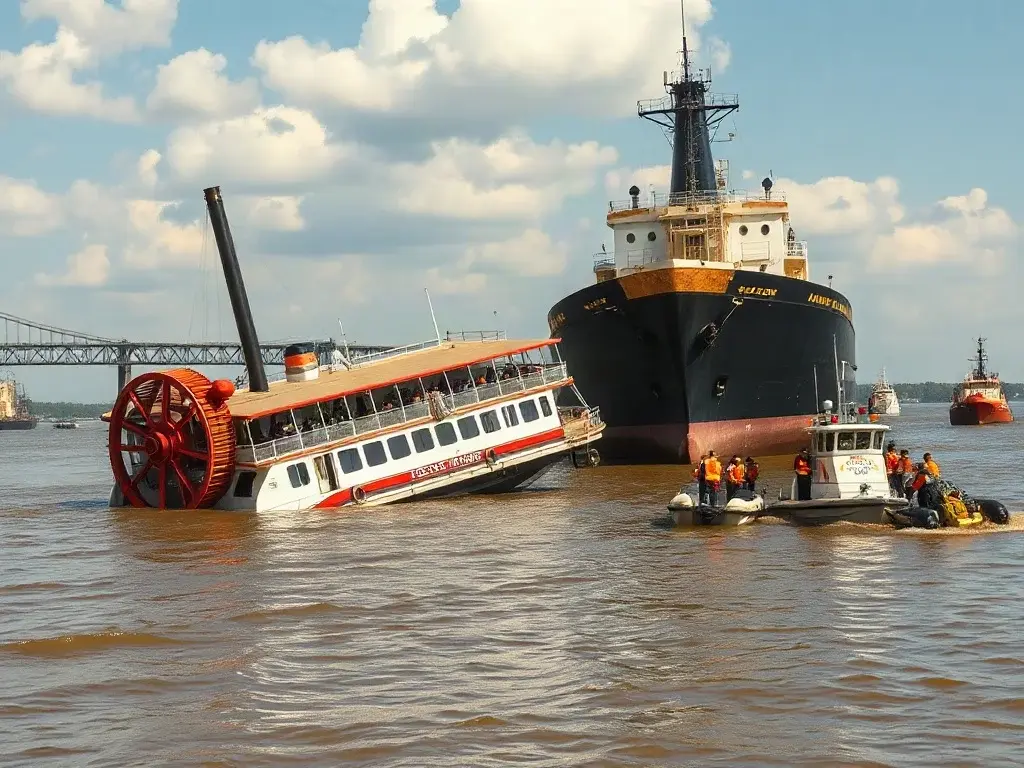
The New Orleans river cruise ship collision on Friday, November 13, is already being called a “Miracle on the Mississippi.” At about 12:30pm local time, the tanker Atlantic Asphalt reportedly lost control on the Mississippi River and struck the American Heritage, a paddlewheel riverboat operated by American Cruise Lines. The passenger vessel capsized and a major emergency rescue operation followed. Everyone aboard has since been accounted for. This article looks at what is known, why such an outcome is so rare, and what the incident may mean for river cruise safety.
“Miracle on the Mississippi”: the phrase attached to the rescue, after every person aboard the capsized riverboat was accounted for.
Early reporting is thin on detail, and this analysis separates confirmed facts from informed interpretation. The cause of the tanker’s loss of control, the number of people aboard and the extent of any injuries should be treated as open questions until official investigators publish findings.
What We Know About the New Orleans River Cruise Ship Collision
The confirmed facts are few but significant:
- The collision happened around 12:30pm local time on Friday, November 13, in New Orleans, Louisiana.
- The tanker Atlantic Asphalt lost control and struck the American Heritage.
- The riverboat capsized, which triggered a large emergency rescue response.
- All passengers and everyone else aboard have been accounted for.
That last point is why the story is remarkable. Capsizing is among the most dangerous events a passenger vessel can suffer. It can happen within minutes, and it can trap people in cabins, stairwells and lounges. A river of this size and temperature makes it worse. That a full headcount was reached speaks to fast reactions on the water, effective emergency coordination and, almost certainly, some luck.
The Vessels Involved: A Paddlewheeler Meets an Asphalt Tanker
The American Heritage and the Paddlewheel Tradition
The American Heritage belongs to a lineage that stretches back to the nineteenth-century paddle steamer. Modern paddlewheelers recall that era with sweeping decks and rotating wheels, but they are built around contemporary engineering and regulation. Their appeal is the unhurried, scenic character of the river cruise, which gives passengers close views of historic cities, plantations and working waterfront.
That design philosophy brings a trade-off. Riverboats are broad, multi-deck vessels with shallow draft. They are optimized for sightseeing and comfort, not for absorbing a heavy side impact from a loaded commercial ship.
The Atlantic Asphalt and the Nature of Tanker Traffic
The Atlantic Asphalt is a tanker. Its name suggests a cargo of bitumen, though readers should note that the cargo status at the time of impact has not been established in the information available here. Asphalt tankers are often specialized, heated vessels, and the lower stretches of the Mississippi carry heavy commercial traffic of this kind. The river is a working artery for bulk commodities, and passenger vessels share it with tankers, barges and towboats.
Why the Mississippi at New Orleans Is So Unforgiving
Every mariner who works near New Orleans knows how demanding this stretch is. The river bends sharply, the current runs strong, and eddies form along the banks. Vessel traffic is dense and the Port of New Orleans region is one of the busiest maritime zones in the United States. Large ships moving downstream have limited room to stop or turn. A loss of steering, propulsion or situational control can turn a manageable passage into an emergency within seconds.
This does not tell us what went wrong with the Atlantic Asphalt. “Lost control” is a broad description that could cover mechanical failure, a steering gear problem, a propulsion fault, navigational error or a combination of factors. Responsible analysis waits for evidence.
How Did All Passengers Survive the Collision?
Many readers will ask this question, and the honest answer is that investigators will have to establish it. Still, maritime safety offers clear reasons why survival is plausible, even after a capsize.
Proximity to Shore and Rescue Resources
An incident in a major port city differs from one in open water. Rescue crews, commercial vessels and emergency responders can reach the scene quickly. Nearby boats can act as improvised rescue platforms, which matters a great deal in the first minutes. The scale of the emergency rescue operation reported suggests the response was rapid and coordinated.
Safety Equipment and Procedures
Passenger vessels carry life jackets, emergency lighting, alarms and evacuation procedures, and crews train regularly for a range of emergencies. Where lifeboats or rescue craft are available, their deployment can be critical. Whether these systems were used here is a matter for the official inquiry. Quick, disciplined crew action is often the difference between a tragedy and a near miss.
The Role of Timing
The collision happened in the early afternoon, in daylight. Passengers were likely awake, mobile and dressed, which is a large advantage over a night-time incident. Visibility helped both the people on the water and the rescuers. Daylight alone does not explain the outcome, but it plausibly improved the odds.
The Physics of a Capsize
A vessel stays upright because of its ship stability, the balance between its center of gravity and its buoyancy. A tall passenger riverboat has a relatively high superstructure. A large force against its side, followed by flooding or sudden shifts in weight, can erode that balance quickly. Once the heel passes a critical angle, recovery becomes unlikely.
This is why a collision with a much heavier ship is so dangerous. Even a glancing blow can transfer enormous energy. The fact that the American Heritage capsized suggests the force of impact was substantial. It also makes the full accounting of passengers more extraordinary.
What the Investigation Will Examine
In the United States, marine casualties of this kind normally draw scrutiny from the United States Coast Guard, which manages maritime safety and rescue, and often from the National Transportation Safety Board, an independent agency that investigates transportation accidents. Readers can follow official updates through the NTSB and the U.S. Coast Guard.
Investigators in a case like this typically look at several areas:
- Mechanical condition: propulsion, steering and control systems on the tanker.
- Human factors: crew actions, communications and the role of the maritime pilot, if one was aboard.
- Traffic data: records from the Automatic Identification System and the vessel traffic service.
- Structural response: how the riverboat’s hull and stability behaved after impact.
- Emergency response: alarm timing, evacuation and the speed of the search and rescue effort.
Final reports of this kind can take many months, and early assumptions often change. The responsible approach is to wait for the evidence.
What Travelers Should Take From the Incident
One dramatic event should not be read as proof that river cruising is unsafe. Passenger vessel incidents remain rare relative to the number of voyages. Still, the episode offers practical lessons for anyone planning a trip.
- Pay attention to the safety briefing. It is the most useful five minutes of any cruise.
- Locate your life jacket and exits on day one. Know at least two routes out of your cabin and the main decks.
- Keep essential items accessible. Medications and identification should be easy to grab.
- Ask operators about their emergency procedures. Reputable lines will explain drills, crew training and equipment.
- Follow crew instructions immediately. In an emergency, hesitation costs time.
Industry and Regulatory Implications
The incident raises questions that the maritime and tourism industries will have to consider. Should passenger vessels and commercial ships follow stricter separation practices in congested waterways? Are current stability and damage-survivability standards enough for tall riverboats? Do emergency drills reflect the possibility of a rapid capsize?
Vessels operating on inland waterways are governed by a different framework from ocean-going ships, which follow rules such as the International Convention for the Safety of Life at Sea. Whether this event prompts changes will depend on the investigation, not on public emotion. There are also economic consequences to consider, from the loss of a vessel to disruption of river traffic to the effect on passenger confidence in river cruise bookings.
Frequently Asked Questions
What happened in the New Orleans river cruise ship collision?
The tanker Atlantic Asphalt lost control and struck the paddlewheel riverboat American Heritage on the Mississippi River at about 12:30pm local time on Friday, November 13. The riverboat capsized.
Did everyone survive the American Heritage capsize?
According to the reporting, everyone aboard has been accounted for, which is why the event has been described as a “Miracle on the Mississippi.”
Who operates the American Heritage?
The vessel is operated by American Cruise Lines.
What caused the tanker to lose control?
The cause has not been established in the information available. Official investigators will need to determine it.
Is river cruising still safe?
Serious accidents remain uncommon, but this incident shows why safety training, equipment and traffic management matter. Passengers should always follow briefings and crew instructions.
The Question the River Is Now Asking
The most important insight from this event is that survival was not an accident of the vessel’s design. It was the product of layered defenses: trained crews, nearby responders, daylight and quick decisions. Layers like these are only visible when they work, and they are easiest to cut when they seem unnecessary.
Watch for three developments over the coming months. The first is the official findings on why the Atlantic Asphalt lost control, because that answer will determine whether this was an isolated failure or a symptom of a wider weakness. The second is whether investigators recommend changes to traffic management or passenger vessel stability standards. The third is how American Cruise Lines and its peers respond in operations and in public communication.
A reasonable prediction is that regulators and operators will examine emergency evacuation and waterway separation more closely, though the scale of any change is unknowable until the evidence is public. The unanswered question is the uncomfortable one: if a collision this violent can end with everyone accounted for, how many near misses on busy rivers go unexamined, and what would it take to learn from them before the next one ends differently?
Frequently Asked Questions
Has the cause of the Atlantic Asphalt losing control been determined?
No. The article stresses that 'lost control' is a broad description. It could point to mechanical failure, a steering gear problem, a propulsion fault, navigational error or a mix of factors. Official investigators have not yet published findings, so any explanation at this stage is speculation.
Was the Atlantic Asphalt carrying asphalt when it hit the American Heritage?
That is not established. The vessel's name suggests a bitumen cargo, and asphalt tankers are often specialized heated ships, but the available information does not confirm whether the tanker was loaded at the time of impact. Investigators will need to verify cargo status.
Why is this stretch of the Mississippi considered so risky for ships?
The river near New Orleans bends sharply, has strong currents and bank eddies, and carries dense traffic in one of the busiest maritime zones in the United States. Large downstream ships have little room to stop or turn, so a steering or propulsion failure can become an emergency within seconds.
Why are paddlewheel riverboats vulnerable to a collision like this?
Riverboats are broad, multi-deck vessels with shallow draft, built for sightseeing and comfort rather than absorbing a heavy side impact. Although modern paddlewheelers use contemporary engineering and regulation, that design trade-off makes them more exposed when struck by a large commercial ship such as a tanker.
Why is it so unusual that everyone aboard was accounted for after the capsizing?
Capsizing can happen within minutes and trap people in cabins, stairwells and lounges, and the river's size and temperature add danger. A full headcount suggests fast reactions on the water and effective emergency coordination, though the article says luck probably played a part too.
Are the number of people aboard and the extent of injuries confirmed?
Not yet. The article treats the total number of people aboard and any injuries as open questions. The only confirmed point is that everyone aboard has been accounted for. Details on injuries and passenger counts should wait for official statements from investigators or authorities.