
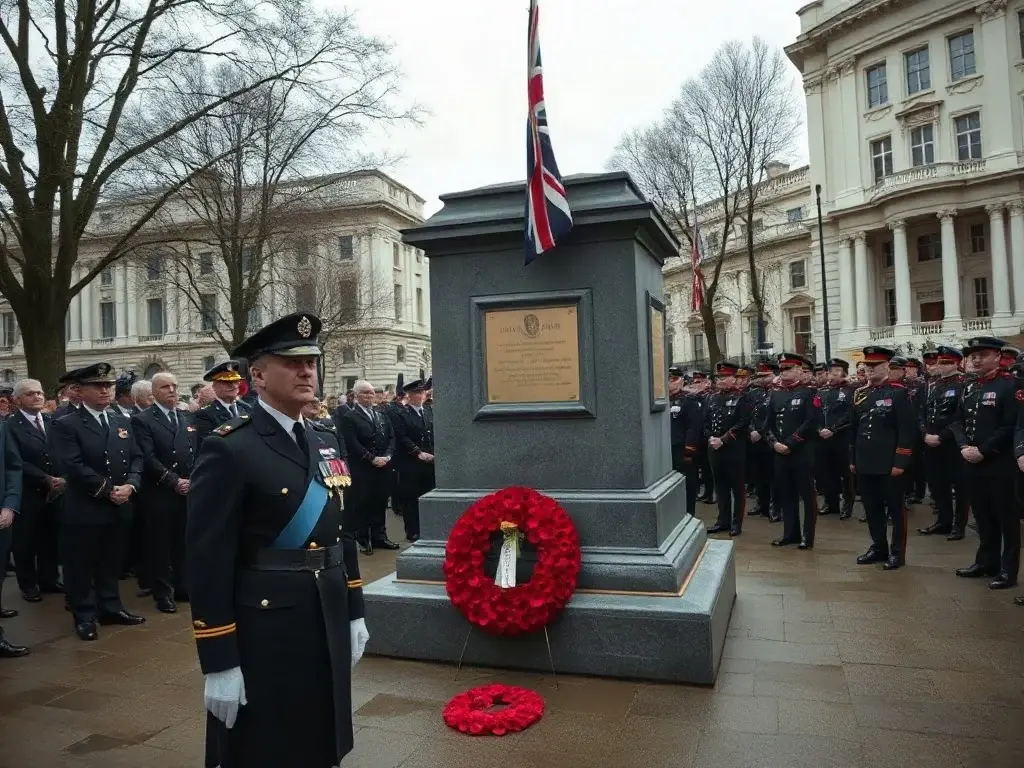
The annual Remembrance Sunday ceremony at the Cenotaph in Whitehall is one of the few British state occasions in which almost nothing is improvised. This year, King Charles led the commemorations and laid a wreath at the solemn service, while royals and veterans gathered to reflect on those who died in war. The coverage is brief. The ritual behind it is not, and it is worth examining as both a tradition and a public statement about how a nation chooses to remember.
This analysis looks past the pageantry. It asks what the ceremony is built to do, why its restraint is its main strength, and what pressures it faces as living memory of the two World Wars fades.
What Happens at the Cenotaph on Remembrance Sunday
For readers wondering what happens at the Cenotaph on Remembrance Sunday, the sequence is fixed and deliberately plain. Remembrance Sunday falls on the second Sunday of November, the Sunday closest to 11 November. The service takes place on Whitehall in central London, and the central moment is the two-minute silence at 11am.
The order of the ceremony
- Assembly: Servicemen and servicewomen, representatives of the Commonwealth, clergy and political leaders take their places around the monument.
- The silence: A gun salute marks the start and end of the two minutes, with the bells of Big Ben tied into the timing.
- The Last Post: Buglers, traditionally from the Royal Marines, sound the Last Post, followed by Reveille after the silence.
- Wreath-laying: The sovereign lays the first wreath, followed by other members of the Royal Family, political leaders and representatives of the armed forces and Commonwealth nations.
- March-past: Veterans and service associations file past the monument, an element coordinated by the Royal British Legion.
Members of the Royal Family traditionally watch from a balcony at the Foreign, Commonwealth and Development Office when they are not laying wreaths. The visual hierarchy is clear: the monarch acts first, and everyone else follows.
The Monument and Its Origins
The structure at the centre of the event is The Cenotaph, designed by Sir Edwin Lutyens. A temporary version was erected for the 1919 Peace Day celebrations. Its public reception led the government to commission a permanent Portland stone monument, which was unveiled on 11 November 1920 by George V. The word cenotaph comes from Greek and means
Frequently Asked Questions
Why is Remembrance Sunday held on a Sunday rather than always on 11 November?
Remembrance Sunday falls on the second Sunday of November, the Sunday closest to 11 November. This lets large numbers of veterans, families and officials attend the Whitehall service. Armistice Day on 11 November itself is still marked with a two-minute silence at 11am.
Why does the sovereign lay the first wreath at the Cenotaph?
The order of wreath-laying reflects a clear visual hierarchy: the monarch acts first as head of state and head of the armed forces, and others follow. Royals, political leaders and representatives of the services and Commonwealth then lay theirs, showing national unity and precedence.
What role do the Royal British Legion and the Royal Marines play in the ceremony?
The Royal British Legion coordinates the veterans' march-past, in which service associations file by the monument after the wreaths are laid. Buglers, traditionally from the Royal Marines, sound the Last Post before the silence and Reveille afterward, marking its start and end with a recognisable signal.
Does the Cenotaph commemorate only the two World Wars?
The monument was unveiled in 1920 after the First World War, but the article presents the ceremony as a broader public statement about how the nation remembers those who died in war. The ceremony faces pressure as living memory of the two World Wars fades, so its meaning must be sustained across generations.
Why is the restraint of the ceremony considered its main strength?
The sequence is fixed and deliberately plain, with almost nothing improvised. Because there are no speeches or spectacle to distract, attention stays on the silence and on those being remembered. That consistency also makes the ritual instantly recognisable and helps it endure as living memory of the World Wars fades.
Where were the Royals when they are not laying wreaths?
Members of the Royal Family who are not laying wreaths traditionally watch from a balcony at the Foreign, Commonwealth and Development Office overlooking Whitehall. From there they observe the silence, the wreath-laying and the veterans' march-past without taking part in the formal sequence on the ground.