
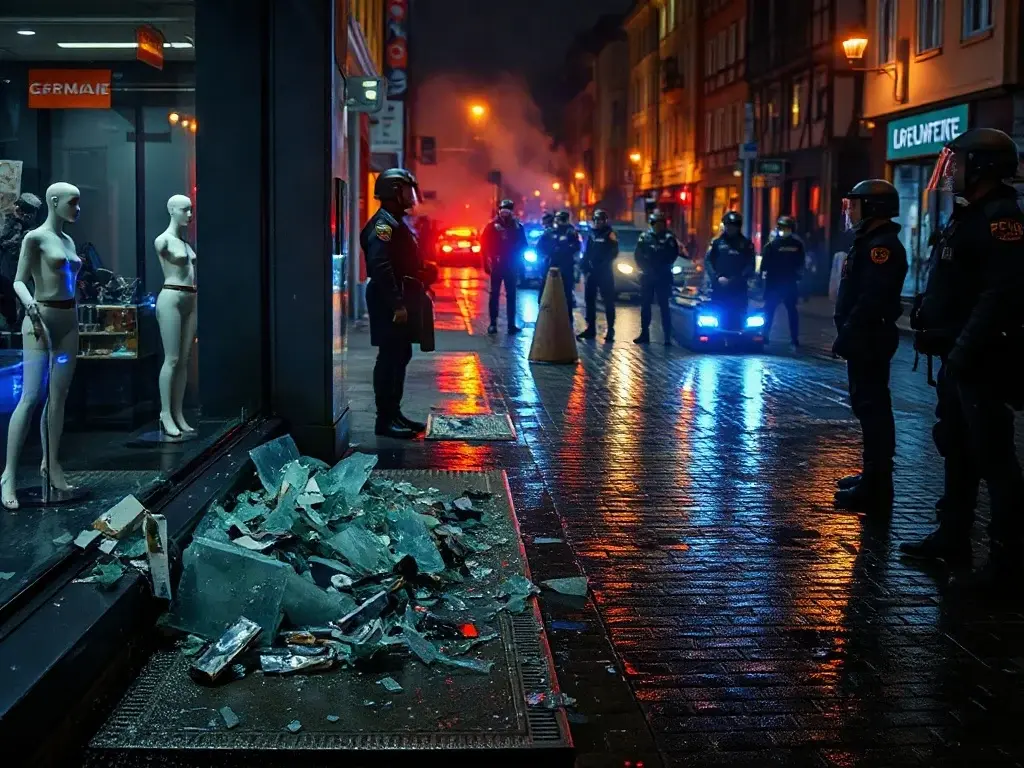
The German cost of living protests have taken a sharper turn. Police in Frankfurt say “violent riots” took place in the city centre, shops were looted, and unrest was also reported in Berlin, Hamburg and Cologne. Those are the confirmed outlines. Much else, including the number of participants, arrests, injuries, organisers and total damage, is not established in the initial report, and this analysis does not guess at it. What it does is examine why economic grievance in Germany can move from the demonstration to the shop window, and what that shift means for policy, policing and retailers.
What the Initial Reports Actually Establish
The factual core is narrow. Frankfurt police used the term “violent riots” for events in the city centre. Looting of shops was reported. Disturbances were also reported in three other major cities: Berlin, Hamburg and Cologne.
Three caveats matter for any serious reading:
- Police language is an interpretation. “Riot” is a legal and operational characterisation, usually made early, and it can be revised once investigations conclude.
- Co-occurrence is not coordination. Unrest in four cities may reflect a shared trigger, a shared online call to action, or separate events grouped by headlines. The report does not say which.
- Protesters and looters are not necessarily the same people. Research on riots repeatedly finds that opportunistic looting often involves actors distinct from the original demonstrators.
Why Cost of Living Grievances Resonate in Germany
The inflation shock
Germany’s recent price history explains the sensitivity. After Russia’s invasion of Ukraine, wholesale natural gas prices spiked, and German consumer inflation climbed above 10 percent in autumn 2022, according to the Federal Statistical Office (Destatis), the highest reading in decades. Inflation has since eased, but price levels do not fall back. Households that absorbed the shock still face a permanently higher base for energy, food and rent.
A cultural dimension
Germany’s postwar economic identity rests on price stability, shaped by memories of hyperinflation and embodied in the Deutsche Bundesbank tradition. When inflation breaks that expectation, the grievance is not only financial. It becomes a perceived breach of the social contract, and that makes protest more emotionally charged than the raw numbers alone would suggest.
Uneven exposure
The burden is not spread evenly. Lower-income households spend a larger share of income on energy and food, so headline inflation understates their experience. Rents in cities such as Frankfurt, Berlin, Hamburg and Cologne add to the squeeze. That the unrest appeared in large cities fits this logic, though the initial report does not confirm that housing costs were a trigger.
From Demonstration to Riot: How Escalation Happens
Scholars of collective action generally distinguish several pathways. None is confirmed for these events, but they are the standard hypotheses an informed reader should weigh.
- Peaceful march, violent fringe. A small, organised group uses a large crowd as cover. Black-bloc tactics are the classic example in German protest history.
- Policing-triggered escalation. Containment tactics such as kettling or aggressive dispersal can turn a tense crowd confrontational. Critics of police practice raise this often, and police unions typically reject it.
- Opportunistic crime. Once a shop window is broken, the perceived cost of looting drops sharply. This does not require ideological motive.
- Online mobilisation. Social media can summon crowds faster than organisers or police can structure them, which weakens the stewarding and coordination that keep protests peaceful.
The mention of looting points toward the third pathway, at least in part. Looting is rarely a political statement about inflation. It is a property crime committed in the context of one, and conflating the two helps neither the protesters nor the public debate.
The Comparison Problem: Yellow Vests and Beyond
The closest European precedent is France’s yellow vests movement, which began in 2018 over fuel costs and produced serious rioting and looting in Paris. The comparison is tempting, and it is also limited. The French movement was leaderless, geographically peripheral in origin and driven by a specific tax. Germany’s situation involves a different protest culture, strong union and party structures, and a federal policing system in which each state runs its own police.
The real lesson from the French case is about trajectory. Cost of living movements that begin with broad public sympathy can lose it quickly when property destruction dominates coverage, and governments can then shift the debate from the grievance to public order.
Political Exploitation and the Risk of Narrative Capture
Economic anger is politically valuable, and Germany‘s fragmented landscape offers many claimants. The far right, including the Alternative for Germany, has campaigned on energy and living costs, and parts of the far left mobilise around rents and wages. Whether any organised group was involved in these disturbances has not been established. Readers should be sceptical of early attributions from any side, because violence is a convenient tool for discrediting an opponent’s movement.
The constitutional backdrop matters too. The right to assemble is protected under the Basic Law, and freedom of assembly covers peaceful gatherings only. Violent riots fall outside that protection, which gives authorities legal grounds to restrict, ban or dissolve events. How proportionately they use those powers will shape public trust more than the initial clashes.
Economic Consequences for Retailers and Cities
The immediate cost falls on shopkeepers, many of them independent traders still recovering from pandemic closures and energy-driven overheads. Insurance may cover some losses, but policies differ on civil unrest and looting, and premiums often rise afterward. Inner-city retail also suffers from reputational damage, since footfall drops when shoppers perceive risk. Reliable loss figures are not yet available, and any early estimate should be treated cautiously.
There is a second-order effect. Looting of retail goods can feed the very cost of living pressures protesters complain about, as higher security spending and insurance costs are eventually priced into goods and rents.
Policy Responses: What Governments Can and Cannot Do
The limits of monetary policy
The European Central Bank controls interest rates for the eurozone, not for Germany alone, and rate policy cannot address localised housing or energy-bill pain. Official information on its inflation mandate is available on the ECB website.
Fiscal tools and their trade-offs
Berlin’s real levers are fiscal: energy price caps, targeted transfers, housing measures and wage-support mechanisms such as the minimum wage. Each carries trade-offs. Broad subsidies are fast but expensive and poorly targeted, while targeted support is efficient but administratively slower. Slowness is itself a grievance when households feel immediate pressure.
The stagflation worry
Weak growth combined with persistent prices raises the spectre of stagflation. Germany’s slow growth in recent years has made that concern more than academic, and it narrows the government’s room for generous relief.
Practical Guidance for Businesses and Local Authorities
- Review insurance wording. Check explicitly whether civil commotion, looting and business interruption are covered, and what the claim documentation requirements are.
- Coordinate with local police. Retailers’ associations in city centres can request protest route information and adjust opening hours accordingly.
- Prepare documentation. Timestamped photographs of stock and premises before and after an incident speed up claims.
- Avoid ad hoc physical hardening. Improvised barricades can create fire-safety and liability problems. Professional advice is worth the cost.
- Monitor official channels. Police statements and city notices are more reliable than viral footage, which often lacks context or date.
For local authorities, the more difficult task is separating enforcement from engagement. Prosecuting looters is straightforward. Addressing the grievances that supplied the crowd is not.
Frequently Asked Questions
Why did the German cost of living protests turn violent?
The initial report does not give a cause. Common explanations include violent fringe groups, opportunistic crime, policing dynamics and rapid online mobilisation. Confirmation requires police findings and independent reporting.
Which German cities were affected?
Police in Frankfurt reported violent riots in the city centre, and unrest was also reported in Berlin, Hamburg and Cologne.
Are the Frankfurt riots the same as the peaceful protests?
Not necessarily. Peaceful demonstrations are protected by German law, while riots and looting are criminal offences. Participants in each may overlap, but the groups are often distinct.
Is inflation in Germany still high?
Inflation has fallen from its 2022 peak, but price levels remain well above pre-crisis levels. Current figures are published by Destatis.
The Question This Unrest Leaves Open
The central insight is that the violence and the grievance operate on different timelines. The grievance, a permanently higher cost base for ordinary households, will outlast any news cycle. The violence will be remembered chiefly for what it does to the political standing of the cause. If investigators show that organised extremist groups or opportunistic criminals drove the damage, mainstream concern about living costs may be dismissed alongside them, which would be an analytical error but a likely political outcome. If instead the data show large numbers of ordinary protesters turning to confrontation, that signals a deeper failure of trust in institutions.
Watch three things next: the formal police findings on who was arrested and from where, whether further demonstrations are called and how they are policed, and the next inflation release from Destatis. A reasoned prediction is that the debate will split, with security politics dominating the short term while housing and energy costs resurface in budget negotiations. The unanswered question is whether Germany’s political system can show that peaceful protest still works before the next price shock tests it again.
Frequently Asked Questions
Does the use of the word "riot" by Frankfurt police mean the events are legally proven to be riots?
No. The term is an operational and legal characterisation, usually made early in an incident. It can be revised once investigations conclude. Readers should treat it as the police's initial interpretation rather than a final finding about what happened or who was responsible.
Are the people looting shops necessarily the same people who were protesting about living costs?
Not necessarily. Research on riots often finds that opportunistic looting involves people distinct from the original demonstrators. Looting is generally a property crime committed in the context of a protest, not a political statement about inflation, so treating the two as one can distort the debate.
Does unrest in four cities at once prove the protests were coordinated?
No. Simultaneous disturbances in Frankfurt, Berlin, Hamburg and Cologne could reflect a shared trigger, a common online call to action, or separate incidents grouped together by headlines. The initial report does not say which explanation applies, so coordination remains unconfirmed.
Why does inflation provoke such strong reactions in Germany specifically?
Germany's postwar economic identity is built on price stability, shaped by memories of hyperinflation and the Bundesbank tradition. When inflation exceeded 10 percent in autumn 2022, it was felt as a breach of the social contract, which makes the grievance more emotional than the raw figures suggest.
If inflation has eased, why are living costs still a grievance?
Easing inflation means prices rise more slowly, not that they fall back. Households that absorbed the energy shock still face a permanently higher base for energy, food and rent. Lower-income households feel this most, because they spend a larger share of income on necessities.
How can a peaceful demonstration turn into a riot?
Scholars point to several pathways: a violent fringe hiding in a large crowd, escalation triggered by policing tactics such as kettling, opportunistic crime once windows are broken, and online mobilisation that outpaces stewarding. None is confirmed for these events; they are hypotheses to weigh.