
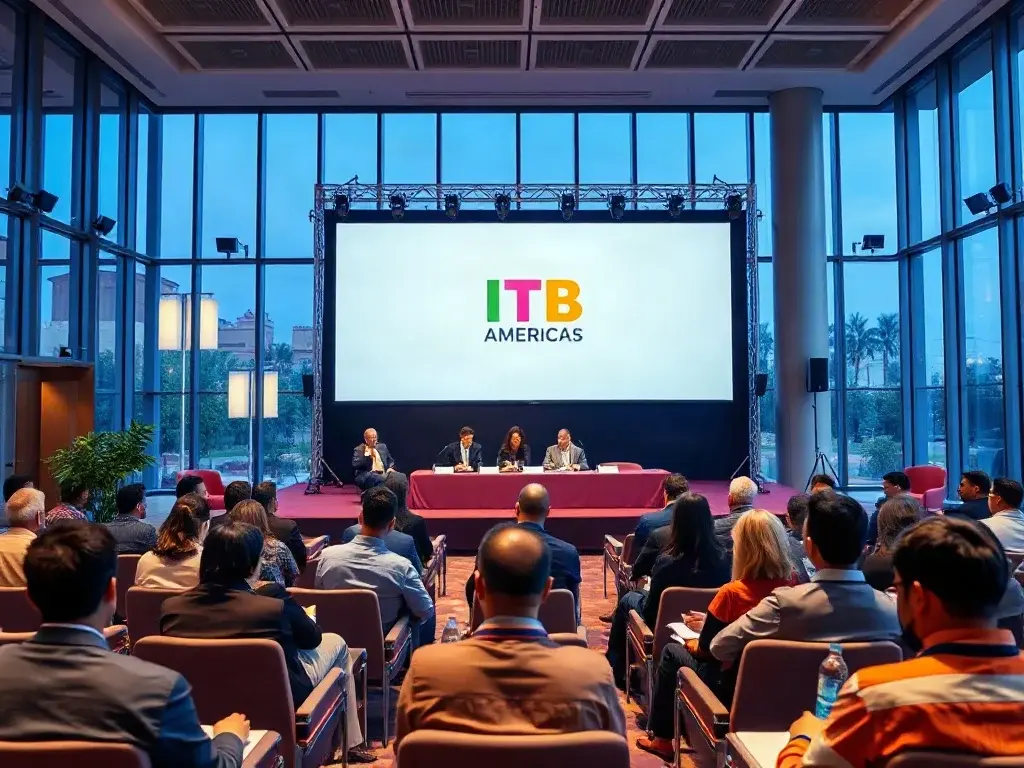
The travel industry is entering a new phase of regional growth and global collaboration, and the inaugural ITB Americas event, taking place from 10 to 12 November 2026 at Expo Guadalajara, is positioned to become a central meeting point for that transition. Alongside the exhibition, the ITB Americas Conference will host more than 90 speakers from organizations including the World Travel & Tourism Council (WTTC), Netflix and Expedia Group, delivering over 40 sessions focused on the trends, challenges and opportunities shaping travel across the Americas and beyond. This article examines what the conference represents, why its programme matters to executives and policymakers, and what the themes on its agenda reveal about the direction of the global tourism economy.
What the ITB Americas Conference Is and Why It Matters
ITB is one of the best-known trade fair brands in the global travel calendar, traditionally associated with its long-running event in Berlin. The launch of an ITB Americas edition reflects a broader recognition that the Americas constitute a distinct and increasingly important market for tourism, with their own patterns of outbound demand, inbound visitation, infrastructure investment and policy priorities. The conference component is designed as the intellectual core of that effort: rather than focusing solely on commercial exhibitions, it provides a structured environment for strategic dialogue among senior executives, destination leaders, regulators and technology innovators.
The programme’s breadth is significant. Industry conferences often struggle to balance corporate perspectives with public-sector and destination-level viewpoints. By bringing together organizations such as the WTTC, whose research on travel and tourism’s economic contribution is widely cited, alongside digital platforms and consumer-facing brands, the event creates an opportunity for cross-sector exchange that is rare in a single forum.
Background: The Growing Importance of Travel in the Americas
Tourism is a major economic driver across Latin America and North America, supporting employment, small enterprises and foreign exchange earnings. Mexico’s selection of Guadalajara as host city also signals the role that secondary urban destinations are playing in the regional tourism picture. Guadalajara, the capital of the state of Jalisco, combines a substantial business infrastructure with cultural and culinary assets, making it a useful case study for how mid-sized cities can position themselves within international travel networks. Readers interested in the country context may consult the entry on tourism in Mexico for background on the sector’s scale and structure.
Key Themes Shaping the Conference Agenda
Although the full programme spans a wide range of topics, the thematic direction of the conference can be understood through several recurring areas of concern for the travel sector. Each carries practical consequences for businesses, governments and travellers.
Digital Platforms and the Changing Distribution of Travel
The presence of streaming and online travel companies on the speaker roster points to the convergence of entertainment, content and travel decision-making. Online travel agencies have fundamentally reshaped how consumers search for, compare and book trips, a shift documented extensively in the history of the online travel agency model. Meanwhile, media platforms increasingly influence destination awareness, making the boundary between content consumption and travel planning less distinct than it was a decade ago.
The advantage of this convergence is greater reach and more precise targeting of travellers. The risk lies in concentration: when a small number of platforms control discovery and booking, smaller operators can become dependent on algorithms and commission structures they do not control. Sessions exploring distribution strategy are therefore likely to be of particular interest to independent hotels, tour operators and destination marketing organizations.
Sustainability, Economic Value and Measurement
Sustainable tourism has moved from a niche concern to a central business and policy issue. Discussions led by bodies such as the WTTC typically emphasize travel’s contribution to gross domestic product and employment, while also addressing the environmental and social pressures that high visitor volumes can create. The challenge for the sector is to demonstrate economic value while managing impacts such as carbon emissions, water use and the displacement of local residents in popular destinations. Those tensions are often described as the question of overtourism, a term that captures the strain that excessive visitation places on infrastructure and communities.
Expert opinion is divided on how best to address these pressures. Some argue that managed growth, supported by dispersal strategies that move visitors to less crowded locations, offers the most realistic path. Others contend that demand-side measures, including pricing and visitor caps, are necessary in the most affected areas. Both positions have supporters and critics, and a conference of this kind offers a venue where those trade-offs can be examined with data rather than rhetoric.
Policy, Regulation and Travel Facilitation
Policymakers attending the event will be concerned with visa regimes, air connectivity, border processing and safety standards, all of which shape whether travellers choose a destination. Facilitation measures can expand tourism quickly, but they can also raise questions about security, data protection and the distribution of benefits. Cross-border cooperation within the Americas is therefore an important theme, as neighbouring countries often compete for the same visitors while also depending on shared routes and corridors.
Common Mistakes in Regional Travel Strategy
- Treating the Americas as a single market, when demand, regulation and infrastructure vary considerably between subregions.
- Relying on a single source market or a single distribution channel, which increases vulnerability to economic or platform changes.
- Measuring tourism success only by visitor arrivals rather than by spending, length of stay, employment quality and community impact.
- Investing in marketing campaigns without parallel investment in transport access, accommodation capacity and service quality.
Practical Applications for Industry Professionals
For professionals planning to attend, the value of a conference of this scale lies less in any single session than in the quality of the networks it enables. Participants can maximize their outcomes by identifying in advance the sessions most relevant to their business model, prioritizing discussions with destination representatives and technology providers who might become partners, and preparing specific questions about regulation or distribution that they cannot easily answer through published research.
Destination organizations should evaluate how they present their offer to the platforms and media companies represented at the event, since visibility increasingly depends on structured data, high-quality imagery and accurate, up-to-date information. Smaller operators may find that collective marketing through regional associations offers better returns than individual efforts. Throughout, the most useful practice is to set measurable objectives, such as partnerships secured or specific market intelligence obtained, and to review progress after the event rather than treating attendance as an end in itself.
Future Developments to Watch
It remains too early to assess the outcomes of the first ITB Americas, and any predictions about its long-term influence should be treated as informed expectation rather than established fact. Nonetheless, several developments are likely to shape the coming years. The first is the continued integration of digital tools, including artificial intelligence-driven trip planning and personalized recommendations, which may alter how travel is researched and sold. The second is the growing policy focus on the distribution of tourism benefits between major hubs and secondary destinations. The third is the increasing expectation that tourism businesses report credible environmental and social metrics, a trend that regulators and investors are beginning to reinforce.
The most important question for the sector is whether the Americas can develop a travel economy that is both competitive and resilient, drawing visitors without overwhelming the places they come to experience. The answer will depend less on the size of any single event than on whether the conversations started in Guadalajara translate into shared standards, cooperative investment and measurable improvements in how destinations are managed. Readers should watch for concrete follow-up: published commitments, collaborative initiatives between governments and companies, and transparent data on visitor spending and community outcomes. Those indicators will reveal whether the inaugural conference marks a lasting shift in regional tourism leadership or simply another milestone in an industry that has always been adept at reinventing its agenda.
Frequently Asked Questions
When and where will the inaugural ITB Americas event take place?
The inaugural ITB Americas event will be held from 10 to 12 November 2026 at Expo Guadalajara in Mexico. It includes an exhibition alongside the ITB Americas Conference, which features more than 90 speakers and over 40 sessions covering trends, challenges and opportunities across the Americas and beyond.
Why did ITB launch a separate edition for the Americas instead of relying on its Berlin event?
ITB's expansion reflects recognition that the Americas form a distinct tourism market with their own patterns of outbound demand, inbound visitation, infrastructure investment and policy priorities. A regional edition allows these specific dynamics to be addressed directly, rather than treating the region as a secondary part of a European-focused agenda.
Why is Guadalajara a meaningful choice of host city for this conference?
Guadalajara, capital of Jalisco, combines substantial business infrastructure with cultural and culinary assets. Its selection highlights how secondary urban destinations are gaining importance in regional tourism, and it serves as a useful case study for how mid-sized cities can position themselves within international travel networks.
How might the involvement of streaming and online travel companies affect smaller tourism businesses?
Streaming and online travel platforms increasingly shape how travellers discover and choose destinations. While this offers greater reach and targeting, it can also concentrate control over discovery and booking in a few platforms. Smaller hotels and tour operators may become dependent on algorithms and commission structures they cannot influence, which is why distribution strategy sessions matter to them.
Who would benefit most from attending the ITB Americas Conference sessions?
The conference is designed for senior executives, destination leaders, regulators and technology innovators. Its mix of corporate, public-sector and destination-level perspectives makes it especially relevant to policymakers shaping tourism strategy, independent hotels and tour operators seeking distribution options, and technology providers looking for regional partners.
Why does the WTTC's presence matter at this conference?
The World Travel & Tourism Council is widely cited for its research on travel and tourism's economic contribution. Its participation brings credible, data-driven economic perspective into the discussion, helping link commercial and policy debates to measurable impacts on employment, enterprise and foreign exchange earnings across the region.