
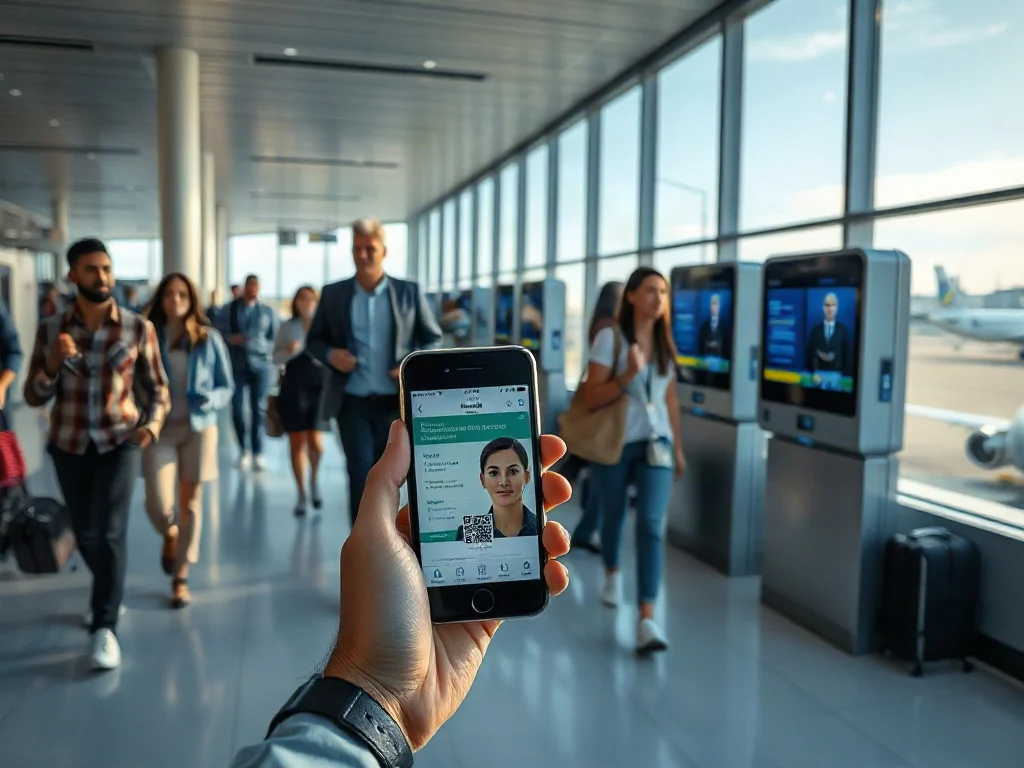
The International Air Transport Association (IATA) has released the findings of its 2026 Global Passenger Survey (GPS), and the results point to a clear shift in how travelers think about identity, documents, and the airport experience. Among the three major trends the survey identifies, the mainstreaming of biometric identification and growing enthusiasm for digital passports stand out as the most consequential for airlines, airports, governments, and passengers alike. Passengers are no longer merely tolerating biometric checkpoints; they are actively asking for them, and many are willing to link their identity to travel services well before they reach the terminal. This article examines what the survey reveals, why these preferences are emerging, and what the transition toward biometric and digital travel documents means in practice.
Background: From Paper Documents to Digital Identity
For most of aviation history, air travel has depended on physical documents. Passengers presented paper tickets, handed over passports for manual inspection, and repeated the same verification steps at check-in, security, boarding, and border control. Each checkpoint created friction, and each additional handoff of identity data increased the chance of delay, error, or inconsistency.
The modern shift began with machine-readable travel documents standardized under the International Civil Aviation Organization (ICAO), which defined the format of the biometric passport chip and facial image requirements. Over the following two decades, governments introduced electronic passports containing a contactless chip that stores the holder’s facial image and sometimes fingerprints, enabling automated verification. Airports then built on this foundation with biometric technologies such as facial recognition, which matches a live image of a traveler against a stored reference.
The concept of a digital passport extends this logic further. Rather than a physical booklet, the digital passport is a verifiable credential stored on a mobile device, linked to a trusted issuing authority and presented through cryptographic proof. Industry discussions around digital identity, including work on digital identity frameworks, have grown as governments and aviation bodies explore how such credentials could operate across borders while preserving privacy and security.
What the 2026 Survey Reveals About Passenger Attitudes
The central finding of the IATA survey is that biometrics have moved from a novelty associated with frequent travelers to a mainstream expectation. Passengers show strong interest in using biometric identification to reduce repeated document checks, which is among the most persistent sources of frustration in the travel journey. The appeal is straightforward: a traveler who is verified once and recognized thereafter spends less time in queues, handles fewer documents, and experiences fewer points of failure.
Interest in digital passports is equally notable. Respondents indicate willingness to use digital credentials for check-in and for more personalized services at the time of booking. This matters because it suggests that passengers see identity not as a one-time event at the airport but as a continuous thread running from reservation to arrival. A passenger who verifies identity during booking can receive tailored offers, faster check-in, and seamless baggage handling, with the airport becoming a confirmation point rather than the first place identity is examined.
Why Passengers Are Embracing Biometric Travel
Several forces explain this acceptance. The first is convenience, since biometric processing can shorten checkpoint times considerably when infrastructure is well designed. The second is trust in process: when passengers understand that biometric data is used for a narrow purpose and deleted or protected according to clear rules, resistance diminishes. The third is familiarity, because smartphones have already normalized facial and fingerprint authentication for banking and everyday services, lowering the psychological barrier to using the same methods at an airport.
The Role of Personalization
The interest in personalized services at booking deserves particular attention. Passengers appear to accept that sharing verified identity data can unlock benefits beyond speed, such as preferred seating, accessibility support, or recognition of loyalty status across carriers. This reflects a broader pattern in which consumers exchange data for value, but the exchange only holds if the value is real and the data handling is transparent.
The Operational Case for Biometrics and Digital Passports
For airlines and airports, the operational logic is compelling. Biometric processing reduces the labor required for manual document checks and allows staff to focus on exceptions and passenger assistance. It also creates opportunities to redesign the terminal around flow rather than fixed checkpoints. When identity is confirmed continuously, the traditional sequence of queues can give way to a model in which passengers move through a journey with minimal interruption.
Digital passports add another dimension by allowing identity verification to begin before arrival at the airport. If a traveler’s credentials are verified remotely and linked to a booking, the airport can prepare for the passenger in advance, reducing congestion at peak times. This is especially valuable during periods of high demand, when even small efficiency gains compound across thousands of daily departures.
Advantages and Limitations
The benefits of biometrics are real, but they are not uniform. Biometric systems depend on the accuracy of their matching algorithms, and performance can vary with lighting, image quality, and demographic factors. Regulators and independent researchers have repeatedly stressed the need for rigorous testing and for human oversight in cases where automated decisions carry consequences. A system that performs well on average can still produce unacceptable error rates for specific groups, which is why transparent evaluation matters as much as speed.
Digital passports introduce their own challenges. They require reliable device support, robust cryptographic standards, and interoperability between national issuing systems and airline or airport infrastructure. Passengers without compatible smartphones, or those uncomfortable with digital credentials, must have an equally dignified alternative. Any serious deployment must preserve choice, because a digital-first system that excludes some travelers is not an improvement for everyone.
Privacy, Security and Ethical Considerations
Biometric data is among the most sensitive categories of personal information. Unlike a password, a facial template or fingerprint cannot be changed if it is compromised. This permanence raises legitimate concerns about data retention, secondary use, and the possibility of function creep, in which a system introduced for boarding gradually expands into surveillance or commercial profiling. The ethical question is not simply whether biometrics work, but whether their deployment is proportionate, limited to stated purposes, and subject to meaningful oversight.
Security considerations cut in both directions. Biometric verification can strengthen identity assurance and reduce document fraud, but it also creates new attack surfaces, including spoofing attempts, data breaches, and the concentration of valuable information in centralized databases. Well-designed digital credential systems attempt to mitigate these risks through decentralization, encryption, and selective disclosure, which allows a traveler to prove a specific fact, such as eligibility to board, without revealing unnecessary details. Experts in digital identity generally agree that these design principles matter more than the choice of any single technology.
Regulatory Landscape
Regulatory frameworks differ widely across jurisdictions. Some regions impose strict limits on biometric data collection and require explicit consent or clearly defined legal bases for processing. Others prioritize border security and allow broader use. Airlines operating internationally therefore face a patchwork of requirements, and the question of how to harmonize standards across borders remains open. The emergence of digital travel credentials is prompting renewed discussion among governments and aviation bodies about common technical and legal foundations.
Practical Implications for Airlines, Airports and Travelers
For airlines, the most immediate step is to map the passenger journey and identify where repeated document checks create the greatest friction. Targeted deployment, such as biometric boarding at gates with high volumes or digital check-in for frequent travelers, often produces faster returns than a sweeping overhaul. Clear communication is essential, since passengers who understand what data is collected, why, and how long it is kept are far more likely to participate.
Airports should focus on interoperability and inclusion. Systems that connect seamlessly with airline reservation platforms and government databases deliver more value than isolated solutions. Maintaining accessible alternatives for passengers who cannot or prefer not to use biometric options protects both equity and trust. Operators should also establish regular performance audits, tracking matching accuracy, wait times, and exception rates across different passenger groups.
Best Practices for Implementation
- Purpose limitation: Collect biometric data only for clearly defined travel functions and avoid repurposing it without explicit legal basis and consent.
- Data minimization: Store the smallest amount of data necessary and define deletion schedules that are publicly documented.
- Opt-in choice: Provide a genuine alternative process so that participation is a choice rather than a condition of travel.
- Independent testing: Evaluate accuracy across demographic groups and publish results where feasible.
- Security by design: Use encryption, decentralized storage, and selective disclosure wherever technically possible.
Common Mistakes to Avoid
A frequent error is treating biometrics as a purely technical upgrade while neglecting governance and communication. Another is deploying systems without staff training, leaving frontline employees unable to assist passengers whose verification fails. A third is ignoring the passenger who lacks a smartphone or who has legitimate concerns about data, which can turn a convenience initiative into a source of resentment. Successful programs treat these human factors as central to design rather than as afterthoughts.
Future Developments: What Could Change Over the Next Few Years
The trajectory suggested by the survey points toward a travel ecosystem in which identity is established early, verified continuously, and carried securely across services. Digital travel credentials are likely to expand as governments issue standardized digital versions of passports and as aviation stakeholders agree on common verification protocols. Interoperability will be the decisive factor, because a credential that works only within one airline or one country offers limited benefit to a global traveler.
Artificial intelligence will play a growing role in how these systems operate, from improving matching accuracy to predicting congestion and personalizing the journey. Yet this growth also heightens the stakes for transparency and accountability. Reasonable predictions suggest that the most successful programs will be those that combine technical sophistication with clear rights for passengers, robust independent oversight, and genuine choice. Less certain is how quickly regulatory frameworks will converge across regions, and whether public trust will keep pace with deployment.
Frequently Asked Questions
What is a digital passport in air travel?
A digital passport is a verifiable digital credential, typically stored on a mobile device, that represents a traveler’s identity and travel eligibility. It is linked to an authoritative issuing source and can be presented for check-in or boarding through cryptographic verification, reducing the need to show a physical document at each step.
Are biometric checkpoints mandatory for passengers?
Requirements vary by airport, airline, and country. Many jurisdictions offer alternative manual processes alongside biometric options. Travelers should check the policies of their specific carrier and destination and ask whether a non-biometric alternative is available.
Is biometric data safe at airports?
Safety depends on how systems are designed and governed. Responsible deployments limit data collection, encrypt stored information, define deletion timelines, and undergo independent testing. Passengers can ask airports and airlines how their data is handled and how long it is retained.
Will digital passports replace physical passports?
Physical passports are unlikely to disappear quickly, because they remain essential for many border processes and for travelers without compatible devices. Digital credentials are more likely to complement physical documents over the coming years, with adoption expanding gradually as standards mature.
The Question Beneath the Convenience
The most important insight from the 2026 survey is that passengers are not simply asking for faster airports. They are signaling a willingness to rethink the relationship between identity and mobility, provided that the exchange is trustworthy and the benefits are tangible. What readers should watch next is whether the industry earns that trust through transparent governance, inclusive design, and interoperable standards, or whether convenience outpaces accountability. The unanswered question is whether a single global framework for digital travel identity will emerge, or whether travelers will navigate a fragmented set of national and corporate systems. Whichever path prevails, the traveler who once carried a paper booklet across borders may soon carry a credential that proves who they are without revealing more than necessary, and the design choices made in the coming years will determine whether that future feels empowering or intrusive.
Frequently Asked Questions
Why are passengers now asking for biometric checkpoints instead of just accepting them?
Passengers have come to see biometrics as a way to cut repeated document checks, which are a major source of queues and errors. Once identity is verified, a traveler is recognized at multiple points without handling paperwork again. Familiarity with smartphone facial and fingerprint authentication has also made the technology feel routine rather than intrusive, which lowers resistance.
What is the difference between an electronic passport and a digital passport?
An electronic passport is still a physical booklet, but it contains a contactless chip storing the holder's facial image and sometimes fingerprints, allowing automated verification. A digital passport has no physical booklet at all. It is a verifiable credential stored on a mobile device, linked to a trusted issuing authority and presented through cryptographic proof rather than a printed document.
Why would a traveler verify their identity during booking rather than at the airport?
Verifying identity early turns the airport into a confirmation point instead of the first place identity is examined. Passengers who do this can receive personalized offers, faster check-in, and smoother baggage handling. The survey suggests travelers view identity as a continuous thread from reservation to arrival, not a one-time event at the terminal.
How do travelers know their biometric data is being used safely?
Acceptance tends to grow when passengers understand that biometric data serves a narrow, clearly defined purpose and is protected or deleted according to transparent rules. Trust in the process, rather than the technology alone, is what reduces resistance. Clear communication from airlines, airports, and governments about data handling is therefore central to adoption.
Why does a standard like ICAO's matter for biometric and digital travel documents?
ICAO standards define the format of the biometric passport chip and facial image requirements, so that documents and readers work consistently across countries. Without shared standards, each border or airline would need proprietary systems, making cross-border automation impractical. Any future digital credential would similarly need interoperable rules to function across different authorities.